

Grain markets are evolving as changing consumption patterns, global trade dynamics, climate variability, and commodity price volatility reshape supply and demand across agricultural regions. Companies entering this sector must navigate fluctuating grain prices, shifting trade policies, storage infrastructure, and buyer requirements while ensuring efficient sourcing and distribution.
A well-defined market entry strategy enables businesses to assess market demand, competitive intensity, regulatory conditions, and supply chain resilience before expansion. A robust Grain market entry strategy helps identify high-potential regions, evaluate customer segments, manage commodity risks, and establish sustainable growth opportunities in an increasingly competitive and interconnected global grain market.
Global cereal production for 2025 is estimated at 3,043 million tonnes, up 6.1% from 2024, while 2025/26 utilization is estimated at 2,952 million tonnes. Global cereal trade is projected to decline by 0.3% to 507.2 million tonnes in 2026/27 after expanding 4.8% in 2025/26. These shifts support Grain market entry strategy planning by highlighting demand, trade exposure, stock management, and commodity volatility risks.
Assessing Grain Market Entry Opportunities Across High-Demand Regions
This involves evaluating consumption growth, production capacity, trade flows, pricing trends, storage infrastructure, buyer demand, and regulatory conditions to identify attractive grain market entry opportunities:
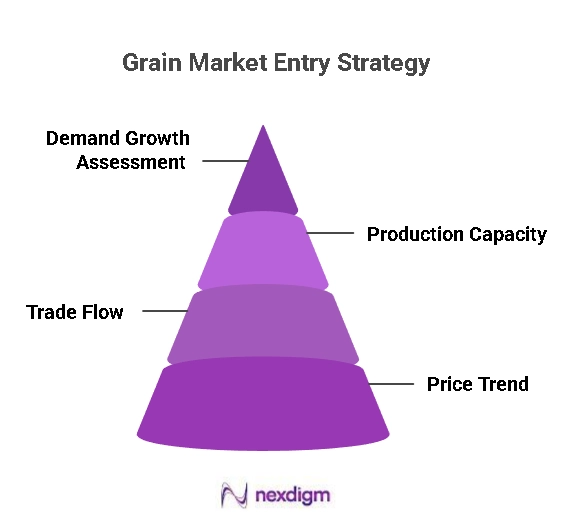
-
Demand Growth Assessment
Analyze population trends, food consumption, feed demand, and processing needs to identify regions with strong grain market potential.
-
Production Capacity Review
Evaluate crop output, yield levels, acreage, and seasonal supply patterns to assess sourcing strength across target regions.
-
Trade Flow Mapping
Review import-export volumes, trade corridors, tariffs, and cross-border demand to understand market access opportunities.
-
Price Trend Analysis
Assess commodity price movements, seasonal fluctuations, and volatility risks to support entry timing and pricing decisions.
Nexdigm Import, Export, and Regulatory Readiness Assessment
Nexdigm can help grain market entrants assess import-export rules, quality standards, food safety requirements, tariff structures, documentation needs, and trade compliance obligations. This supports market entry strategy by identifying regulatory risks, approval requirements, cost implications, and cross-border trade opportunities across high-demand grain markets.
Nexdigm Trade Flow Mapping for Grain Market Expansion
Nexdigm can analyze import-export volumes, trade corridors, sourcing regions, tariff exposure, buyer demand, logistics routes, and supply risks to support grain market expansion decisions.
-
Import Volume Analysis
Evaluate grain import trends, demand gaps, buyer concentration, and seasonal procurement needs across target markets.
-
Export Supply Mapping
Identify major sourcing regions, surplus production zones, export capacity, and supply reliability for grain market expansion.
-
Trade Corridor Review
Analyze key trade routes, port access, transport costs, border procedures, and logistics efficiency for grain movement.
-
Tariff Exposure Assessment
Review duties, trade agreements, non-tariff barriers, and landed cost impact across import and export markets.
Nexdigm’s case:
Nexdigm supported a grain market entrant map trade flows across high-demand regions. The analysis identified import-dependent markets with 15–20% demand gaps, sourcing corridors with 10–12% logistics cost variation, and buyer segments contributing nearly 35% of projected volume. These insights helped the company prioritize trade routes, assess supply risks, evaluate tariff exposure, and build a focused grain market expansion strategy.
To take the next step, simply visit our Request a Consultation page and share your requirements with us.
Harsh Mittal
+91-8422857704