

Agricultural procurement decisions increasingly influence how businesses manage environmental impact, resource consumption, and supply chain responsibility. India’s first Biennial Transparency Report submitted to the UNFCCC in 2025 shows that agriculture accounted for 15% of the country’s total greenhouse gas emissions in 2022.
Meanwhile, APEDA recorded approximately 3.96 million hectares of farm area under NPOP certification, including organic and in-conversion land, during 2024–25. These developments highlight the importance of evaluating sustainability across agricultural supply networks.
Businesses need to understand not only what suppliers offer but also how efficiently and responsibly they operate. Green agriculture supplier benchmarking provides a structured way to compare vendors on environmental performance, input efficiency, and ESG practices alongside commercial capabilities.
Why Green Supplier Benchmarking Requires More Than Sustainability Claims
A supplier’s environmental positioning does not necessarily reflect its actual operational performance. Businesses need to examine measurable indicators such as water and energy consumption, waste management, input efficiency, and environmental compliance. Differences in production processes and reporting practices can make comparisons difficult. Establishing common evaluation criteria helps procurement teams identify meaningful performance gaps, assess available evidence, and distinguish documented sustainability practices from unverified claims.
What Should Businesses Compare When Evaluating Green Agricultural Suppliers?
An effective benchmarking exercise should consider three interconnected dimensions rather than relying on a single sustainability indicator:
- Environmental Footprint: Examine available data on emissions, water consumption, energy use, waste generation, and environmental compliance across supplier operations.
- Agricultural Input Efficiency: Compare product performance information, nutrient-use efficiency, resource conservation potential, and suitability for responsible agricultural applications.
- ESG Accountability: Review supplier policies, certifications, traceability systems, labour practices, governance disclosures, and supporting sustainability documentation.
These comparisons help businesses develop a more balanced understanding of supplier performance and identify areas requiring further verification.
Nexdigm’s Role in Advancing Evidence-led Agricultural Procurement
Our Expert-led services bring a research-driven view to agricultural procurement by examining supplier capabilities, market practices, and evolving sustainability expectations. Our work connects supplier-level intelligence with broader industry developments, helping businesses understand vendor positioning and assess sourcing options through relevant market evidence. This approach enables procurement teams to look beyond product availability and pricing, incorporating environmental performance, resource efficiency, and supplier accountability into their evaluation process.
Nexdigm’s Approach to Evaluating Green Agricultural Suppliers
Our expertise brings together agricultural market intelligence, supplier research, and comparative assessment to help businesses evaluate vendors against relevant sustainability and procurement requirements. Our green agriculture supplier benchmarking approach can include:
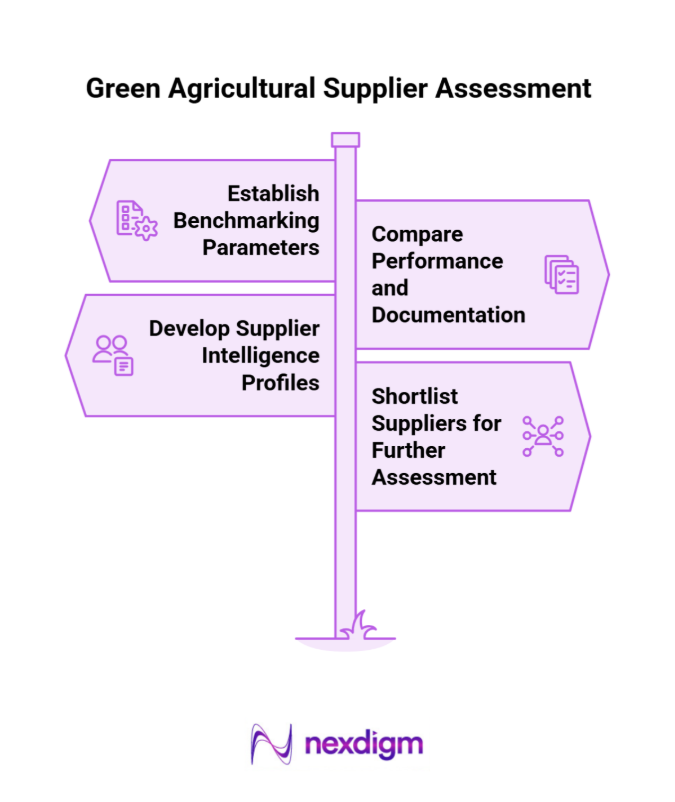
- Establishing Relevant Benchmarking Parameters: Define evaluation criteria covering environmental practices, resource efficiency, product capabilities, ESG disclosures, and commercial performance.
- Developing Supplier Intelligence Profiles: Research manufacturers and vendors across selected agricultural categories, consolidating information on products, operational capabilities, market presence, and sustainability practices.
- Comparing Performance and Documentation: Assess available supplier information against common parameters to identify differences in environmental practices, input efficiency, and reporting transparency.
- Shortlisting Suppliers for Further Assessment: Organize findings into comparative profiles to help procurement teams prioritize vendors for technical, commercial, and sustainability-related evaluation.
This structured approach helps businesses move beyond broad supplier comparisons and develop a clearer understanding of vendor strengths, sustainability practices, and areas requiring further evaluation.
Turning Nexdigm’s Supplier Benchmarking Insights into Sustainable Procurement Decisions
Supplier benchmarking creates value when its findings translate into practical procurement priorities. Our benchmarking approach helps businesses use comparative insights to strengthen supplier selection through three key areas:
- Identifying High-Potential Suppliers: Use benchmarking results to identify vendors demonstrating relevant product capabilities, resource-efficient practices, transparent documentation, and the operational capacity to meet procurement requirements.
- Addressing Supplier Performance Gaps: Highlight differences in environmental practices, input efficiency, and ESG disclosures to identify areas requiring further verification, supplier engagement, or improvement.
- Aligning Sourcing with Sustainability Goals: Integrate environmental and commercial findings into supplier evaluation to prioritize sourcing options that support responsible procurement without overlooking cost, availability, and operational feasibility.
By connecting supplier performance insights with procurement objectives, businesses get to make more informed sourcing decisions and build a stronger foundation for sustainable agricultural supply networks.
Nexdigm’s Case
An agricultural inputs company engaged Nexdigm to benchmark fertilizer and bio-based crop input suppliers across three sourcing markets. The assessment covered 28 suppliers and found that 32% had limited environmental performance documentation, while 25% provided insufficient information on resource-use efficiency. Based on the findings, the company shortlisted 9 suppliers for further technical, sustainability, and commercial evaluation.
To take the next step, simply visit our Request a Consultation page and share your requirements with us.
Harsh Mittal
+91-8422857704