

In markets attracting over $1 billion in Foreign Direct Investment (FDI) annually, the choice between Greenfield and Brownfield investments significantly impacts capital expenditure (CapEx) efficiency. In 2026, global FDI is projected to reach $1.7 trillion, with major players like China, the US, and India at the forefront.
Nexdigm helps firms assess these investment types, providing data-driven insights to optimize decision-making and maximize CapEx efficiency in high-stakes markets.
Greenfield vs. Brownfield Investments
Greenfield investments involve building new facilities from scratch. In 2024, establishing a new manufacturing plant can cost between $12 million to $55 million, offering flexibility for incorporating advanced technology but requiring high upfront capital.
Brownfield investments, on the other hand, involve refurbishing existing infrastructure, costing between $6 million to $22 million. While this approach requires less capital initially, retrofitting old structures may limit long-term efficiency. Nexdigm’s tools help businesses analyze these investment options for better strategic alignment.
Impact on CapEx Efficiency
Greenfield investments typically demand higher initial costs but offer long-term operational efficiency. Amazon’s $2 billion investment in automation in 2024 enhanced its distribution efficiency.
Meanwhile, Brownfield investments often incur lower initial costs but can lead to higher long-term expenses due to maintenance and retrofitting.
For example, General Motors’ $900 million refurbishment of its Michigan plant in 2024 shows the hidden costs of upgrading older facilities. Nexdigm provides tools to forecast the long-term financial impact of both investment types.
Key Factors in Investment Choice
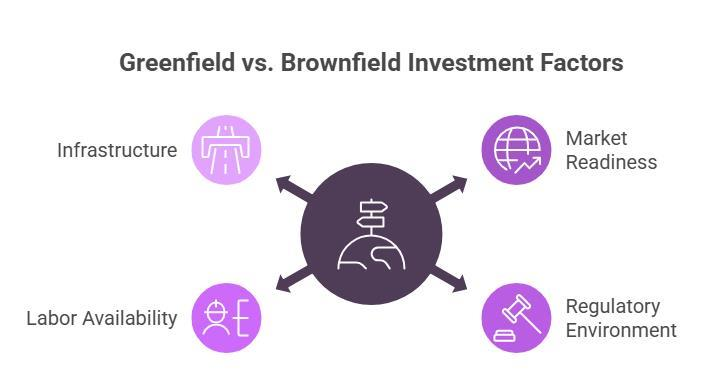
Several factors influence the decision between Greenfield and Brownfield investments:
-
Market Readiness:
Greenfield investments are often ideal for emerging markets that require the development of new infrastructure, enabling businesses to create modern, efficient systems tailored to their needs.
In contrast, Brownfield investments are better suited for markets that already have established facilities, allowing businesses to take advantage of existing structures and minimize initial setup costs.
-
Regulatory Environment:
Brownfield investments typically benefit from quicker regulatory approvals, especially in markets with well-established infrastructure and regulatory frameworks, such as India’s industrial parks initiative. These projects often face fewer environmental or compliance challenges.
In contrast, Greenfield investments can require extensive permits and longer approval timelines due to the need for new construction and planning processes.
-
Labor Availability:
Greenfield projects are particularly well-suited to regions with a skilled workforce capable of supporting advanced technology and specialized operations, such as high-tech manufacturing.
On the other hand, Brownfield investments are often preferred in regions with lower labor costs, where companies can capitalize on existing labor forces while upgrading or repurposing old facilities.
-
Infrastructure:
Brownfield investments make use of existing infrastructure such as transportation networks, utilities, and facilities, which can significantly reduce initial costs and speed up project implementation.
In contrast, Greenfield investments offer the flexibility to build new, state-of-the-art facilities that can incorporate the latest technologies and meet future demands but often require substantial capital investment and time to establish from the ground up.
Nexdigm helps businesses evaluate these factors using market data and predictive tools to ensure the best investment strategy.
Nexdigm Case
A global manufacturing firm needed to decide between Greenfield and Brownfield investments for expansion. Using Nexdigm’s data-driven tools, they analyzed market conditions, infrastructure, and labor availability. The firm found that a Brownfield investment in a region with established facilities and lower labor costs was more cost-effective, saving 30% on initial CapEx. While retrofitting existing infrastructure posed challenges, it allowed for quicker market entry. Nexdigm’s analysis ensured the firm made an informed decision, optimizing both short-term costs and long-term operational efficiency, ultimately achieving faster ROI and sustainable growth in the target market.
To take the next step, simply visit our Request a Consultation page and share your requirements with us.
Harsh Mittal
+91-8422857704