

Grocery benchmarking in a segment of retail spend is critical for understanding performance dynamics across pricing, margins, inventory, and demand patterns. Grocery food and beverage benchmarking enable companies to systematically compare operations with industry peers and identify efficiency gaps.
Linked to competitive intelligence, it helps businesses track competitor strategies, monitor consumer trends, and anticipate market shifts. By leveraging data-driven insights, organizations can refine pricing, optimize supply chains, and improve product assortment. It supports informed decision-making and strengthens competitive positioning in the evolving grocery and food and beverage landscape.
The grocery segment accounts for over 50% of total retail spend globally, underscoring its critical economic role. Food and beverage categories alone contribute nearly 60–70% of grocery sales, driven by essential consumption patterns. Organized retail is expanding at a CAGR of around 6–8%, particularly in emerging markets.
Grocery Food and Beverage Benchmarking Reports and Actionable Insights
Grocery food and beverage benchmarking reports provide comparative analysis of pricing, margins, and demand trends. They deliver actionable insights to optimize operations, improve competitiveness, and support data-driven strategic decisions.
-
Pricing and Margin Benchmarking Insights
Analyzing pricing structures and margin performance across competitors to identify optimization opportunities and improve profitability within grocery food and beverage segments.
-
Consumer Demand and Purchase Behavior Analysis
Evaluating buying patterns, preferences, and demand shifts to align product offerings and enhance customer engagement and sales performance effectively.
-
Product Mix and Category Performance Benchmarking
Assessing performance of product categories and assortment strategies to optimize shelf space, improve turnover, and meet evolving consumer preferences.
-
Supply Chain and Inventory Efficiency Insights
Benchmarking inventory turnover, logistics efficiency, and stock management to reduce costs, prevent stockouts, and ensure consistent product availability.
-
Competitive Positioning and Market Share Analysis
Comparing market share, competitor strategies, and positioning to identify growth opportunities and strengthen competitive advantage in grocery retail markets.
Nexdigm Risk, Compliance, and Regulatory Benchmarking in Grocery
Nexdigm risk, compliance, and regulatory benchmarking in grocery evaluates how companies align with evolving food safety, labeling, taxation, and supply chain regulations. It compares compliance frameworks, risk exposure, and governance practices across industry peers.
By integrating competitive intelligence, Nexdigm helps identify gaps, mitigate regulatory risks, and strengthen internal controls. This enables grocery businesses to ensure compliance, avoid penalties, and maintain operational resilience in a highly regulated retail environment.
Nexdigm’s Performance Analysis Across Grocery Segments
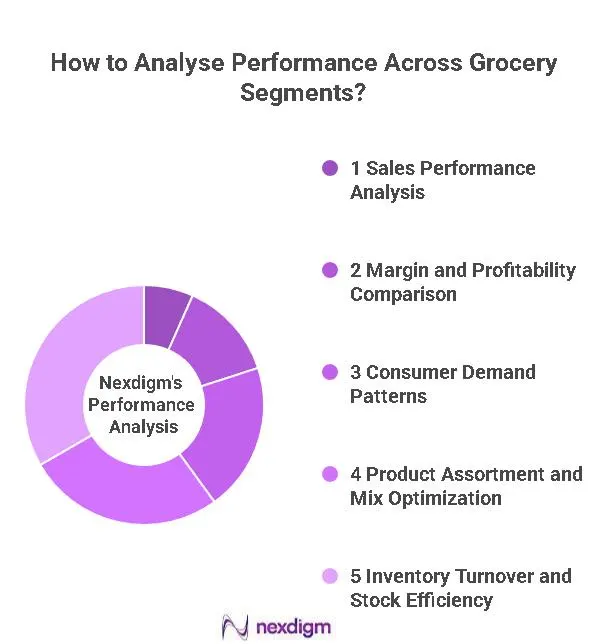
Nexdigm performance analysis across grocery segments evaluates category-wise sales, margins, and demand trends. It helps identify high-performing segments, optimize assortment strategies, and improve overall retail efficiency and profitability:
-
Sales Performance Analysis
Evaluating sales trends across grocery categories to identify high-performing segments and optimize focus on profitable and fast-growing product groups effectively.
-
Margin and Profitability Comparison Across Segments
Analyzing margins across categories to identify profitability differences and implement strategies to enhance returns and control cost structures efficiently.
-
Consumer Demand Patterns by Grocery Segment
Assessing demand variations across segments to align inventory, pricing, and product assortment with evolving consumer preferences and seasonal trends.
-
Product Assortment and Mix Optimization
Benchmarking assortment strategies to ensure the right product mix, improve shelf utilization, and enhance customer satisfaction and sales outcomes.
-
Inventory Turnover and Stock Efficiency Analysis
Measuring inventory movement across segments to reduce holding costs, prevent stockouts, and improve overall supply chain and operational efficiency.
Nexdigm’s case:
A grocery retailer engaged Nexdigm to strengthen risk, compliance, and performance benchmarking. By aligning processes with regulatory standards and industry KPIs, the company achieved a 12% reduction in operational costs, 10% margin improvement, and 15% efficiency gains. Enhanced inventory controls also reduced holding costs by 12%, while improved compliance frameworks increased customer satisfaction by nearly 20%, supporting stronger operational resilience.
To take the next step, simply visit our Request a Consultation page and share your requirements with us.
Harsh Mittal
+91-8422857704