

The grocery retail sector continues to evolve as consumer preferences shift toward convenience, value, premium offerings, and omnichannel shopping experiences. While many markets appear attractive based on population size or economic growth, retailers must look beyond surface-level indicators to understand the true addressable opportunity.
A key challenge for grocery retailers is determining not only how large the market is, but also which retail format can capture that opportunity most effectively. A supermarket, neighborhood convenience store, value-focused format, or premium grocery concept may perform very differently in the same market.
This is where grocery retail market sizing and entry analysis becomes critical. By combining market sizing, demand assessment, consumer insights, and entry feasibility evaluation, retailers can better understand where opportunities exist and how to capitalize on them.
At Nexdigm, businesses and retailers leverage data-driven market intelligence to analyze opportunity size, identify attractive customer segments, evaluate format suitability, and develop effective market-entry strategies.
How Large Is the Addressable Grocery Opportunity?
Before investing in a new market, retailers need to understand the realistic revenue opportunity available to them. Market size is not simply about total population or overall grocery spending. It involves evaluating the portion of the market that aligns with the retailer’s target customers, format strategy, and operational capabilities. Through its grocery retail market sizing and entry analysis services, Nexdigm helps businesses determine the true addressable market and identify opportunities that support sustainable growth.
Looking Beyond the Market Size
Many retailers focus exclusively on headline market figures. However, a large grocery market does not automatically translate into a viable expansion opportunity. A comprehensive assessment should address:
- Who are the target customers?
- What are their shopping habits?
- Which grocery formats are preferred?
- How much do households spend on groceries?
- How accessible is the market?
- What share of demand can realistically be captured?
Understanding these factors helps businesses move beyond theoretical opportunities and focus on achievable market potential.
Measuring the Size of the Opportunity
Market sizing forms the foundation of an effective expansion strategy. It helps brands estimate the total revenue potential, target customer base, and long-term growth opportunities within a specific market or geography.
Understanding the size of the opportunity enables luxury retailers to prioritize markets where consumer demand, purchasing power, and commercial potential align with their expansion objectives. Nexdigm here evaluates:
Key Market Sizing Components
- Total Addressable Market (TAM)
- Serviceable Available Market (SAM)
- Serviceable Obtainable Market (SOM)
- Household grocery expenditure
- Category-level demand
- Growth potential across customer segments
This analytical approach by Nexdigm help retailers understand both the scale of the market and the realistic share they can target.
Understanding Demand Drivers
Demand is influenced by several market-specific factors. Nexdigm assesses the following factors:
- Population growth
- Urbanization trends
- Income levels
- Household purchasing behavior
- Consumer lifestyle shifts
- Evolving grocery preferences
These insights help retailers identify markets with sustainable long-term demand.
Matching the Right Format to the Market
A successful grocery expansion strategy goes beyond location selection. It requires choosing a store format that aligns with local customer expectations, shopping habits, and purchasing behaviors. Factors such as basket size, convenience preferences, visit frequency, and household spending patterns play a critical role in determining which format is most likely to succeed.
The right format can enhance customer engagement, improve operational efficiency, strengthen market positioning, and drive long-term profitability. Before entering a new market, retailers must answer a key question:
Which Grocery Format Fits Best?
Different markets favor different retail models depending on demographics, purchasing power, and shopping behavior. Nexdigm evaluates opportunities for formats such as:
- Supermarkets
- Hypermarkets
- Neighborhood grocery stores
- Convenience stores
- Value discount formats
- Premium grocery concepts
The objective is to identify which format has the greatest potential for customer adoption and commercial success.
Understanding Consumer Preferences
Retail formats succeed when they reflect how consumers shop. Nexdigm helps businesses evaluate:
- Shopping frequency
- Basket size
- Product preferences
- Convenience expectations
- Brand loyalty
- Omnichannel engagement
These insights support more effective format selection and market positioning.
Assessing Market Entry Potential
Once the opportunity has been quantified, retailers must evaluate their ability to successfully enter and compete within the market.
Market Entry Considerations
Nexdigm assesses factors to be considered for market entry, such as:
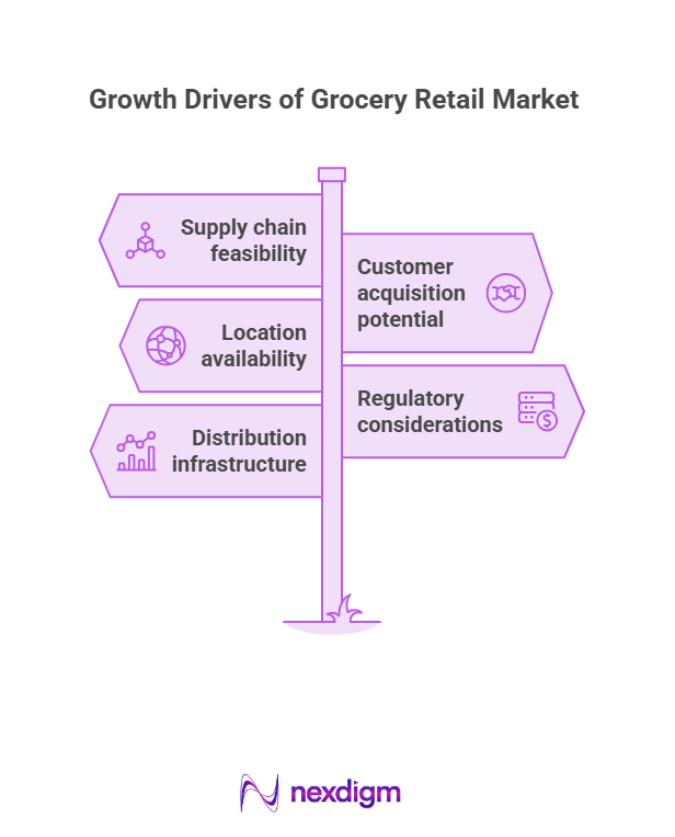
- Customer acquisition potential: Evaluate the ability to attract and retain target customers by analyzing demand levels, consumer preferences, purchasing behavior, and market accessibility.
- Location availability: Assess the availability and suitability of retail, commercial, or operational locations based on visibility, footfall, accessibility, and growth potential.
- Supply chain feasibility: Examine sourcing, warehousing, logistics, inventory management, and supplier capabilities to ensure efficient and cost-effective operations.
- Distribution infrastructure: Review the strength and reach of distribution networks, transportation systems, channel partners, and delivery capabilities required to serve the market effectively.
- Regulatory considerations: Evaluate licensing requirements, industry regulations, compliance obligations, taxation frameworks, and other legal factors that may impact market entry and operations.
These factors help Nexdigm develop market-entry strategies that are commercially viable, operationally efficient, and aligned with long-term business objectives.
The Nexdigm Approach to Grocery Market Expansion
Nexdigm combines market intelligence, demand analysis, consumer research, competitive benchmarking, and commercial evaluation into a comprehensive decision-support framework. Through its grocery retail market sizing and entry analysis services, Nexdigm helps organizations:
- Measure addressable market opportunities: Measure the realistic market potential by evaluating target customers, demand levels, spending capacity, and growth prospects.
- Assess customer demand: Analyze consumer behavior, shopping preferences, purchasing patterns, and demand drivers to validate market attractiveness.
- Evaluate retail format suitability: Determine which retail format best aligns with customer expectations, market conditions, and business objectives.
- Develop market-entry strategies: Design effective expansion plans, including location selection, channel strategy, positioning, and growth roadmaps.
- Assess financial viability: Evaluate revenue potential, operating costs, profitability, and investment requirements to support sustainable business growth.
- Prioritize expansion opportunities: Compare multiple markets and opportunities to identify initiatives that offer the strongest strategic and commercial value.
This integrated approach helps retailers make informed decisions while minimizing investment risks.
Converting Market Potential to Expansion Success with Nexdigm
Understanding market size is only the beginning of a successful retail expansion journey. The real value lies in determining how that opportunity can be captured through the right format, location strategy, and entry model. Nexdigm helps retailers convert market insights into practical action plans that support profitable and scalable growth.
Nexdigm’s Case
In a recent engagement, Nexdigm supported a grocery retail client in assessing addressable market potential, format suitability, and entry strategy. Real-time insights increased market opportunity visibility by 36%, improved location prioritization by 31%, optimized investment planning by 24%, and accelerated expansion decisions by 33%.
This opportunity assessment approach enabled the client to validate market potential, refine format strategy, and pursue growth opportunities with greater commercial confidence.
To take the next step, simply visit our Request a Consultation page and share your requirements with us.
Harsh Mittal
+91-8422857704