

When retailers wish to enter a new market, they often focus on demand, customers, and locations. However, there is another important factor that determines the success of expansion, the supply chain.
Even the high potential; growth opportunities can face challenges if products cannot be sourced, stored, and delivered efficiently. Assessing supply chain readiness early helps businesses minimize operational risks, control costs, and build a strong foundation for sustainable growth.
This raises an important question:
Can the supply chain support growth?
A retailer may identify a strong market opportunity, but if products cannot be sourced, stored, and delivered efficiently, expansion can quickly become costly and difficult to manage. This is why supply chain readiness should be evaluated before making major investment decisions.
Organizations like Nexdigm, refer to grocery supply chain entry strategy consulting, helping businesses assess whether their sourcing network, warehousing capabilities, cold chain infrastructure, and delivery operations are prepared for growth.
Why Supply Chain Readiness Matters
A successful expansion requires more than customer demand. Retailers must ensure they have the operational capabilities needed to serve the market consistently and profitably. In such a case, Nexdigm’s supply chain readiness strategy helps answer some key questions:
- Can suppliers support future demand?
- Is warehouse capacity sufficient?
- Will perishable products remain fresh during transit?
- Are delivery costs commercially viable?
- Can operations scale as the business grows?
Answering these questions helps businesses avoid operational bottlenecks and protect profitability.
Understanding the Supply Chain Expansion Dynamics
Many expansion plans are built around market demand and revenue potential. However, growth often places significant pressure on supply chain operations. As store networks expand and customer orders increase, businesses need to ensure their supply chain can maintain product availability, service quality, and cost efficiency.
In such a case, organizations like Nexdigm, helps businesses with a thorough supply chain assessment that helps them determine whether their existing infrastructure can support future growth without creating operational challenges.
The Hidden Cost of Supply Chain Gaps
Even a promising market opportunity can become challenging if supply chain inefficiencies are overlooked. Some common challenges of the supply chain expansion include:
- Product stockouts
- Delayed replenishment
- High transportation costs
- Increased product wastage
- Inconsistent product availability
- Poor customer experience
Identifying these risks early allows businesses to make informed decisions and avoid costly disruptions after expansion.
Core elements of Supply Chain Expansion
Successful supply chain expansion requires a strong operational foundation that can support increasing demand while maintaining efficiency, product availability, and customer satisfaction. Businesses must evaluate every stage of the supply chain to ensure scalability, cost control, and long-term growth. Such as:
Sourcing
Reliable sourcing ensures that products remain available as demand increases. Businesses must evaluate supplier capacity, product quality, procurement costs, and supply continuity before entering a new market.
Warehousing
Warehouses play a critical role in inventory management and product availability. The right warehousing strategy helps retailers reduce stockouts, improve efficiency, and support growth.
Cold Chain
For grocery retailers, maintaining product freshness is essential. A strong cold chain helps preserve product quality while reducing spoilage and wastage across the supply chain.
Last-Mile Delivery
The final stage of the supply chain has a significant impact on customer satisfaction and costs. Efficient delivery operations help businesses balance service quality with profitability.
Balancing Service Levels and Profitability
Customers expect products to be available when and where they need them. At the same time, retailers must manage operating costs and protect margins. Hence, Nexdigm helps in finding the right balance through careful assessment of:
- Inventory levels: Determine the optimal amount of stock required to meet customer demand while minimizing excess inventory and carrying costs.
- Warehousing costs: Evaluate storage, handling, labor, and facility expenses to improve operational efficiency without compromising product availability.
- Delivery performance: Measure delivery speed, reliability, and order accuracy to ensure customer satisfaction and support business growth.
- Logistics expenses: Analyze transportation, distribution, and fulfillment costs to identify opportunities for cost optimization and improved profitability.
- Service expectations: Understand customer requirements regarding product availability, delivery timelines, and shopping convenience to maintain competitive service standards.
A well-planned supply chain supports both customer satisfaction and sustainable profitability.
Nexdigm’s Approach to Grocery Supply Chain Market Entry Strategy
Expanding into a new market requires a clear understanding of both opportunity and operational readiness. Through its grocery supply chain entry strategy services, Nexdigm helps businesses evaluate whether their supply chain infrastructure can support successful market entry and long-term growth. Nexdigm’s approach typically includes:
- Supplier and sourcing assessments
- Warehousing and distribution analysis
- Cold chain feasibility evaluation
- Last-mile cost and efficiency analysis
- Supply chain risk assessment
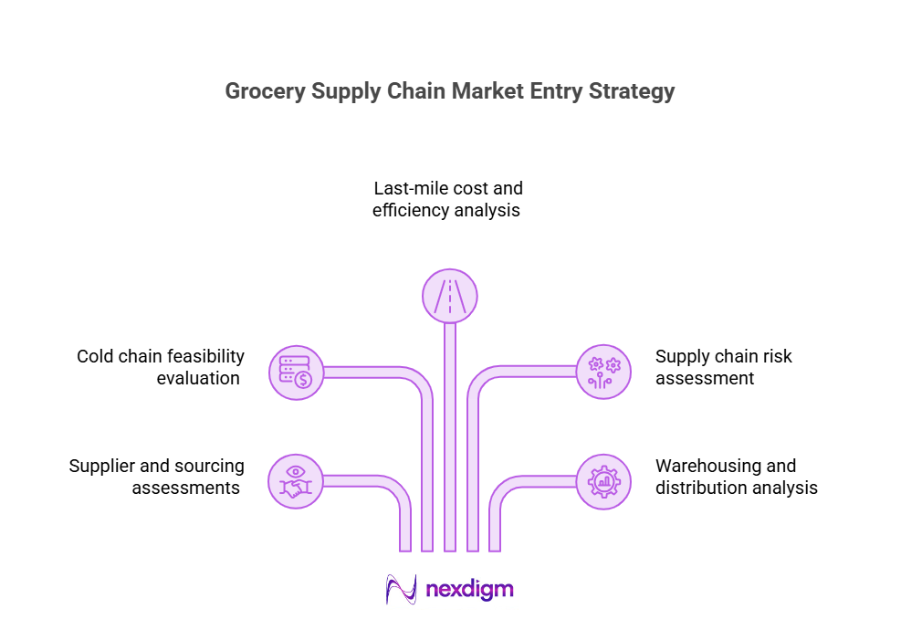
By combining market intelligence with operational expertise, Nexdigm helps organizations make confident expansion decisions.
Benefits of Nexdigm’s Grocery Supply Chain Entry Strategy
Businesses that partner with Nexdigm can benefit from a more structured and data-driven approach to supply chain planning, helping them align operational capabilities with expansion objectives.
By assessing the entire supply chain ecosystem, Nexdigm enables organizations to identify risks, improve efficiency, and build scalable growth strategies. Businesses that partner with Nexdigm can benefit from:
- Stronger sourcing networks
- Improved inventory availability
- Better operational efficiency
- Reduced logistics risks
- Enhanced cold chain performance
- Improved decision-making through data-driven insights
These benefits help retailers build supply chains that not only support expansion but also improve overall business performance.
Nexdigm’s Case
In a recent engagement, Nexdigm supported a retail client in assessing supply chain readiness for expansion across sourcing, warehousing, cold chain, and last-mile economics. Real-time analysis improved logistics efficiency by 30%, reduced supply chain costs by 22%, optimized inventory planning by 28%, and enhanced scalability.
This structured approach enabled the client to strengthen operational readiness, optimize expansion economics, and build a resilient foundation for sustainable growth.
To take the next step, simply visit our Request a Consultation page and share your requirements with us.
Harsh Mittal
+91-8422857704