

A combine harvester can spend much of the year doing almost nothing. That makes harvesting equipment a fundamentally different market from tractors. The opportunity depends on whether enough acreage reaches harvest at the same time, whether labour is available, and whether the machine can be kept productive across a sufficiently large operating territory.
India’s farm structure makes this utilisation question particularly important. Average operational holdings have fallen to around 0.74 hectares, while small and marginal farmers account for nearly 85% of holdings. High-cost harvesting equipment is therefore difficult to justify through individual ownership alone, increasing the relevance of custom hiring and shared machinery models.
Start With Harvest Windows, Not Machine Sales
Harvester demand is fundamentally seasonal. A district with 500,000 cultivated acres may be less attractive than one with 250,000 acres if the latter has a highly concentrated harvest window and a crop configuration suited to mechanized harvesting.
The assessment therefore begins with crop calendars. Paddy, wheat, soybean, maize and pulses create different harvesting requirements. Their acreage, maturity periods and field conditions determine how many machine-days are actually available.
This creates the first commercial filter: acreage concentration × harvest window × machine capacity.
Labour Scarcity Changes the Payback
Harvesting is particularly exposed to labour availability because delays can translate directly into crop losses, quality deterioration and higher wage rates.
ICAR has documented persistent challenges around access to combine harvesters and agricultural labour, while recent mechanization programmes continue to emphasise reducing labour burden and improving operational efficiency.
For equipment manufacturers, this means labour cost should be treated as part of the machine’s economic proposition. A harvester becomes more attractive when it can replace expensive or unreliable labour during a narrow harvest window.
Utilisation Separates a Market From a Business
A machine generating ₹X of revenue per acre is not necessarily commercially attractive. What matters is how many acres it can cover during the season.
A machine operating for 250 hours annually has a very different economics from one operating for 700 hours. Transport between villages, machine downtime, field size, road connectivity and maintenance support all influence effective utilisation.
This is where custom hiring changes the equation. One machine can serve dozens or hundreds of farms, converting fragmented landholdings into a viable equipment market.
Geography Becomes a Network Problem
The strongest harvester markets are therefore likely to have three characteristics together: concentrated crop acreage, short harvesting windows and labour constraints.
But a manufacturer also needs to consider the distance between demand clusters. If a machine must travel 150 kilometres between jobs, transport and idle time can destroy utilisation. Dense clusters of harvest-ready acreage can support substantially better machine economics.
The resulting opportunity map is less about identifying “high-production states” and more about identifying high-utilisation corridors.
How Nexdigm Tests Harvester Economics
A structured harvester equipment market assessment can translate crop and labour conditions into equipment demand.
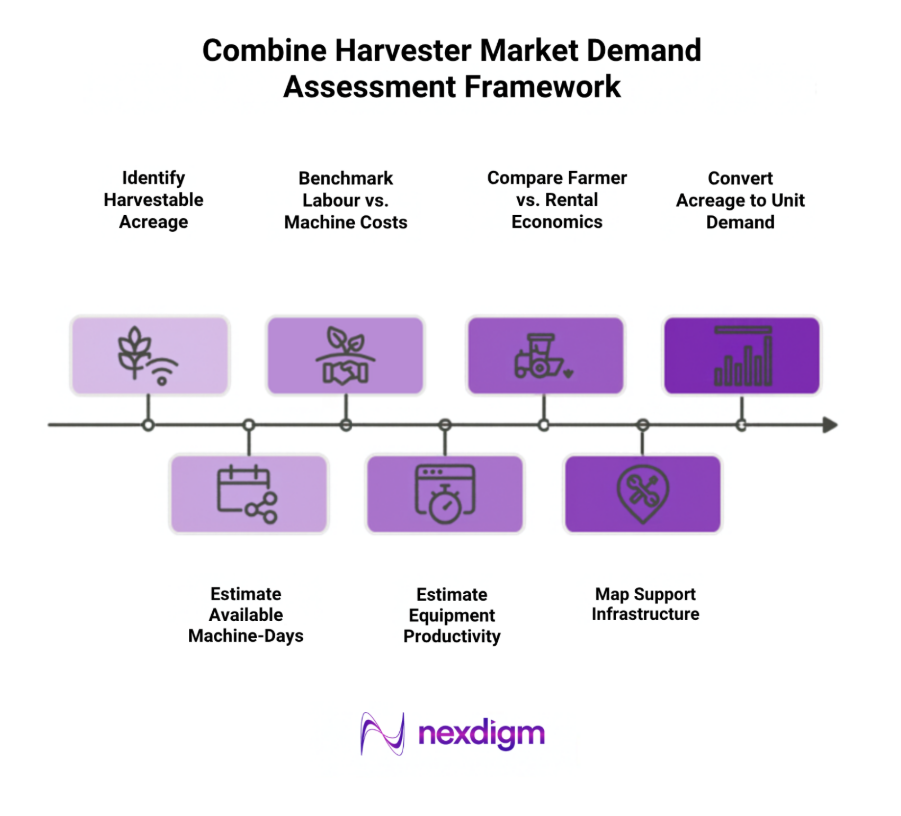
- Crop concentration mapping
Quantify harvestable acreage by crop and district, then identify contiguous production clusters where machine deployment can achieve high field coverage. - Harvest-window modelling
Overlay crop calendars and maturity periods to estimate available machine-days and determine whether demand is sufficiently concentrated. - Labour replacement economics
Benchmark harvesting wages, labour availability and harvesting delays against machine operating costs to calculate the economic value of mechanisation. - Machine utilisation modelling
Estimate acres covered per hour, operating hours, downtime, relocation time and seasonal utilisation to determine realistic equipment productivity. - Ownership versus custom hiring
Compare farmer ownership economics with rental and service-provider models, including financing, maintenance and depreciation. - Service-network feasibility
Map dealerships, workshops, spare-parts availability and transport corridors so equipment can remain productive during compressed harvesting periods. - Market sizing and deployment scenarios
Convert acreage and utilisation assumptions into unit demand under different adoption, pricing and custom-hiring scenarios.
This produces a market view that distinguishes equipment demand from commercially viable equipment deployment.
Nexdigm’s Case Study: Finding the High-Utilisation Harvester Belt
A farm-equipment manufacturer screened 14 districts covering 6.8 million cultivated acres. Three crop clusters accounted for 2.1 million harvestable acres within concentrated 35–45-day windows. The model identified 740 commercially serviceable machine opportunities, with projected utilisation of 620 hours per machine versus 340 hours under the existing deployment pattern. The redesigned territory plan increased potential equipment revenue by ₹212 crore over three years.
To take the next step, simply visit our Request a Consultation page and share your requirements with us.
Harsh Mittal
+91-8422857704