

Healthcare costs are changing the role of health insurance. Medical inflation, rising treatment intensity, and the growing use of advanced diagnostics and procedures are increasing the financial exposure associated with major health events. In emerging markets such as India, medical cost inflation is cited at approximately 12%–14% annually, driven by private healthcare modernization, advanced diagnostics, and higher treatment intensity.
At the same time, chronic conditions such as cardiovascular disease, hypertension, and diabetes are increasing the need for recurring care and medication. For households without adequate coverage, a major hospitalization can quickly erode savings. This is making health insurance increasingly relevant as a mechanism for protecting household finances against high-severity medical expenses.
Employer Coverage Is Expanding Awareness, But Leaving Protection Gaps
Employer-sponsored group insurance is often the first point of exposure to formal health coverage. In India, corporate group policies account for approximately 47% of insured lives, covering more than 27.5 crore people. Employees become familiar with cashless hospitalization, network hospitals, and pre-authorization processes through these policies.
However, employer coverage does not necessarily provide sufficient protection for expensive treatments. Corporate policies commonly carry sums insured of around ₹3 lakh–₹5 lakh, while major cardiovascular procedures, intensive care, and oncology treatments can exceed these limits. Room-rent restrictions, procedure-specific caps, and exclusions can further increase the amount patients pay themselves.
Employment-linked coverage also creates another vulnerability. A career break, job transition, downsizing, or retirement can remove coverage precisely when healthcare requirements may be increasing. This creates demand for individual policies, particularly top-up and super top-up products that supplement employer-provided insurance.
The Underinsured Population Represents a Significant Opportunity
The more commercially relevant opportunity can lie between the insured and uninsured populations: households that have coverage, but insufficient sums insured.
Older policies may have been adequate when treatment costs were lower but now leave substantial gaps between policy limits and actual hospitalization expenses.
A health insurance demand assessment can quantify these gaps by income group, geography, age, treatment category, and existing coverage, helping insurers identify where supplemental protection is most relevant.
This analysis can reveal demand for:
- High-deductible super top-ups that extend protection above employer or base-policy limits.
- Senior-citizen products designed around higher healthcare utilization and chronic conditions.
- Critical illness policies providing lump-sum benefits following specified diagnoses.
- OPD and wellness products covering preventive screenings, diagnostics, telemedicine, and chronic disease management.
The opportunity therefore depends on understanding what existing policies fail to cover, rather than simply measuring insurance penetration.
Product Design Determines Whether Protection Gaps Convert Into Demand
Different consumer segments face different coverage deficiencies. Younger employees may prioritize affordable catastrophic protection above corporate benefits, while older consumers may place greater value on coverage for chronic and critical conditions.
Super top-ups can address high-severity events at relatively accessible premiums by applying a deductible before additional coverage begins. Critical illness products address a different financial need by providing a lump-sum payment that can help cover income disruption, rehabilitation, travel, or other expenses that standard indemnity policies may not reimburse.
This makes product architecture an important part of market sizing. Two markets with similar insurance penetration can have very different opportunities depending on policy limits, exclusions, provider costs, household affordability, and the prevalence of underinsurance.
Nexdigm’s Health Insurance Demand Assessment Framework
Nexdigm evaluates health insurance demand by connecting healthcare expenditure and medical inflation with actual coverage gaps and consumers’ ability to pay. The assessment examines:
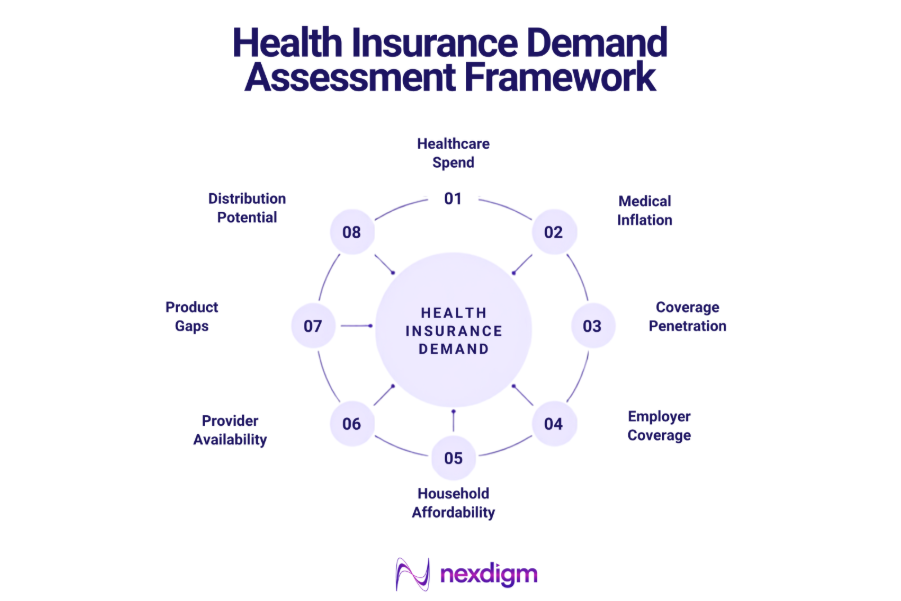
- Healthcare Spend: Per-capita healthcare expenditure and the role of out-of-pocket spending.
- Medical Inflation: Changes in hospitalization, procedure, bed-day, and treatment costs.
- Coverage Penetration: Public schemes, corporate policies, and retail insurance across target markets.
- Employer Coverage: Policy limits, co-payments, benefit retention, and coverage loss after employment.
- Household Affordability: Income bands, premium sensitivity, and willingness to pay for additional protection.
- Provider Availability: Hospital networks, cashless facilities, diagnostics, and TPA infrastructure.
- Product Gaps: Unmet demand for super top-ups, senior coverage, OPD, and critical illness products.
- Distribution Potential: Agency, corporate, digital aggregator, and health-platform channels.
The result is a market view that identifies where protection needs are largest and which customer segments, products, and distribution channels can convert that need into commercially viable demand.
How Nexdigm Identifies the Strongest Health Insurance Opportunities
A private health insurer assessed 15 metropolitan and Tier-2 markets to identify underinsured middle-income households. The analysis found approximately 6.8 million households with basic policies capped at ₹4 lakh or below, despite local tertiary hospitalization costs averaging ₹10 lakh–₹14 lakh. The insurer subsequently prioritized super top-up and senior critical illness products, creating an estimated ₹1,200 crore ($144 million) annual premium opportunity.
To take the next step, simply visit our Request a Consultation page and share your requirements with us.
Harsh Mittal
+91-8422857704
[email protected]