

Health Insurance Premium Pricing Feasibility Research helps insurers evaluate whether proposed premiums remain commercially sustainable, competitively positioned, and affordable across markets experiencing rising claims ratios. Through robust Pricing Strategy Analysis, organizations can assess medical cost trends, loss ratios, customer price sensitivity, regulatory requirements, benefit design, and competitor premiums.
This evidence-based approach supports risk-adjusted pricing, market-specific premium corridors, portfolio segmentation, and scenario modeling. Health insurance premium pricing feasibility research enables insurers to balance profitability, coverage accessibility, and long-term financial resilience while responding effectively to evolving claims experience across portfolios.
Recent industry data illustrates that U.S. health insurers’ loss ratio reached 88.6% in mid-2025, while profit margins declined to 1.8%. Separately, proposed premiums for 2027 show a median 14% increase, reinforcing the need for disciplined pricing feasibility research.
Pricing Strategy Analysis for Sustainable Health Insurance Premiums
Pricing Strategy Analysis for Sustainable Health Insurance Premiums helps insurers balance claims costs, affordability, competitiveness, regulatory requirements, and profitability through data-driven premium design, segmentation, forecasting, and portfolio optimization strategies.
Its key elements include:
- Claims Ratio and Cost Trend Assessment: Analysis of historical claims ratios, medical inflation, utilization patterns, and cost drivers to determine premium adequacy and identify emerging financial risks across insurance portfolios and markets.
- Customer Affordability and Price Sensitivity: Evaluation of policyholder income levels, renewal behavior, price elasticity, and coverage preferences to design premiums that support affordability, retention, and sustainable insurance participation across segments.
- Medical Inflation and Utilization Forecasting: Projection towards healthcare cost inflation, treatment utilization, provider charges, and disease trends to estimate future claims exposure and establish financially sustainable premium requirements across insurance markets.
- Benefit Design and Premium Alignment: Evaluation of coverage limits, deductibles, co-payments, exclusions, and wellness benefits to align plan value with premium levels, affordability expectations, and target customer needs across segments.
Nexdigm’s Support for Data-Driven Premium Pricing Strategies
Nexdigm partners with health insurers to develop premium pricing strategies that strike the right balance between affordability, competitiveness, and profitability. Through Health Insurance Premium Pricing Analysis, Pricing Strategy Analysis and Premium Pricing Feasibility Research, we help insurers evaluate claims trends, customer behavior, market dynamics, and regulatory requirements. Our data-driven approach enables informed pricing decisions, strengthens portfolio performance, improves policyholder retention, and supports sustainable growth in an increasingly complex insurance landscape.
Nexdigm’s Pricing Analysis Framework for High-Claims Insurance Markets
Nexdigm’s pricing analysis framework helps health insurers respond to rising claims through structured diagnostics, forecasting, segmentation, and implementation planning that support sustainable, competitive, and evidence-based premium pricing decisions. Its major steps include:
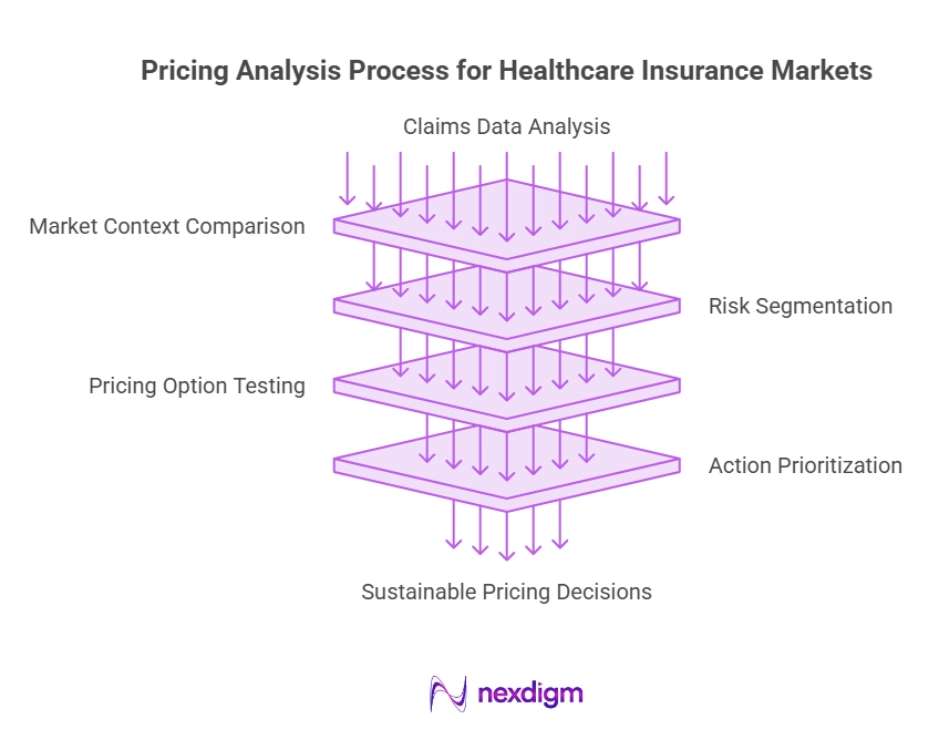
- Understanding Driving Claims: Examination of claims trends, treatment costs, utilization patterns, member profiles, and benefit structures to identify the main factors putting pressure on premium adequacy and portfolio performance.
- Comparing the Market Context: Reviewing competitor premiums, customer affordability, regulatory requirements, and benefit positioning to understand where current pricing stands and how much flexibility exists across different markets.
- Grouping Risks: Segmentation of policies by age, geography, plan type, claims behavior, and customer profile to develop pricing approaches that better reflect expected risk and portfolio economics.
- Testing Different Pricing Options: Modeling premium increases, benefit changes, retention risks, and claims scenarios to understand the likely financial and customer impact before any pricing decision is finalized.
- Prioritizing Right Actions: Identifying which pricing changes should be implemented first based on financial impact, customer sensitivity, operational readiness, regulatory considerations, and overall business priorities.
Nexdigm’s Case
A health insurer engaged Nexdigm to address rising claims and uneven portfolio performance. Nexdigm’s pricing analysis identified targeted premium adjustments that improved the projected loss ratio by 6%, increased portfolio margins by 9%, and limited expected policyholder attrition to 3%, supporting more sustainable pricing decisions across priority customer segments and markets.
To take the next step, simply visit our Request a Consultation page and share your requirements with us.
Harsh Mittal
+91-8422857704