

Healthcare organizations are generating and using increasingly large volumes of clinical, financial, operational, and patient data. The global healthcare analytics market was valued at $65.6 billion in 2025 and is projected to reach $198.8 billion by 2033, representing a 13.5% CAGR from 2026 to 2033.
The growing use of predictive technologies further demonstrates the expanding role of analytics. In 2024, 71% of U.S. hospitals reported using predictive AI integrated with their electronic health records, up from 66% in 2023.
Analytics is also moving beyond traditional reporting. Between 2023 and 2024, hospital use of predictive AI for billing simplification increased by 25 percentage points, while use for scheduling increased by 16 percentage points.
As analytics becomes more embedded in healthcare decision-making, healthcare analytics platform vendor benchmarking can help organizations distinguish platforms based on their ability to integrate data, generate actionable insights, scale across use cases, and support effective user adoption.
Analytics Platforms Are Evolving Beyond Reporting
Healthcare analytics platforms increasingly bring together data from EHRs, claims, laboratory systems, imaging, financial systems, and operational applications. The objective is shifting from simply presenting historical information toward enabling predictive analysis, performance management, operational optimization, and faster decision-making. This makes platform selection dependent on both technical capability and practical usability.
Analytics Maturity Is Becoming a Key Platform Differentiator
As healthcare analytics expands from descriptive reporting to predictive and operational applications, platforms increasingly differ in their ability to support data quality, advanced modeling, real-time insights, workflow integration, and decision support. Organizations therefore need to consider not only what a platform delivers today, but also how effectively it can accommodate more sophisticated analytics use cases, growing data volumes, and broader adoption across clinical and business functions.
What Separates More Mature Analytics Platforms
Platform maturity is shaped by more than the number of analytical features offered. From a Nexdigm benchmarking view, healthcare organizations can differentiate platforms by examining data integration depth, analytical sophistication, scalability, usability, and workflow connectivity. These factors indicate whether a platform can support basic reporting as well as more advanced clinical, operational, and financial use cases. A balanced evaluation therefore considers both current capabilities and the platform’s readiness to support future analytics requirements.
How Nexdigm Evaluates Analytics Value Across Healthcare Use Cases
The same analytics platform can create different value depending on who uses it and what decisions it supports. Nexdigm can assess this variation across key healthcare use cases:
- Clinical Decision Support: Examine how effectively platforms translate patient and clinical data into insights that can support care coordination, risk identification, and informed clinical decisions.
- Operational Performance: Evaluate capabilities for monitoring capacity, patient flow, workforce utilization, service performance, and other operational indicators that influence healthcare delivery efficiency.
- Financial & Executive Insights: Assess reporting and analytics that help leaders understand costs, revenue, performance trends, resource allocation, and broader organizational priorities.
This user- and use-case-oriented view helps organizations determine whether a platform delivers practical value across the healthcare enterprise rather than serving only as a reporting tool.
Nexdigm’s Healthcare Analytics Platform Assessment
Nexdigm can structure the assessment through healthcare analytics platform vendor benchmarking to evaluate platforms across the factors that influence their technical capability, practical usability, and long-term relevance. These factors are:
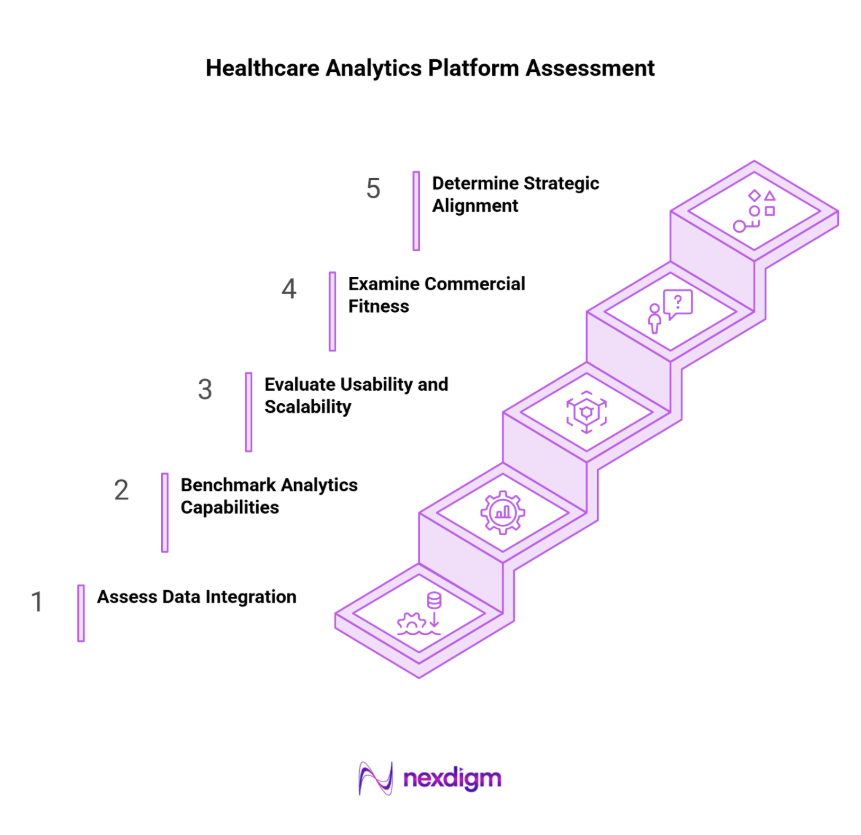
- Assess Data Integration: Examine connectivity, APIs, interoperability, data ingestion, normalization, and the ability to consolidate information from diverse healthcare sources.
- Benchmark Analytics Capabilities: Compare reporting, visualization, predictive modeling, forecasting, decision support, and other analytical functionality across relevant platforms.
- Evaluate Usability and Scalability: Assess user experience, workflow integration, customization, data volumes, user growth, multi-site deployment, and expansion across new use cases.
- Examine Implementation and Commercial Fit: Consider deployment models, integration complexity, implementation requirements, support, licensing structures, recurring costs, and lifecycle economics.
- Determine Strategic Alignment: Assess how each platform supports current priorities while providing flexibility for future analytics requirements, technology changes, and broader organizational adoption.
This assessment provides a structured basis for comparing platforms and identifying which options combine technical strength, practical usability, scalability, and commercial value most effectively.
How Nexdigm’s Assessment Supports Commercial Value
Nexdigm’s assessment can help organizations connect platform capabilities with procurement outcomes by identifying cost differences, integration implications, scalability requirements, and potential areas for negotiation. By comparing technical performance alongside licensing, implementation, support, and lifecycle considerations, the analysis can help procurement teams identify platforms that offer stronger overall value rather than simply lower upfront costs.
Nexdigm’s Case
Nexdigm supported a healthcare organization in evaluating 34 analytics platforms across technical and commercial criteria. The assessment found 27% with stronger overall platform fit, 19% with more scalable architectures, and 14% with greater commercial flexibility, helping the organization prioritize platforms for detailed technical validation and procurement discussions.
To take the next step, simply visit our Request a Consultation page and share your requirements with us.
Harsh Mittal
+91-8422857704