

Healthcare automation is shifting toward targeted workflow transformation. Hospitals are evaluating processes based on labour intensity, financial leakage, throughput constraints, and integration feasibility, creating opportunities across revenue cycle management, prior authorization, clinical documentation, laboratory, pharmacy, and logistics.
The global healthcare automation tools market reached USD 52.94 billion in 2025 and is projected to reach USD 116.83 billion by 2033 at a 10.5% CAGR. The key question is where automation has enough operational friction, economic value, and organizational readiness to justify investment.
Administrative Workflows Offer the Clearest Starting Point
Administrative processes offer immediate automation opportunities because their costs are measurable and workflows are repetitive. Revenue cycle management, claims processing, eligibility verification, coding, denial management, and prior authorization can generate significant administrative overhead.
Prior authorization is another opportunity. Manual payer portals, documentation requirements, and clinical reviews can delay procedures and consume staff time. The commercial opportunity depends on identifying health systems where transaction volumes and administrative burden justify automation.
Key indicators include:
- Claims, authorization, and eligibility volumes
- Administrative staffing requirements
- Denial and rework rates
- Accounts-receivable delays
- Payer complexity
- EHR integration
The strongest opportunities are likely to be organizations where automation can address a measurable financial or operational loss.
Clinical Automation Requires a Higher Readiness Threshold
Clinical automation has a higher adoption threshold. Ambient documentation, clinical decision support, and diagnostic automation can reduce clinician workload, but adoption depends on data governance, clinical validation, privacy, and accountability.
Providers must assess accuracy, system integration, data handling, workflow disruption, and the risks associated with automated clinical outputs.
Key considerations include:
- Workflow compatibility
- Clinical validation
- Data privacy and security
- EHR interoperability
- Physician acceptance
- Governance requirements
Strong clinical demand may still translate into limited adoption where health systems lack the infrastructure or governance needed for deployment.
Operational Processes Can Create a Different Automation Opportunity
Operational workflows across laboratories, pharmacies, inventory, specimen handling, and transportation also present automation opportunities. Laboratory automation can improve sample processing, pharmacy systems can standardize dispensing, and autonomous robots can transport medications, meals, linens, specimens, and supplies.
However, adoption depends on facility readiness. Solutions that work in newly built hospitals may require costly retrofitting in older facilities, particularly for infrastructure and system integration.
The Automation Opportunity Depends on More Than Technology
A workflow may be suitable for automation but commercially unattractive if volumes are too low. Conversely, repetitive processes can present strong opportunities where customers have sufficient scale, labor costs, integration capabilities, and investment capacity.
Automation providers therefore need to understand which healthcare organizations face the greatest process burden, which workflows receive budget priority, and where competing technologies are already installed.
How Nexdigm Determines Which Healthcare Processes Are Ready for Automation
A Healthcare automation market study should connect process burden, economic value, technology readiness, and purchasing capacity to determine where automation investment is most commercially viable. Nexdigm assesses the underlying workflow, the economic problem it creates, the customer’s ability to implement a solution, and the competitive environment before determining whether an opportunity is commercially attractive.
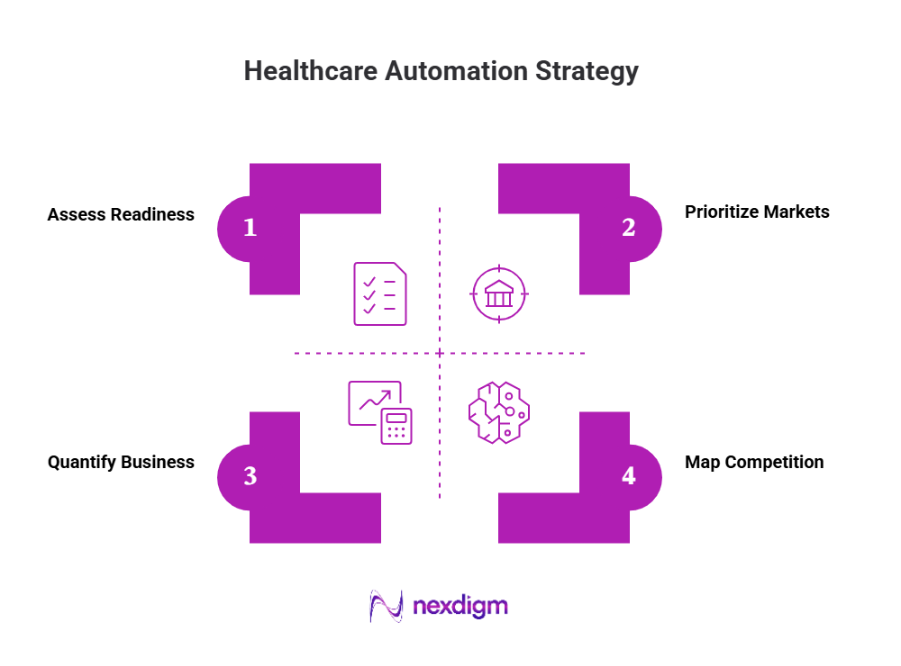
- Identify High-Value Automation Opportunities
Nexdigm maps clinical, administrative, and operational workflows to identify where manual intervention creates significant workload, delays, errors, or capacity constraints. Transaction volumes, process frequency, staffing requirements, and workflow complexity help distinguish genuinely automation-ready processes from low-value use cases. - Quantify the Business Case
The next step is to establish whether the problem is financially significant enough to support investment. Nexdigm evaluates labor costs, revenue leakage, denial rates, turnaround times, capacity utilization, error-related costs, and other measurable inefficiencies to estimate the value that automation could address. - Assess Provider Readiness
A strong business case does not guarantee adoption. Nexdigm evaluates whether healthcare organizations have the infrastructure and organizational capabilities required to deploy the solution, including EHR compatibility, interoperability, cybersecurity requirements, existing automation, workforce capabilities, procurement processes, and implementation complexity. - Segment the Addressable Customer Base
Nexdigm then determines which providers represent the strongest commercial targets. Hospitals and health systems can be segmented by facility size, specialty mix, workflow volumes, technology maturity, capital expenditure capacity, geographic presence, and existing technology investments. This separates the total customer universe from the realistically addressable market. - Map Competitive Intensity and White Space
Understanding who is already serving the market is essential to estimating commercial potential. Nexdigm benchmarks competing vendors, installed systems, product capabilities, pricing approaches, partnerships, and customer penetration to identify saturated segments as well as underserved workflows and provider groups. - Prioritize the Markets That Can Convert
The final stage brings demand, economics, readiness, and competition together. Nexdigm can rank applications, provider segments, and geographies according to their commercial attractiveness, helping clients determine where to focus sales efforts, which use cases to prioritize, where partnerships may be required, and where market entry should be deferred.
This approach helps automation providers distinguish between healthcare organizations interested in automation and those with the need, budget, infrastructure, and business case to purchase it.
How Nexdigm Converts Automation Demand Into Market Priorities
An automation provider assessed 150 healthcare facilities across four markets.
Initial screening identified 80% as potential customers; deeper analysis reduced the immediately addressable pool to 42%, concentrating commercial efforts on facilities with higher workflow volumes, stronger infrastructure, and greater spending readiness.
To take the next step, simply visit our Request a Consultation page and share your requirements with us.
Harsh Mittal
+91-8422857704
[email protected]