

Automation technologies are becoming central to improving efficiency across clinical and administrative healthcare operations. Hospitals, clinics, and healthcare technology providers are adopting automation to streamline patient scheduling, claims processing, documentation, clinical decision support, inventory management, and care coordination. As healthcare systems face rising cost pressures, workforce shortages, and growing patient volumes, automation offers a pathway to faster workflows, reduced errors, and better resource utilization.
A strong market entry strategy is essential for companies entering this space, as success depends on regulatory alignment, workflow integration, stakeholder adoption, and measurable value creation. Healthcare automation technology entry strategy must prioritize scalability, compliance, interoperability, and operational impact.
The healthcare automation market is estimated at USD 44.75 billion in 2025 and projected to reach USD 69.06 billion by 2030, growing at 9.07% CAGR. Administrative spending also remains a major efficiency target, accounting for nearly 15% to 25% of U.S. healthcare expenditure, while physicians reported spending 7.3 hours weekly on administrative tasks.
What are the Market Entry Strategy for Healthcare Automation Technologies?
Market entry strategy for healthcare automation technologies involves assessing demand, regulatory requirements, workflow integration needs, target customers, pricing models, partnerships, and ROI potential to support successful adoption across clinical and administrative healthcare operations:
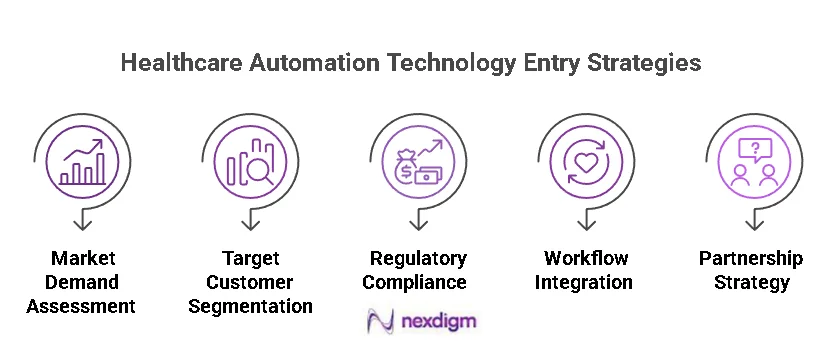
- Market Demand Assessment: Evaluate automation needs across hospitals, clinics, payers, and administrative functions to identify high-value entry opportunities.
- Target Customer Segmentation: Define priority users, including providers, health systems, insurers, laboratories, and back-office healthcare teams.
- Regulatory Compliance Review: Assess healthcare regulations, privacy laws, data security standards, and automation-related compliance requirements.
- Workflow Integration Planning: Ensure compatibility with EHR, HIS, billing systems, clinical pathways, and administrative processes.
- Partnership Strategy: Identify hospitals, technology integrators, payers, and implementation partners to accelerate market access.
Nexdigm Clinical and Administrative Workflow Transformation Advisory
Nexdigm Clinical and Administrative Workflow Transformation Advisory helps healthcare automation companies identify process inefficiencies, redesign workflows, and align technology with provider operations. It supports automation across scheduling, billing, claims, documentation, reporting, and care coordination, enabling smoother adoption, reduced manual effort, improved compliance, and measurable efficiency gains across healthcare organizations.
Nexdigm Healthcare Automation Market Assessment and Opportunity Mapping
Nexdigm Healthcare Automation Market Assessment and Opportunity Mapping helps companies evaluate demand, target segments, competitor landscape, adoption barriers, regulatory considerations, and growth opportunities for effective healthcare automation market entry and expansion.
- Market Demand Assessment: Nexdigm evaluates automation demand across hospitals, clinics, payers, and administrative healthcare functions to identify high-growth opportunities.
- Customer Segment Mapping: Nexdigm identifies priority customer groups, including hospitals, diagnostic chains, insurers, laboratories, and health-tech providers.
- Competitor Landscape Review: Nexdigm benchmarks automation vendors, pricing models, product capabilities, service gaps, and market positioning.
- Adoption Barrier Analysis: Nexdigm assesses workflow resistance, integration challenges, cost concerns, compliance issues, and buyer readiness.
Nexdigm’s case:
Nexdigm supported a healthcare automation technology company evaluate entry into the hospital operations segment by assessing 20+ provider networks, benchmarking 12 competing automation vendors, and identifying five high-priority use cases across billing, claims, scheduling, and documentation.
Nexdigm supported the company with opportunity mapping, pricing inputs, and partner identification, helping define a phased launch plan targeting 30 hospitals and an estimated 25% reduction in manual administrative workload within the first year.
To take the next step, simply visit our Request a Consultation page and share your requirements with us.
Harsh Mittal
+91-8422857704