

Healthcare consumers in India are becoming more involved in decisions about where, when, and how they receive care. Growing provider choice, insurance coverage, digital healthcare, diagnostics networks, and access to healthcare information are making the patient journey more consumer-driven.
Convenience is also becoming an important part of healthcare access. By August 2026, India’s eSanjeevani platform had facilitated more than 49 crore teleconsultations, demonstrating the scale at which consumers are willing to access healthcare beyond traditional physical settings.
A Healthcare consumer preference analysis helps providers understand how patients balance cost, quality, accessibility, convenience, trust, and experience when selecting healthcare services.
Nexdigm helps healthcare organizations analyze consumer behavior, patient feedback, and healthcare utilization data to understand the factors influencing healthcare choices. This enables providers to create patient-focused healthcare models.
Role of Cost in Healthcare Decisions
Healthcare affordability remains one of the strongest factors affecting patient choices. Consumers are paying closer attention to treatment costs, insurance coverage, and the financial impact of healthcare decisions. It is important for organizations to study how cost influences healthcare utilization. By analyzing patient trends and service patterns, providers can understand whether consumers are choosing certain care options because they are more affordable or accessible.
Role of Quality in Building Patient Confidence
Cost is important, but healthcare consumers also want reliable and high-quality care. Patients consider factors such as provider experience, treatment outcomes, reviews, and overall service quality before making healthcare decisions. Online ratings and patient feedback have made quality information easier to access. Assessing the impact of quality on patient behaviour helps healthcare providers identify service improvements and better align care delivery with evolving consumer expectations.
Role of Access and Convenience in Changing Expectations
Convenience has become a major part of healthcare decision-making. Patients increasingly expect easy appointment scheduling, shorter waiting times, nearby services, and flexible care options. Digital healthcare has played a major role in this change. Need to understand how patients use different healthcare channels, including hospitals, outpatient facilities, and digital platforms. This allows providers to identify where patients prefer virtual care and where in-person services remain necessary.
Nexdigm in Analyzing Healthcare Utilization Patterns
Understanding how and why patients use healthcare services is important for effective planning and service delivery. Nexdigm helps healthcare organizations analyze utilization patterns across hospitals, clinics, diagnostics centres, and digital platforms to identify changing demand and patient preferences. Through healthcare analytics and market assessments, Nexdigm helps organizations:
- Understand the factors influencing patient choices and utilization
- Identify changing demand across inpatient, outpatient, and digital channels
- Assess gaps in service accessibility and care delivery
- Optimize healthcare infrastructure, service offerings, and resource allocation
- Support capacity planning, expansion strategies, and investment decisions
By analyzing healthcare utilization patterns, Nexdigm uses Intelligence Framework to help organizations align services with evolving patient needs and make informed, data-driven decisions.
Nexdigm’s Healthcare Intelligence Framework
Understanding healthcare utilization begins with understanding patient preferences. Nexdigm’s structured Healthcare consumer preference analysis helps organizations evaluate how factors such as cost, quality, accessibility, convenience, and care experience influence healthcare decisions.
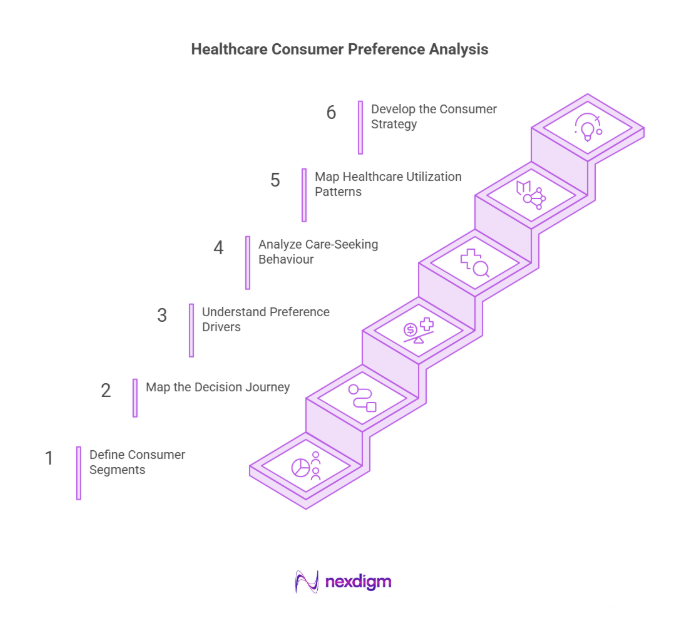
- Define Consumer Segments: Identify relevant patient groups by age, income, geography, condition, insurance status, healthcare usage, and other behavioural characteristics.
- Map the Decision Journey: Understand how consumers recognise healthcare needs, search for providers, compare alternatives, make appointments, receive treatment, and manage follow-up care.
- Understand Preference Drivers: Evaluate the importance of cost, physician expertise, hospital reputation, location, availability, digital access, waiting time, and overall experience.
- Analyze Care-Seeking Behaviour: Understand where patients seek care, which providers they prefer, and how they choose between inpatient, outpatient, diagnostic, and digital services.
- Map Healthcare Utilization Patterns: Measure service utilization across hospitals, clinics, diagnostic centres, pharmacies, and virtual care platforms to identify emerging demand trends.
- Develop the Consumer Strategy: Identify the gaps affecting healthcare access and patient satisfaction and convert the findings into recommendations covering service design, pricing, locations, communication, digital channels, partnerships, and patient engagement.
By applying its Healthcare consumer preference analysis framework, Nexdigm helps healthcare organizations better understand utilization, patient expectations, improve healthcare access and make informed strategic decisions.
Nexdigm In Assessing Growth Opportunities
Insights from Healthcare consumer preference analysis can help organizations identify emerging opportunities driven by changing patient expectations and care-seeking behaviour. As consumers increasingly prioritize convenience, accessibility, transparency, and personalized experiences, demand is growing across digital consultations, preventive health services, home-based care, remote monitoring, coordinated care pathways, and convenient outpatient formats.
Nexdigm helps organizations evaluate evolving consumer preferences, assess the attractiveness of emerging healthcare models, and prioritize opportunities that can enhance patient acquisition, engagement, retention, and long-term market positioning.
Nexdigm’s Case
Nexdigm supported a hospital client by analyzing patient preferences, competitor services, and clinical performance to strengthen its market positioning. The engagement resulted in a 22% increase in patient retention and 18% faster strategy alignment, demonstrating how consumer insights can improve patient loyalty, service planning, and competitive positioning.
To take the next step, simply visit our Request a Consultation page and share your requirements with us.
Harsh Mittal
+91-8422857704