

As healthcare systems become increasingly digital, cybersecurity risks are rising sharply alongside the growing volume of sensitive patient data. With data breaches increasing, protecting clinical, financial, and operational information has become critical. Healthcare cybersecurity analysis plays a key role in competitive intelligence by evaluating threat landscapes, security capabilities, and breach patterns across organizations.
Healthcare cybersecurity risks continue to escalate, with global healthcare data breaches rising by over 15% annually. The average cost of a healthcare data breach has reached nearly $11 million, the highest across industries. Over 60% of healthcare organizations have experienced ransomware attacks in recent years, while nearly 45% report delays in incident detection.
It helps identify vulnerabilities, benchmark security maturity, and assess how competitors are safeguarding data. This intelligence enables healthcare providers to strengthen defenses, ensure regulatory compliance, and maintain trust while staying competitive in a highly connected digital ecosystem.
Role of Competitive Intelligence in Healthcare Cybersecurity Analysis
Competitive intelligence in healthcare cybersecurity analysis involves monitoring threats, breaches, and security practices across organizations to benchmark defenses, identify vulnerabilities, and strengthen data protection strategies in a digital healthcare ecosystem:
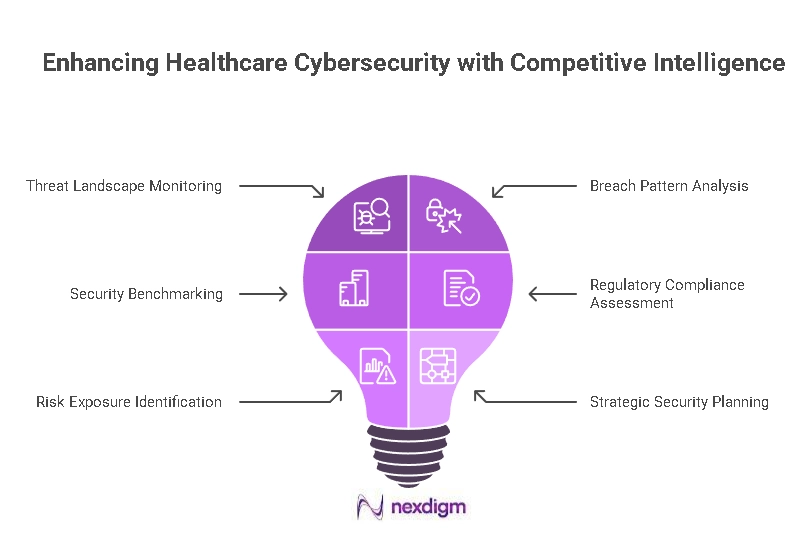
Threat Landscape Monitoring
Tracks evolving cyber threats in healthcare, including ransomware, phishing, and malware attacks affecting digital systems and sensitive patient data.
Breach Pattern Analysis
Examines past data breaches across organizations to identify common vulnerabilities, attack vectors, and areas requiring stronger cybersecurity controls.
Security Benchmarking
Compare cybersecurity maturity, tools, and protocols across healthcare providers to evaluate relative strengths and identify improvement gaps.
Regulatory Compliance Assessment
Reviews adherence to data protection laws and healthcare regulations, ensuring organizations meet required cybersecurity and privacy standards.
Risk Exposure Identification
Identifies weak points in systems and processes that increase vulnerability to cyberattacks and data breaches in healthcare environments.
Strategic Security Planning
Uses insights to guide cybersecurity investments, strengthen defenses, and improve overall resilience against evolving digital threats.
Nexdigm Enabling Data Protection Strategies and Threat Monitoring
Nexdigm enables data protection strategies and threat monitoring by helping healthcare organizations identify vulnerabilities, strengthen security frameworks, and implement proactive risk controls. Using analytics-driven insights and cybersecurity assessments, it monitors evolving threats, ensures regulatory compliance, and enhances incident response readiness. This approach safeguards sensitive patient data, reduces breach risks, and supports resilient, secure digital healthcare ecosystems across increasingly connected and data-intensive environments.
How Nexdigm Enhances Risk Management and Prevents Security Breach
Nexdigm enhances risk management and prevents security breaches by identifying vulnerabilities, monitoring threats, ensuring compliance, and implementing proactive controls to protect healthcare data and strengthen overall cybersecurity resilience.
Risk Assessment Frameworks
Evaluates organizational vulnerabilities, identifying potential threats and weaknesses to build stronger cybersecurity and risk mitigation strategies across healthcare systems.
Proactive Threat Monitoring
Continuously tracks cyber threats and suspicious activities, enabling early detection and prevention of potential security breaches in healthcare environments.
Data Protection Strategies
Implements structured policies and controls to safeguard sensitive patient and operational data from unauthorized access and cyberattacks.
Employee Awareness and Training
Educates staff on cybersecurity best practices, reducing human error and strengthening overall organizational security posture.
Continuous Risk Monitoring and Improvement
Regularly reviews and updates risk management strategies to adapt to new threats and ensure sustained cybersecurity effectiveness.
Nexdigm’s case:
A healthcare client engaged Nexdigm to strengthen cybersecurity governance and data protection across its digital platforms. The engagement included risk assessment, system audits, and threat monitoring framework design. As a result, the organization achieved a 35% improvement in threat detection speed, reduced security vulnerabilities by 40%, and enhanced compliance adherence to over 95%. The solution also improved incident response readiness, enabling faster containment of potential breaches in a high-risk digital healthcare environment.
To take the next step, simply visit our Request a Consultation page and share your requirements with us.
Harsh Mittal
+91-8422857704