

Collaborative Healthcare Ecosystems Improve Service Integration and Patient Access by connecting providers, payers, technology firms, diagnostics networks, pharmacies, and community care partners within a coordinated care model. In fragmented healthcare markets, collaboration helps reduce service gaps, improve referrals, support data sharing, and create smoother patient journeys across physical and digital care channels. A strong Healthcare ecosystem collaboration strategy enables companies to identify the right stakeholders, align service delivery, and improve access across target markets.
As part of a broader market entry strategy, ecosystem collaboration supports faster adoption, stronger local relevance, and scalable healthcare expansion across competitive care environments.
Collaborative healthcare ecosystems are becoming critical as digital care and interoperability needs expand. The global healthcare interoperability solutions market was valued at USD 3.4 billion and is projected to reach USD 8.57 billion by 2030, growing at 14.15% CAGR. The digital health market is also projected to reach USD 1,830.4 billion by 2033, reinforcing the need for Healthcare ecosystem collaboration strategy to improve service integration and patient access.
Role of Healthcare Ecosystem Collaboration in Market Entry Strategy
Healthcare ecosystem collaboration supports market entry strategy by connecting providers, payers, pharmacies, technology partners, and care networks to improve patient access, service integration, local relevance, and expansion readiness:
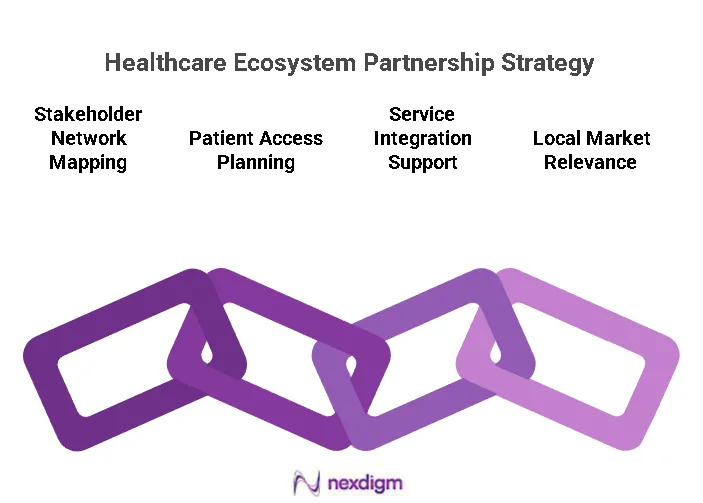
- Stakeholder Network Mapping: Identify providers, payers, pharmacies, diagnostics centers, technology firms, and community care partners relevant to market entry.
- Patient Access Planning: Use ecosystem partners to improve referral pathways, affordability, service reach, and care availability across target markets.
- Service Integration Support: Connect care delivery, diagnostics, pharmacy, digital health, and follow-up services for smoother patient journeys.
- Local Market Relevance: Collaborate with local stakeholders to align healthcare offerings with patient needs, care gaps, and system priorities.
Nexdigm’s End-to-End Advisory for Healthcare Ecosystem Collaboration Strategy and Execution
Nexdigm’s end-to-end advisory supports healthcare ecosystem collaboration strategy and execution by helping companies map providers, payers, pharmacies, diagnostics networks, technology partners, and community care stakeholders. This enables stronger service integration, improved patient access, better partner alignment, reduced entry barriers, and scalable healthcare expansion across connected care markets.
How Does Nexdigm Reduce Market Entry Barriers Through Collaborative Healthcare Models?
Nexdigm helps reduce market entry barriers by mapping ecosystem partners, identifying service gaps, assessing collaboration models, improving stakeholder alignment, and supporting integrated healthcare expansion across fragmented care markets.
- Finding the Right Healthcare Partners Early: Nexdigm helps identify hospitals, clinics, payers, pharmacies, diagnostics players, and technology partners needed for smoother market entry.
- Understanding Where Patients Face Access Gaps: Nexdigm studies unmet patient needs, service gaps, affordability issues, and weak referral pathways in target markets.
- Building Partnerships That Work on Ground: Nexdigm assesses practical collaboration models that fit local healthcare systems, patient flows, and provider capabilities.
- Getting Stakeholders Aligned: Nexdigm helps align hospitals, clinics, insurers, pharmacies, and technology partners around shared market entry goals.
Nexdigm’s case:
Nexdigm evaluated a healthcare services company to reduce market entry barriers through a collaborative ecosystem model across three target cities. By mapping 45+ hospitals, clinics, pharmacies, diagnostics centers, payers, and technology partners, Nexdigm identified 8 service gaps and shortlisted 10 high-fit ecosystem partners. This helped the company improve patient access planning by 35%, reduce potential entry risks by 30%, and build a more connected healthcare expansion roadmap.
To take the next step, simply visit our Request a Consultation page and share your requirements with us.
Harsh Mittal
+91-8422857704