

Healthcare equipment markets are becoming broader and more competitive as hospitals and healthcare systems invest in diagnostics, monitoring, imaging, surgical technologies, and other clinical equipment. The global medical devices market is projected to generate approximately US$576.8 billion in revenue in 2026, with annual growth of about 5.5% expected through 2031.
The scale of the supplier landscape also creates complexity. The World Health Organization estimates that there are around 2 million different types of medical devices worldwide, grouped into more than 7,000 generic device categories. Regulatory capability is becoming equally important: only 32% of regulatory authorities globally currently have the capacity to fully ensure the safety, quality, and effectiveness of health products.
Against this backdrop, healthcare equipment supplier benchmarking can help organizations compare vendors beyond price, examining clinical performance, quality, service, capacity, market presence, and commercial strength together.
Vendor Performance Is More Than a Product Specification
A healthcare equipment vendor can perform strongly on clinical outcomes while offering limited service coverage or unfavorable commercial terms. Another may have competitive pricing but weaker quality systems or limited installed-base support. For healthcare providers and procurement teams, the more useful question is therefore not simply which vendor offers the best equipment, but which supplier delivers the strongest combination of clinical value, operational reliability, commercial attractiveness, and long-term support.
Three Dimensions That Shape Supplier Performance
A meaningful comparison can start with three connected dimensions:
- Clinical & Quality Performance: Evaluate product effectiveness, reliability, safety, quality systems, technical specifications, and relevant clinical evidence.
- Commercial Strength: Compare pricing, lifecycle costs, service arrangements, warranties, financing options, and overall value delivered to customers.
- Operational & Market Capability: Assess manufacturing capacity, service networks, geographic coverage, responsiveness, installed base, and ability to support future requirements.
Looking across these dimensions helps organizations distinguish between vendors that perform well in one area and those that offer a more balanced overall proposition.
How Nexdigm’s Experts View Vendor Performance Differences
Healthcare equipment vendors can appear similar when viewed through headline specifications, but meaningful differences often emerge across service, economics, clinical positioning, and market strength. Nexdigm can help bring these differences into sharper focus:
- Separate Strengths From Gaps: Identify where each vendor genuinely outperforms and where capabilities may fall short of requirements.
- Put Differences Into Context: Assess whether a performance gap is clinically significant, commercially relevant, or primarily operational.
- Highlight Meaningful Trade-offs: Show where stronger clinical performance may involve higher lifecycle costs, or where commercial advantages may come with service limitations.
- Build a Comparative View: Bring multiple supplier attributes together so procurement teams can see the overall positioning of each vendor.
- Identify the Best-Fit Options: Use the comparative findings to highlight vendors whose strengths most closely match the organization’s priorities.
Through healthcare equipment supplier benchmarking, Nexdigm can help transform fragmented vendor information into a clearer picture of competitive positioning and supplier fit.
Nexdigm’s Framework for Healthcare Equipment Supplier Benchmarking
Experts at Nexdigm can structure healthcare equipment supplier benchmarking as a five-part framework that brings clinical, commercial, operational, and market considerations into one comparable view:
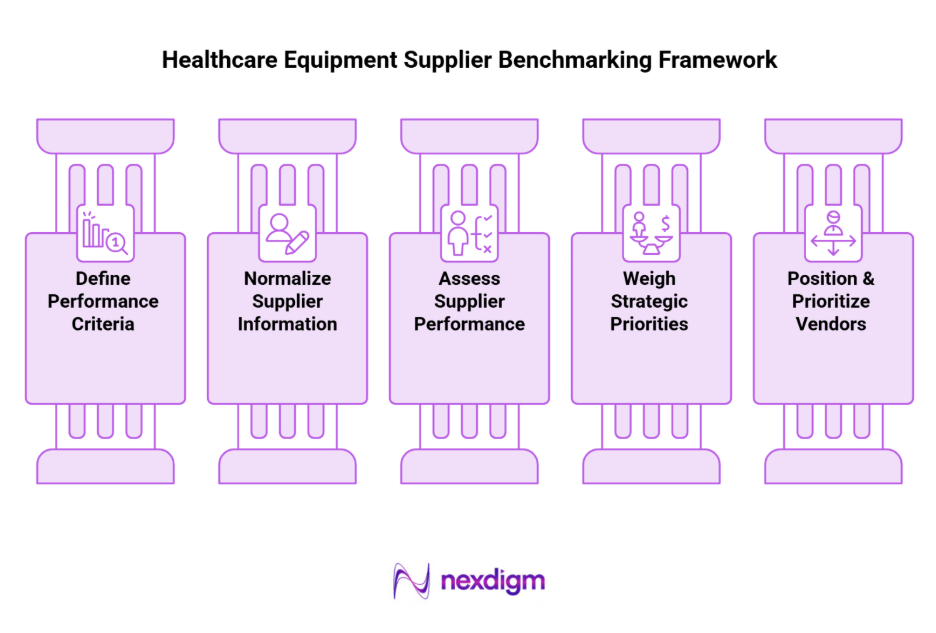
- Define Performance Criteria: Establish benchmarks around clinical performance, quality, technology, pricing, service, lifecycle costs, capacity, and market presence.
- Normalize Supplier Information: Align product specifications, commercial models, service arrangements, contract structures, and market data to enable meaningful comparisons.
- Assess Supplier Performance: Evaluate each vendor against the defined criteria to identify strengths, limitations, and areas requiring deeper validation.
- Weigh Strategic Priorities: Give greater importance to factors that matter most to the organization’s clinical objectives, operational requirements, and procurement strategy.
- Position & Prioritize Vendors: Develop a comparative view showing leading suppliers, performance gaps, trade-offs, and vendors best aligned with the intended requirements.
This framework enables Nexdigm to move beyond simple vendor comparisons and provide a structured view of supplier performance, competitive positioning, and overall fit.
Nexdigm’s Competitive Positioning of Healthcare Equipment Vendors
Once supplier performance is benchmarked, Nexdigm can translate the findings from the framework into a clearer view of where each vendor stands relative to its peers:
- Identify Category Leaders: Highlight vendors that demonstrate stronger performance across critical clinical, commercial, or operational dimensions.
- Reveal Competitive Gaps: Show where suppliers lag peers in areas such as service coverage, technology, pricing, quality, or capacity.
- Understand Trade-offs: Identify situations where a supplier’s strength in one area may be balanced by limitations in another.
- Segment Supplier Positions: Group vendors based on overall performance, strategic fit, and ability to meet specific procurement priorities.
- Highlight Best-Fit Vendors: Identify suppliers whose competitive strengths align most closely with the organization’s clinical, operational, and commercial requirements.
This gives healthcare equipment supplier benchmarking a strategic dimension, helping organizations understand not only who performs well, but why they are positioned differently and where each vendor may fit best.
Nexdigm’s Case
A healthcare organization benchmarked equipment vendors across three markets using Nexdigm’s healthcare equipment supplier benchmarking approach. The analysis identified 23% of vendors with stronger overall clinical-commercial positioning, while 17% showed gaps in service coverage, capacity, or lifecycle economics. The findings helped procurement refine its supplier shortlist and prioritize commercial discussions.
To take the next step, simply visit our Request a Consultation page and share your requirements with us.
Harsh Mittal
+91-8422857704