

Healthcare spending does not translate directly into commercial demand. The same clinical need can produce very different revenues depending on whether treatment is funded by government programs, private insurance, employers, or households. Understanding the payer mix therefore becomes essential when sizing markets, forecasting utilization, and assessing pricing potential.
Global health spending reached USD 9.8 trillion in 2021, according to the WHO, with government and out-of-pocket spending driving much of the increase during the pandemic. Yet financing patterns differ sharply across countries, creating very different conditions for healthcare companies entering or expanding within a market.
The United States illustrates a predominantly insurance-funded model. National health expenditure reached USD 5.3 trillion in 2024, with private health insurance accounting for USD 1.64 trillion, Medicare USD 1.12 trillion, Medicaid USD 932 billion, and out-of-pocket spending USD 557 billion.
The Same Healthcare Need Can Produce Different Commercial Outcomes
Payer structure determines how much of a patient population can realistically access a product or service.
In insurance-heavy systems, coverage policies, deductibles, prior authorization, provider networks, and reimbursement rates can determine utilization. A large addressable patient population may therefore generate limited commercial demand if coverage is restrictive or patient cost-sharing is high.
Publicly funded systems create a different set of constraints. Government budgets, reimbursement schedules, procurement processes, and health technology assessments can influence both pricing and adoption. Companies may need to compete for inclusion within defined reimbursement or procurement pathways rather than rely primarily on consumer willingness to pay.
Out-of-pocket markets introduce another variable: household affordability. WHO data show that out-of-pocket payments remain the main source of health financing in 30 low- and lower-middle-income countries, while in 20 of those countries they account for more than half of total health spending.
India Shows How Funding Structure Shapes Market Access
India demonstrates how a changing funding mix can alter healthcare opportunity. In 2021–22, government spending represented 48% of total health expenditure, while household expenditure, including voluntary health insurance, accounted for 44.1%.
Out-of-pocket spending has also declined substantially over time. WHO data show India’s out-of-pocket share falling from 69.1% of current health expenditure in 2013 to 49.8% in 2021.
For healthcare companies, this shift matters because market sizing based solely on disease prevalence can overstate the addressable opportunity. Products and services must be assessed against insurance coverage, government schemes, household affordability, reimbursement levels, and geographic differences in purchasing capacity.
Funding Determines Where Demand Can Convert Into Revenue
A useful funding analysis should examine four commercial variables:
- Coverage: Who is eligible for reimbursement and under what conditions?
- Reimbursement: What amount is actually paid to providers or suppliers?
- Patient contribution: What portion of the cost remains with households?
- Funding sustainability: Can the payer maintain current utilization and pricing over time?
These variables can produce very different outcomes within the same market. A procedure may have strong clinical demand but limited utilization because patients face high out-of-pocket costs. Conversely, a relatively small patient population can represent an attractive opportunity when reimbursement is comprehensive, and provider capacity is sufficient.
Nexdigm’s Healthcare Funding Market Analysis Framework
A Healthcare funding market analysis needs to move beyond identifying who pays. Nexdigm evaluates how funding mechanisms affect the size, accessibility, and economics of the addressable market.
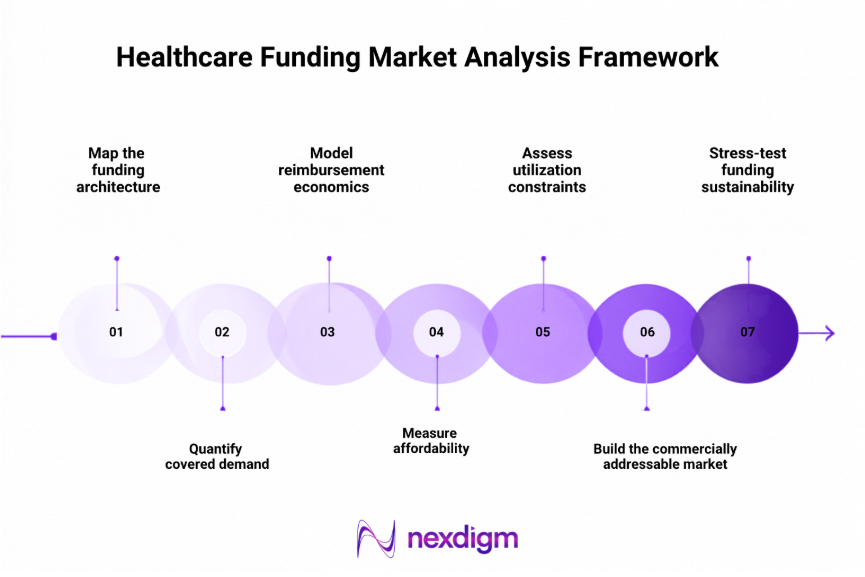
- Map the funding architecture: Identify government programs, statutory insurance, private insurance, employer-sponsored coverage, self-pay, and other financing sources.
- Quantify covered demand: Determine what proportion of the target population is eligible for coverage and where coverage gaps exist.
- Model reimbursement economics: Assess reimbursement rates, pricing controls, deductibles, co-payments, procurement mechanisms, and payment restrictions.
- Measure affordability: Segment populations by income, insurance penetration, household spending capacity, and willingness or ability to pay.
- Assess utilization constraints: Identify how payer policies, authorization requirements, provider networks, waiting periods, and reimbursement limitations affect actual treatment volumes.
- Build the commercially addressable market: Translate epidemiology and utilization into realistic revenue pools by payer, geography, provider type, and product category.
- Stress-test funding sustainability: Evaluate policy changes, budget pressures, insurance expansion, and potential reimbursement revisions that could alter the opportunity over time.
Nexdigm’s Case
A healthcare company evaluated 5 markets covering 240 million people and initially identified a USD 4.8 billion demand pool. After assessing insurance coverage, reimbursement, household affordability, and utilization constraints, the commercially addressable opportunity narrowed to USD 1.7 billion, with 62% concentrated in three priority payer segments. The analysis redirected market-entry efforts toward the funding pools with the strongest revenue potential.
To take the next step, simply visit our Request a Consultation page and share your requirements with us.
Harsh Mittal
+91-8422857704
[email protected]