

Healthcare imports and exports reveal how countries meet medical demand, where domestic production is competitive, and which trading partners occupy critical positions in supply chains. But national trade totals can conceal the commercial differences between finished medicines, active pharmaceutical ingredients, diagnostic devices and hospital equipment.
For manufacturers, distributors and procurement teams, the objective is to identify which products are driving trade, which markets are becoming more dependent on external suppliers and where trade relationships may support expansion or diversification.
Why Healthcare Trade Must Be Mapped by Product
Pharmaceuticals, medical devices, and equipment follow different commercial patterns. Finished medicines depend on regulatory approval, pricing, and distribution access. Medical devices may be sold through tenders or specialist distributors. Capital equipment requires installation, training, and maintenance, which can make local service coverage as important as the product price.
A useful trade map separates the categories before comparing countries. It should also distinguish value from volume: import values can rise because more units are being purchased, because prices have increased or because buyers are shifting toward higher-value products.
Three comparisons are particularly useful:
- Imports versus exports: A persistent gap may indicate reliance on foreign supply, although it does not automatically prove unmet demand or a viable manufacturing opportunity.
- Origin versus destination: Identifying trading partners reveals whether a market relies on a narrow group of suppliers or has diversified its sourcing.
- Product mix over time: Changes in the share of medicines, devices, consumables and equipment can reveal shifts in purchasing priorities that aggregate healthcare trade figures hide.
Where the Trade Numbers Point to Opportunity
India’s medical-device trade illustrates the value of examining both flows. Government data reported imports of ₹137,088 crore and exports of ₹42,360 crore in FY2024–25. From April to December of FY2025–26, imports reached ₹94,664 crore and exports ₹28,106 crore. The partial-year figures show continued trade activity but should not be interpreted as a full-year forecast.
The import-export difference provides a starting point for investigating supply dependence. It does not establish which products offer the best opportunity. That requires a more granular review of product categories, supplier countries, unit values, domestic capacity, and the conditions under which buyers purchase.
For example, a large import value in imaging equipment may reflect high unit prices and hospital capital expenditure. A similar value in consumables may represent recurring purchases across a broader customer base. Each calls for a different market-entry and revenue model.
Turning Healthcare Trade Data into Commercial Decisions
Effective healthcare import export analysis combines product-level trade values, shipment quantities and trading-partner data to identify supply dependencies and potential growth markets. Comparing these indicators across countries helps businesses distinguish sustained demand from price-driven changes and assess where export expansion, alternative sourcing or local production may be commercially viable.
- Find the trade drivers: Identify the products contributing most to import growth or export performance, then separate changes in quantity from changes in unit value.
- Map partner concentration: Measure the share held by leading supplier countries and identify whether market positions are stable or shifting.
- Compare market access: Review tariffs, registration requirements, tender rules and distributor structures before treating import demand as addressable revenue.
- Test the commercial model: Estimate landed cost, channel margins, service obligations and working-capital requirements for the product-market combinations under consideration.
Trade data should also be used to generate questions for further validation. A sudden increase in imports may reflect a major procurement programme, inventory accumulation or a temporary supply disruption rather than a durable change in consumption.
Nexdigm’s Healthcare Trade Prioritisation Framework
Nexdigm can translate trade flows into a decision-ready assessment through four stages:
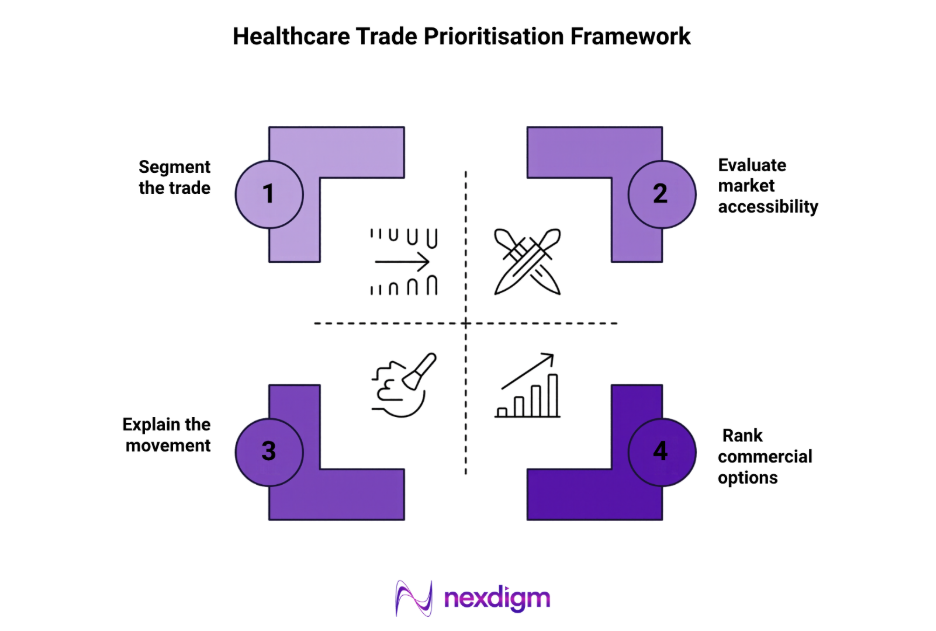
- Segment the trade: Classify medicines, ingredients, devices and equipment separately to avoid misleading comparisons.
- Explain the movement: Assess value, quantity and partner-share changes to identify the drivers behind the trade pattern.
- Evaluate market accessibility: Test regulatory, procurement, distribution and service requirements.
- Rank commercial options: Compare export expansion, alternative sourcing, local partnerships and domestic production against achievable margins and execution risk.
The result is a product-specific view of where to sell, where to source and which apparent opportunities require more validation.
Case Study: Prioritising Healthcare Trade Markets
A healthcare products distributor screened 16 product-market combinations across 9 countries. Import trends and supplier shares narrowed the list to 6; landed-cost, registration and channel analysis reduced it to 3 priority markets. The distributor allocated its next expansion cycle to two markets and deferred the third pending regulatory review.
To take the next step, simply visit our Request a Consultation page and share your requirements with us.
Harsh Mittal
+91-8422857704