

Healthcare expansion now requires a sharper view of demand. Providers and investors need to identify which facility type fits the market best, whether that is a hospital, clinic, diagnostic centre, ASC or specialty facility.
Outpatient care is one clear example. In 2026, CMS removed 285 mostly musculoskeletal procedures from its inpatient-only list, allowing suitable procedures to shift to outpatient departments and ASCs.
This makes facility planning more important before capital is committed.
How Nexdigm Identifies the Right Infrastructure Opportunity
Nexdigm evaluates expansion by connecting patient demand, existing supply, service utilization and investment economics.
A market may have enough general hospital capacity but limited diagnostic access or specialist services. Another may support an ambulatory centre because procedures are increasingly being delivered outside inpatient settings.
The assessment therefore distinguishes between:
- Hospitals: Emergency, inpatient and complex-care requirements
- Clinics: Primary and specialist outpatient demand
- Diagnostics: Imaging, pathology and laboratory services
- Surgical centres: Procedures suitable for ambulatory delivery
- Specialty facilities: Oncology, cardiac, orthopaedic and other focused services
This helps determine whether capital should go toward a new hospital, a smaller outpatient facility, a diagnostic network or a specialty-led model.
Population Size Does Not Tell the Whole Story
A large population can support substantial healthcare demand, but it does not reveal where patients are seeking care.
Nexdigm’s assessment maps:
- Catchment populations
- Patient travel patterns
- Referral flows
- Disease and demographic profiles
- Existing facility utilization
- Payer mix and affordability
These factors reveal locations where patients are travelling outside their immediate area for diagnostics, specialist consultations or procedures. Rather than relying on gross population metrics, the investment decision centres on where a facility can realistically achieve sustainable clinical volume.
Nexdigm’s healthcare infrastructure expansion study helps providers and investors identify the right combination of location, service and facility before committing capital.
The Facility Format Can Change the Investment Case
Identical patient demand can justify distinct operational models.
While acute tertiary needs support full-scale hospitals, high-volume elective procedures thrive in ambulatory centres, and fragmented testing needs favour hub-and-spoke diagnostic networks.
Selecting the right format requires assessing:
- Expected patient volumes
- Capital requirements
- Operating costs
- Service utilization
- Staffing requirements
- Reimbursement
- Time to commercial ramp-up
The objective is to match facility intensity with demand intensity, rather than defaulting to the largest possible asset.
Diagnostics and Specialty Care Can Be Strategic Entry Points
Healthcare expansion does not always need to begin with a greenfield hospital.
Diagnostics and specialty outpatient services can provide more focused ways to enter a market, particularly where patients already travel for specific services.
For example, a provider may identify strong oncology demand but insufficient access to imaging, day-care treatment or specialist consultations. Building the supporting service network may create a stronger commercial case than immediately developing a full-service hospital.
This is why infrastructure planning should assess service combinations, not individual facilities in isolation.
Payment and Regulation Can Change What Is Viable
Facility economics depend heavily on the regulatory and reimbursement environment.
CMS increased 2026 payment rates for hospital outpatient departments and ambulatory surgical centres by 2.6%, while expanding the procedures eligible for outpatient delivery.
Similar policy differences exist across markets and can influence licensing, facility design, reimbursement and the services a provider can deliver.
Before committing capital, investors therefore need to understand whether the proposed facility model is commercially and operationally feasible under local rules.
How Nexdigm Assesses Healthcare Infrastructure Expansion
Before committing capital, healthcare leaders must look beyond basic demographics to ensure long-term commercial and clinical viability.
Nexdigm evaluates expansion across five interconnected dimensions:
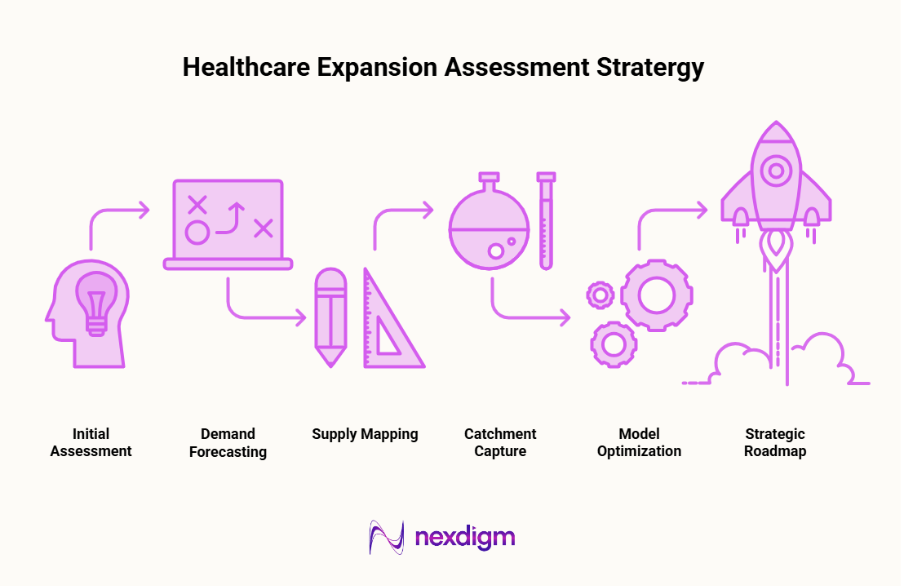
- Demand Forecasting: Sizing market addressability through epidemiological trends, local healthcare utilization, and insurance/payer dynamics.
- Supply Mapping: Assessing competitive density, service gaps, and facility capabilities across the target market.
- Catchment Capture: Identifying high-conversion zones by analyzing patient inflow, travel friction, and specialist referral networks.
- Model Optimization: Evaluating the financial and operational trade-offs between acute hospitals, ASCs, clinics, and hub-and-spoke diagnostic networks.
- Strategic Roadmap: Delivering a prioritized rollout matrix ranked by commercial return, execution speed, and regulatory feasibility.
This structured approach transforms complex market data into an actionable roadmap to ensure every capital commitment delivers sustainable returns.
Nexdigm’s Healthcare Infrastructure Expansion Study
A private healthcare operator assessed expansion across 5 cities and 4 facility formats. Nexdigm evaluated demand, competitive supply, referral patterns, payer mix and investment economics, prioritizing 3 locations for specialty outpatient and diagnostic expansion before larger hospital investments.
Healthcare infrastructure is becoming a portfolio decision rather than a simple capacity decision. Hospitals, clinics, diagnostics and specialty facilities serve different demand patterns and require different investment models.
To take the next step, simply visit our Request a Consultation page and share your requirements with us.
Harsh Mittal
+91-8422857704
[email protected]