

Infrastructure expansion is gaining importance as healthcare capacity demand continues to rise across hospitals, diagnostics, specialty care, and digital-enabled service delivery. Growing patient volumes, aging populations, chronic disease burden, and access gaps are pushing healthcare organizations to expand facilities, upgrade equipment, improve technology systems, and develop scalable care models. A strong market entry strategy helps identify priority locations, assess capacity gaps, evaluate investment feasibility, and align expansion with regulatory and operational requirements.
Healthcare infrastructure expansion strategy must balance demand forecasting, accessibility, cost efficiency, partnership opportunities, and long-term scalability to support sustainable growth in evolving healthcare markets.
The hospital services market is projected to grow from USD 13.19 trillion in 2026 to USD 28.99 trillion by 2035, at 9.15% CAGR. Healthcare construction is also forecast to rise from USD 284.6 billion in 2024 to USD 442.0 billion by 2034, while 4.6 billion people remain not fully covered by essential health services.
Effectiveness of Healthcare Infrastructure for Rising Capacity Demand
Effectiveness of Healthcare Infrastructure Expansion for Rising Capacity Demand depends on matching facility growth with patient demand, location needs, service gaps, investment feasibility, operational readiness, and long-term utilization potential.
- Investment Feasibility: Evaluate capital requirements, operating costs, revenue potential, payback period, and long-term financial sustainability.
- Service Mix Planning: Define the right combination of inpatient, outpatient, diagnostic, specialty, and digital-enabled services.
- Operational Readiness: Assess staffing, equipment, technology systems, workflows, and compliance requirements before facility expansion.
- Utilization Tracking: Monitor occupancy, patient footfall, service demand, wait times, and revenue performance after expansion.
Nexdigm Partnership Strategy for Hospital, Diagnostic, and Specialty Care Expansion
Nexdigm Partnership Strategy for Hospital, Diagnostic, and Specialty Care Expansion helps healthcare organizations identify suitable hospitals, diagnostic chains, specialty clinics, investors, technology providers, and local partners. It supports faster market access, shared infrastructure use, service expansion, operational efficiency, and scalable growth across high-demand healthcare markets.
Nexdigm Go-to-Market Roadmap for Healthcare Infrastructure Expansion
Roadmap for Healthcare Infrastructure Expansion helps define target locations, service mix, partnerships, investment priorities, launch timelines, operating models, and scale-up plans for capacity-driven healthcare growth:
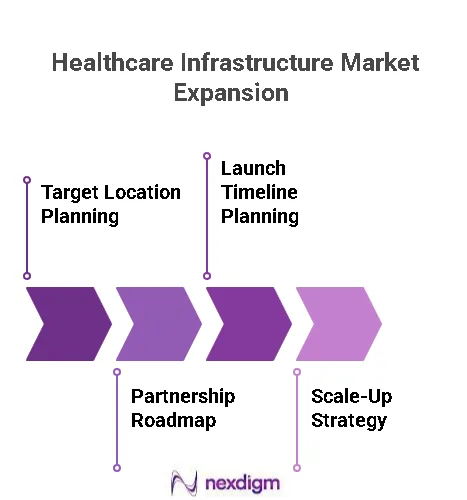
- Target Location Planning: Nexdigm identifies priority geographies based on patient demand, capacity gaps, accessibility, competition, and infrastructure readiness.
- Partnership Roadmap: Nexdigm maps hospitals, investors, diagnostic networks, technology providers, and local partners for expansion support.
- Launch Timeline Planning: Nexdigm defines project phases, entry milestones, partner onboarding, regulatory steps, and operational rollout timelines.
- Scale-Up Strategy: Nexdigm tracks utilization, patient volumes, revenue performance, and expansion readiness for long-term healthcare infrastructure growth.
Nexdigm’s case:
Nexdigm helped a healthcare group plan infrastructure expansion by assessing 10 priority locations, benchmarking 16 hospital and diagnostic providers, and mapping capacity gaps across inpatient beds, diagnostics, and specialty care.
Nexdigm supported the company with site prioritization, service mix planning, and a go-to-market roadmap, helping target 3 new facilities, 150 additional beds, 8 diagnostic partnerships, and a projected 20% increase in patient capacity within two years.
To take the next step, simply visit our Request a Consultation page and share your requirements with us.
Harsh Mittal
+91-8422857704