

Healthcare expansion increasingly depends on access to the wider ecosystem surrounding a product or service. Providers control clinical adoption, payers influence reimbursement, technology companies enable infrastructure and workflow integration, and local stakeholders can determine regulatory and distribution access. Selecting the right partners therefore becomes a market-entry decision rather than a purely commercial exercise.
Healthcare consolidation is reinforcing this shift. A 2025 U.S. Government Accountability Office review found that at least 47% of physicians were employed by or affiliated with hospital systems in 2024, compared with less than 30% in 2012. As provider organizations become larger and more integrated, access to the right institutional relationships can increasingly influence how products and services reach the market.
Technology is creating another layer of ecosystem integration. In 2025, healthcare organizations and technology companies increasingly pursued partnerships around interoperability, clinical workflow, value-based care, and digital infrastructure. The American Hospital Association highlighted collaborations involving providers, payers, and technology companies as part of this broader shift.
Providers Offer Clinical Access and Market Reach
Healthcare providers are often the most important partners for products requiring clinical adoption, patient access, or workflow integration.
Hospitals, physician groups, specialty clinics, diagnostic networks, and ambulatory centers can provide:
- Patient access and referral networks
- Clinical validation
- Distribution and administration capabilities
- Workflow integration
- Local market credibility
However, provider scale alone does not determine partnership value. A large health system may have substantial patient volume but complex procurement structures, long decision cycles, and multiple technology requirements. Smaller specialist networks may offer faster access to a defined patient population.
Payers Can Determine Commercial Viability
For reimbursed healthcare products and services, payer relationships can be as important as provider relationships.
Health insurers, government programs, and other payers influence coverage, reimbursement, utilization management, and patient affordability. A product with strong clinical demand may still struggle commercially if reimbursement is limited or coverage criteria are restrictive.
Partnership opportunities can therefore include:
- Coverage and reimbursement initiatives
- Value-based care arrangements
- Outcomes-based contracts
- Data-sharing programs
- Utilization and population-health partnerships
The appropriate payer partner depends on the product, target population, reimbursement pathway, and market structure.
Technology Partners Extend What Healthcare Companies Can Deliver
Technology partnerships can provide capabilities that would otherwise require significant internal investment.
Cloud platforms, electronic health record vendors, data companies, cybersecurity providers, imaging platforms, and workflow software companies can help integrate products into existing healthcare infrastructure.
GE HealthCare’s USD 2.3 billion acquisition of Intelerad, completed in March 2026, illustrates the strategic value placed on combining medical-device capabilities with cloud-based imaging software, AI, and workflow orchestration. GE HealthCare said Intelerad generated approximately USD 270 million of revenue in its first full year of ownership, with about 90% expected to be recurring.
Partnerships do not always require acquisitions. Microsoft, for example, has built healthcare technology offerings through an ecosystem of software vendors, system integrators, cloud providers, healthcare organizations, and other partners.
Local Stakeholders Can Determine Market Access
International expansion introduces another category of partner: organizations with local market knowledge and operating infrastructure.
These can include:
- Local distributors
- Contract manufacturers
- Regulatory specialists
- Academic institutions
- Diagnostic laboratories
- Government and public-sector organizations
- Industry associations
Their value often lies in reducing the practical barriers between market entry and commercial execution. A company may have regulatory approval and a strong product, but still lack the relationships, distribution infrastructure, clinical credibility, or operational knowledge required to scale.
The Right Partner Depends on the Commercial Objective
Partner selection should therefore begin with the capability the company needs to acquire.
A provider may be the right partner for clinical access but the wrong choice for national distribution. A technology company may solve an integration problem without contributing to reimbursement access. A distributor may provide geographic reach but limited clinical credibility.
The partnership decision needs to consider capability, access, economics, strategic fit, and execution risk together.
Nexdigm’s Partnership Ecosystem Framework
A Healthcare partnership ecosystem assessment should identify which external capabilities are necessary to enter, scale, or defend a healthcare market. Nexdigm evaluates potential partners through six clear filters:
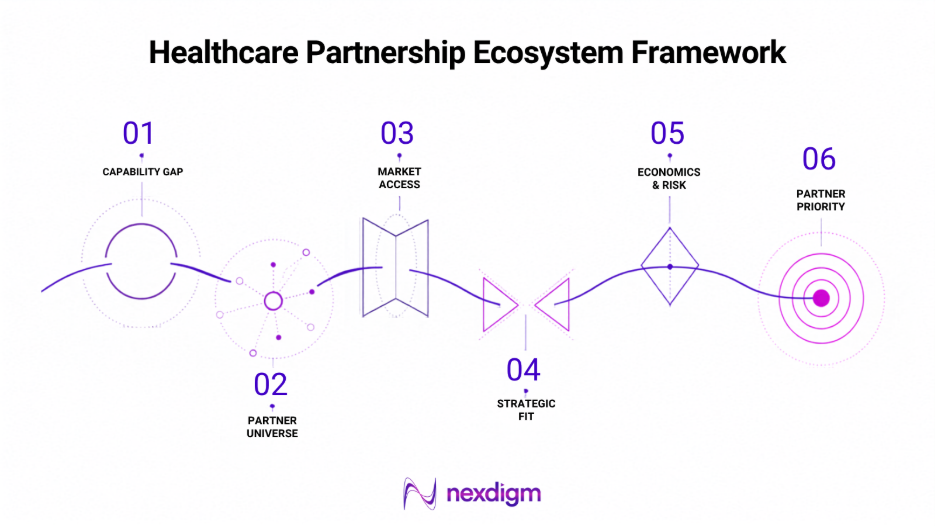
- Capability Gap
What capability does the company need? - Partner Universe
Which providers, payers, technology firms, distributors, and local stakeholders can provide it? - Market Access
Which partners offer the strongest access to patients, providers, payers, or channels? - Strategic Fit
How closely do the partner’s objectives, capabilities, and customer base align? - Economics & Risk
What are the expected commercial benefits, investment requirements, dependencies, and partnership risks? - Partner Priority
Which partners should be pursued, developed, monitored, or excluded
How Nexdigm Identifies the Partners That Can Accelerate Growth
A healthcare technology company evaluated 85 potential partners across four markets. Nexdigm’s assessment narrowed the universe to 24 priority organizations, including 10 providers, 6 payers, and 8 technology or distribution partners. The prioritized partners collectively represented access to more than 15 million potential patients, creating a focused partnership pipeline for market expansion.
To take the next step, simply visit our Request a Consultation page and share your requirements with us.
Harsh Mittal
+91-8422857704
[email protected]