

Healthcare policy can reshape market economics without changing underlying clinical demand. Payment reforms influence care settings and provider margins, while evidence requirements and interoperability mandates affect reimbursement, market access, and technology adoption.
Recent U.S. policy illustrates this impact. Under the CY 2026 CMS Hospital Outpatient Prospective Payment System final rule, certain off-campus hospital outpatient departments will receive physician fee schedule-equivalent rates for drug administration services. CMS estimates this will reduce 2026 OPPS spending by USD 290 million, including USD 220 million in Medicare savings and USD 70 million in beneficiary savings.
These changes can influence site-of-care decisions and provider investment. At the same time, the global ambulatory infusion centres market is projected to grow from USD 43.7 billion in 2026 to USD 76.2 billion by 2033, highlighting the commercial importance of outpatient care models.
Policy Changes Can Redefine Where Healthcare Economics Work
The first impact of policy is often felt through the economics of care delivery.
A payment change can alter the relative attractiveness of hospitals, physician practices, ambulatory centers, and other delivery settings. For investors and healthcare operators, this makes site-of-care analysis increasingly important.
Key questions include:
- Which services experience a meaningful change in reimbursement?
- Which provider types gain or lose economic advantage?
- Could care migrate toward lower-cost settings?
- How might providers respond through partnerships, acquisitions, or capacity changes?
CMS is also phasing out the Inpatient Only list over three years, beginning with 285 predominantly musculoskeletal procedures in 2026. This creates another potential shift in the distribution of procedures between inpatient and outpatient settings.
Evidence Requirements Are Becoming a Market-Access Variable
Policy can also determine the evidence required for commercial success. The EU Health Technology Assessment Regulation, effective since January 2025, introduces Joint Clinical Assessments for new cancer medicines and advanced therapy medicinal products, creating a common EU-level clinical evidence framework while national authorities retain pricing and reimbursement decisions.
For pharmaceutical and medtech companies, this raises the importance of comparative evidence, clinical outcomes, relevant patient subgroups, and data quality in market-access planning.
The commercial implications can include:
- Higher evidence-generation requirements for new therapies
- Greater importance of comparative clinical outcomes
- Changes in launch sequencing across European markets
- Greater differentiation between products with strong and limited clinical evidence
Administrative Policy Can Create New Technology Demand
Regulatory change can also create demand for healthcare technology.
The CMS Interoperability and Prior Authorization Final Rule requires impacted payers to implement interoperability APIs and introduces operational requirements around prior authorization. Certain provisions began taking effect from January 2026, while API development requirements generally have later compliance dates.
This creates opportunities for technology providers supporting electronic prior authorization, workflow automation, data exchange, compliance, and revenue-cycle processes. The market opportunity depends on more than the existence of the mandate. Vendors must determine which payer and provider segments face the greatest implementation burden, where legacy infrastructure creates friction, and how quickly organizations are likely to allocate budgets.
Global Policy Is Expanding the Healthcare Opportunity Map
Policy developments can also create longer-term opportunities in markets where infrastructure and access remain uneven.
At the Seventy-ninth World Health Assembly in 2026, Member States endorsed a resolution on precision medicine and adopted resolutions addressing equitable access to diagnostic imaging through teleradiology and oversight of transplantation of human cells, tissues, and organs.
These developments point toward growing policy attention on genomic medicine, diagnostic capacity, digital delivery models, and regulated advanced therapies. For companies evaluating international expansion, the relevant question is how national systems translate these priorities into funding, infrastructure, reimbursement, and implementation.
How Nexdigm Translates Policy Change Into Commercial Opportunity
A Healthcare policy impact assessment should connect the policy itself with the commercial mechanisms it changes. Nexdigm evaluates the transmission from regulation to market economics through several dimensions:
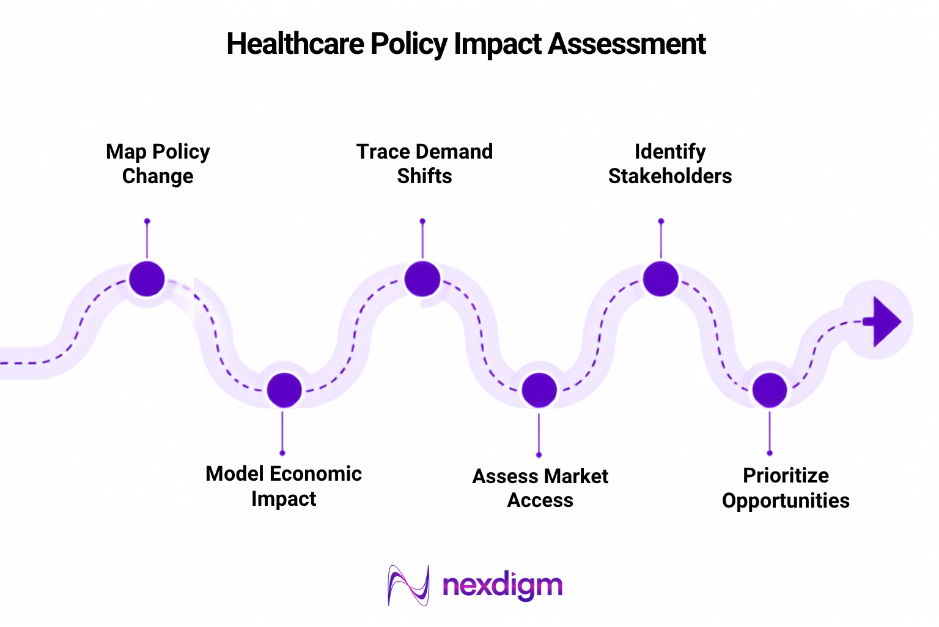
- Map the policy change: Identify the affected services, products, providers, payers, geographies, and implementation timelines.
- Model the economic impact: Assess changes in reimbursement, pricing, provider margins, utilization, operating costs, and investment requirements.
- Trace demand and site-of-care shifts: Determine whether policy is likely to increase, suppress, or redirect demand across hospitals, ambulatory centers, physician practices, pharmacies, and other channels.
- Assess market-access implications: For pharmaceuticals, medtech, and advanced therapies, evaluate evidence requirements, reimbursement pathways, regulatory barriers, and potential launch constraints.
- Identify affected stakeholders: Segment providers, payers, technology vendors, manufacturers, investors, and other participants according to exposure and likely strategic response.
- Prioritize commercial opportunities: Translate the findings into market-entry priorities, investment opportunities, partnership targets, product positioning, and risk scenarios.
This approach allows policy developments to be evaluated as commercial variables rather than isolated regulatory events.
How Nexdigm Converts Policy Shifts Into Market Priorities
A healthcare technology provider assessed 3 markets and 180 healthcare organizations following reimbursement and interoperability changes. Nexdigm’s analysis identified 72 organizations with high policy exposure, of which 31 had near-term technology requirements. Prioritizing these accounts reduced the initial target universe by 83%, giving the client a focused pipeline for market entry and business development.
To take the next step, simply visit our Request a Consultation page and share your requirements with us.
Harsh Mittal
+91-8422857704
[email protected]