

Healthcare Policies Influence Expansion Decisions Across Public and Private Care Systems highlights the role of reimbursement rules, pricing controls, insurance coverage, procurement models, licensing requirements, and care delivery priorities in shaping healthcare growth. Companies entering new markets must understand how public health systems, private providers, payers, and regulatory bodies affect demand, access, affordability, and operational feasibility.
Healthcare policy impact on market entry helps businesses assess risks, prioritize attractive markets, and align offerings with system-level requirements. As part of a broader market entry strategy, policy analysis supports informed expansion decisions across diverse healthcare environments.
Healthcare policies strongly shape expansion decisions across public and private care systems. OECD countries allocated around 9.3% of GDP to health in 2024, while the U.S. spent 17.2%, showing wide policy-driven spending differences. The global healthcare payer services market was estimated at USD 71.7 billion in 2024 and is expected to reach USD 108.0 billion by 2030.
Evaluating Policies for Healthcare Market Entry
Evaluating policies for healthcare market entry helps companies understand reimbursement rules, pricing controls, insurance coverage, procurement systems, and regulatory expectations, enabling informed expansion decisions and reduced market entry risks:
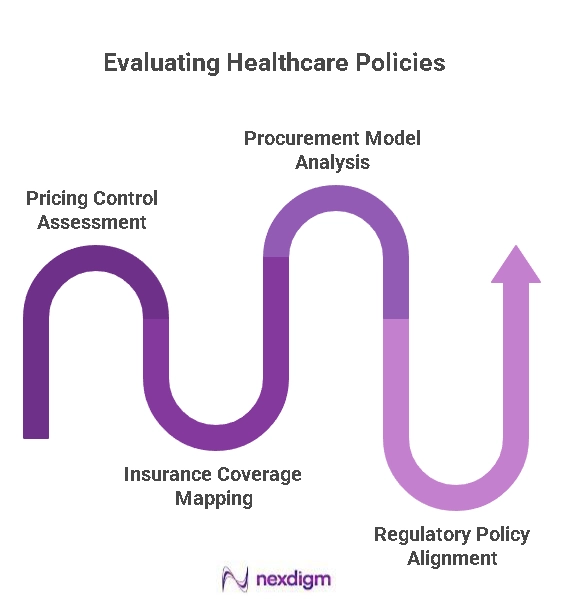
- Pricing Control Assessment: Evaluate price caps, negotiation rules, and affordability policies that may affect margins and launch strategy.
- Insurance Coverage Mapping: Analyze public and private insurance systems to identify patient access, payer influence, and adoption potential.
- Procurement Model Analysis: Review tendering, hospital purchasing, and public procurement systems to plan channel access effectively.
- Regulatory Policy Alignment: Understand licensing, quality, safety, and operating rules that influence healthcare expansion feasibility.
Nexdigm’s Healthcare Policy Intelligence Support for Market Prioritization
Nexdigm’s healthcare policy intelligence support helps companies prioritize markets by assessing reimbursement rules, pricing controls, insurance coverage, procurement models, public health priorities, and regulatory expectations. This enables businesses to compare market attractiveness, identify policy-driven risks, align offerings with care system needs, and build a stronger healthcare market entry strategy.
Nexdigm’s Support in Identifying Expansion Risks Across Public and Private Care Models
Nexdigm helps identify expansion risks across public and private care models by assessing reimbursement barriers, pricing controls, procurement complexity, payer dynamics, regulatory obligations, and operational feasibility before market entry.
- Public Funding Dependency: Nexdigm assesses reliance on government budgets, delayed payments, and funding cycles that may affect expansion stability.
- Private Sector Demand Risk: Nexdigm evaluates patient affordability, private provider adoption, and willingness to pay across target markets.
- Policy Change Exposure: Nexdigm identifies potential risks from changing healthcare reforms, budget revisions, coverage rules, and political priorities.
- Care Delivery Model Fit: Nexdigm assesses whether the company’s offering aligns with hospital-led, clinic-led, insurance-led, or digital care models.
- Stakeholder Influence Mapping: Nexdigm maps decision-makers, payers, providers, regulators, and procurement bodies influencing market entry success.
Nexdigm’s case:
Nexdigm supported a healthcare company identify expansion risks across public and private care models in four target markets. By assessing 25+ policy variables, including reimbursement coverage, pricing controls, procurement models, public funding dependency, and private sector demand, Nexdigm identified 10 high-priority risks.
This helped the company improve market prioritization accuracy by 35%, reduce policy-related entry risks by 30%, and build a stronger healthcare market entry strategy.
To take the next step, simply visit our Request a Consultation page and share your requirements with us.
Harsh Mittal
+91-8422857704