

Healthcare regulation is often treated as a compliance requirement that follows the commercial strategy. In practice, it can determine whether a market is commercially accessible in the first place. Approval requirements, reimbursement rules, data standards, reporting obligations, and product-specific restrictions can alter launch timelines, operating costs, competitive intensity, and ultimately the size of the addressable market.
The regulatory environment is also becoming more dynamic. In the United States, for example, CMS’s prior authorization reforms took effect primarily from January 2026, requiring impacted payers to provide decisions within 72 hours for expedited requests and seven calendar days for standard requests involving medical items and services. Electronic prior-authorization APIs are scheduled to go live from January 2027.
For healthcare companies entering new markets, these changes can create both constraints and opportunities. Regulation can add compliance costs, but it can also standardize processes, reduce administrative friction, or create clearer pathways for innovative products.
Market Access Depends on More Than Product Approval
Obtaining regulatory clearance does not necessarily mean a product can immediately reach its commercial market. Companies must also understand reimbursement, procurement, distribution, data requirements, clinical evidence expectations, and the operating responsibilities that follow approval.
For medical-device companies, the U.S. market provides multiple regulatory pathways, including 510(k), De Novo, and Premarket Approval, depending on the device and its risk profile. The pathway selected affects the evidence required and the resources needed before commercialization.
Europe is similarly adding layers of structured compliance. From May 28, 2026, four EUDAMED modules became mandatory: actor registration, UDI/device registration, notified bodies and certificates, and market surveillance. This increases traceability and regulatory visibility for companies placing medical devices on the European market.
The commercial implication is straightforward: market attractiveness needs to be assessed alongside the regulatory pathway, rather than after it.
A Healthcare Regulatory Environment Analysis Can Change Market Priorities
Regulation affects markets through several transmission mechanisms. A company may face a relatively straightforward product approval process but encounter difficult reimbursement conditions. Another market may impose more demanding evidence requirements while offering stronger public procurement or faster adoption once approval is achieved.
The assessment therefore needs to examine:
- Approval pathway: Determine classification, evidence requirements, review procedures, and expected timelines.
- Reimbursement and pricing: Assess payer coverage, reimbursement mechanisms, price controls, and utilization restrictions.
- Compliance burden: Estimate registration, certification, reporting, quality-management, and post-market obligations.
- Data and technology requirements: Evaluate interoperability, cybersecurity, data localization, privacy, and electronic health-information requirements.
- Market-entry economics: Quantify regulatory costs and delays alongside expected patient or provider demand.
- Competitive implications: Determine whether regulation creates barriers that protect incumbents or standards that enable new entrants.
- Policy trajectory: Assess proposed and upcoming reforms that could materially change the market after entry.
This distinction matters because regulatory barriers are not always negative. High compliance requirements can restrict competition while simultaneously creating a more defensible position for companies that can meet them.
Regulation Can Also Accelerate Adoption
Policy changes can actively create demand for healthcare technology and services. CMS’s prior authorization reforms are one example. By requiring affected payers to digitize parts of the authorization process and provide specific reasons for denials, the policy creates an environment in which interoperability and workflow-automation solutions can become more relevant. CMS estimates that its interoperability and prior-authorization policies could save approximately $15 billion over 10 years.
Regulatory alignment can also shorten the distance between approval and reimbursement. In April 2026, FDA and CMS announced the RAPID Coverage Pathway, designed to accelerate Medicare coverage for eligible FDA-designated Breakthrough Devices by bringing regulatory and coverage considerations together earlier.
For technology and medical-device companies, these developments demonstrate why policy monitoring should form part of market strategy. A regulatory change can alter the addressable market without changing the underlying disease burden or provider base.
The Entry Decision Should Reflect the Full Regulatory Burden
A market with strong healthcare demand may still be unattractive if approval takes several years, reimbursement is uncertain, or compliance requires disproportionate investment. Conversely, a smaller market can become strategically attractive when regulatory pathways are predictable and market-access conditions are favorable.
Nexdigm therefore evaluates regulatory environments alongside commercial fundamentals. The objective is to determine how regulation affects time to market, cost to serve, addressable demand, competitive barriers, and expected returns.
Nexdigm’s Regulatory Market-Entry Framework
Nexdigm assesses market-entry opportunities through a structured sequence:
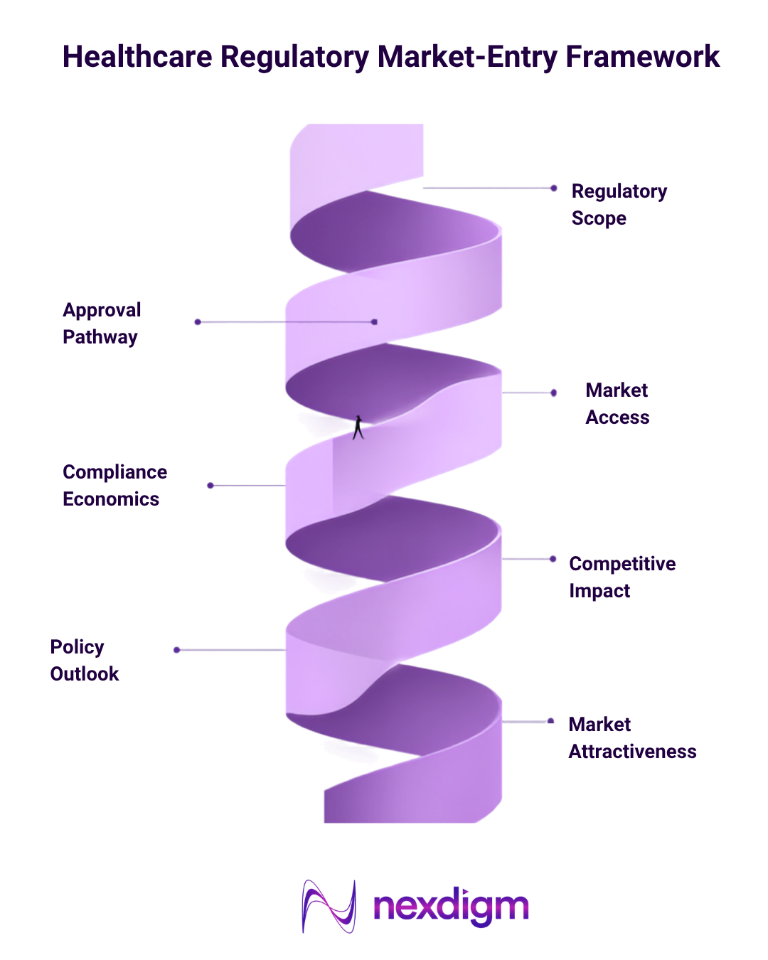
- Regulatory Scope: Identify the laws, agencies, classifications, and standards applicable to the product or service.
- Approval Pathway: Map required evidence, certification, clinical validation, registration, and review timelines.
- Market Access: Evaluate reimbursement, procurement, payer requirements, distribution controls, and provider adoption conditions.
- Compliance Economics: Estimate registration costs, quality systems, reporting obligations, local representation, and ongoing compliance expenditure.
- Competitive Impact: Determine whether regulation raises barriers for all participants or creates advantages for established competitors.
- Policy Outlook: Track upcoming legislation, regulatory reforms, and implementation timelines that could alter market conditions.
- Market Attractiveness: Combine regulatory complexity with demand, competition, investment requirements, and commercial potential to rank entry opportunities.
How Nexdigm Identifies Markets Ready for Entry
A healthcare company evaluating international expansion can apply this framework across target markets to distinguish regulatory complexity from genuine commercial barriers. Nexdigm can then prioritize markets where approval pathways, reimbursement conditions, compliance requirements, and demand fundamentals are sufficiently aligned to support entry.
The central issue is not whether regulation exists. Every healthcare market is regulated. The strategic question is how that regulatory architecture changes the economics and timing of reaching patients, providers, and payers.
For companies entering new healthcare markets, understanding that relationship before committing capital can prevent expensive delays and identify markets where regulatory change is creating new commercial opportunities.
To take the next step, simply visit our Request a Consultation page and share your requirements with us.
Harsh Mittal
+91-8422857704
[email protected]