

Regulatory Strategies Reduce Delays Across Highly Controlled Healthcare Markets by helping companies manage complex approval pathways, documentation requirements, compliance standards, and country-specific healthcare regulations. In regulated sectors such as pharmaceuticals, medical devices, diagnostics, and healthcare services, delays often arise from unclear registration processes, evolving guidelines, quality requirements, and incomplete submissions.
A strong Healthcare regulatory market entry strategy enables businesses to anticipate regulatory barriers, align product approvals with launch timelines, and reduce market access risks. As part of a broader market entry strategy, regulatory planning supports smoother approvals, faster commercialization, and stronger compliance discipline across highly controlled healthcare markets.
Regulatory delays can significantly affect healthcare market entry. In Europe, the average time from regulatory approval to patient access reached 578 days, while only 46% of centrally approved innovative medicines were available to patients. In the U.S., drug review time has improved to around 9.9 months in recent years. These figures highlight why a strong Healthcare regulatory market entry strategy is critical for reducing delays, improving launch readiness, and accelerating commercialization.
Using Regulatory Intelligence to Improve Healthcare Market Entry Decisions
Regulatory intelligence improves market entry decisions by tracking approval pathways, compliance requirements, timelines, policy changes, and documentation needs, helping healthcare companies reduce delays, assess risks, and plan launches effectively:
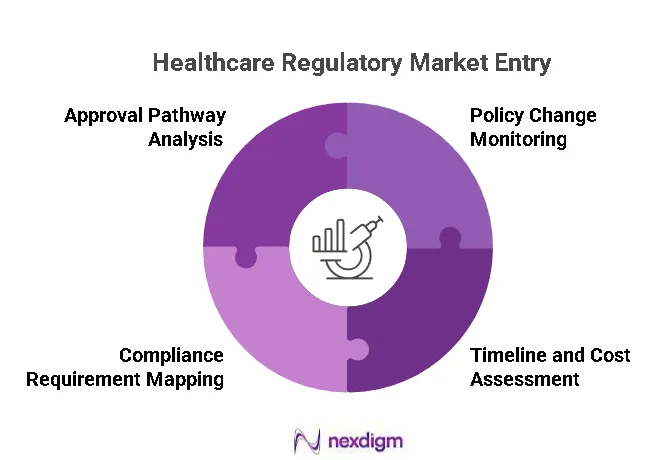
- Approval Pathway Analysis: Regulatory intelligence helps identify product registration routes, approval steps, and authority requirements before entering healthcare markets.
- Compliance Requirement Mapping: It tracks licensing, quality, labeling, safety, and documentation standards to reduce compliance gaps.
- Policy Change Monitoring: Continuous monitoring of regulatory updates helps companies adjust market entry plans before changes create delays.
- Timeline and Cost Assessment: Regulatory intelligence estimates approval timelines, submission costs, and resource needs for better launch planning.
Nexdigm’s Support in Identifying Regulatory Risks Before Market Entry
Nexdigm supports companies in identifying regulatory risks before market entry by assessing approval pathways, licensing requirements, compliance gaps, documentation needs, and country-specific healthcare regulations. This helps businesses anticipate delays, reduce non-compliance risks, align launch timelines, and build a stronger Healthcare regulatory market entry strategy for controlled healthcare markets.
Nexdigm’s Expertise in Reducing Approval Delays Through Early Regulatory Planning
Nexdigm helps reduce approval delays through early regulatory planning by mapping approval pathways, identifying compliance gaps, preparing documentation requirements, and aligning regulatory timelines with healthcare market entry and launch objectives.
- Approval Pathway Mapping: Nexdigm identifies relevant approval routes, regulatory authorities, submission steps, and timelines before healthcare market entry begins.
- Compliance Gap Assessment: Nexdigm reviews product, quality, labeling, licensing, and documentation gaps that may delay approvals.
- Documentation Readiness: Nexdigm helps define dossier, certification, testing, and registration document requirements for smoother regulatory submissions.
- Timeline Alignment: Nexdigm aligns regulatory approval timelines with product launch, distribution, pricing, and market access plans.
Nexdigm’s case:
Nexdigm helped a healthcare company reduce approval delays through early regulatory planning across two target markets. By mapping 15+ approval requirements, identifying 10 compliance gaps, and preparing a structured documentation checklist, Nexdigm enabled the company to improve submission readiness by 35%. The engagement also helped reduce expected approval timeline risks by 25% and aligned regulatory planning with the company’s broader healthcare market entry strategy.
To take the next step, simply visit our Request a Consultation page and share your requirements with us.
Harsh Mittal
+91-8422857704