

Healthcare robotics benchmarking refers to the structured evaluation and comparison of robotic systems deployed across advanced healthcare facilities to measure their effectiveness, efficiency, and impact on clinical and operational outcomes. It involves analyzing how different hospitals integrate technologies such as surgical robots, automated pharmacy systems, and service robots for tasks like disinfection, logistics, and patient support.
In the context of competitive intelligence, healthcare robotics benchmarking serves as a strategic mechanism for organizations to assess their technological maturity relative to competitors, identify innovation leaders, and uncover gaps in adoption and performance.
Studies show that healthcare robotics benchmarking is becoming increasingly important as adoption accelerates worldwide. The global medical robotics market is projected to exceed USD 60–70 billion by 2030, driven by rising surgical robot utilization, which already accounts for over 1.2 million procedures annually using systems like da Vinci. Hospitals using robotic-assisted surgery report up to 20–30% reduction in post-operative complications and 15–25% shorter recovery times, highlighting measurable performance gains that competitive intelligence teams.
By systematically comparing metrics such as accuracy, turnaround time, cost efficiency, and patient safety outcomes, healthcare providers and med-tech companies can make data-driven decisions to enhance their competitive positioning and guide future investments in automation and digital transformation.
Role of Competitive Intelligence in Healthcare Robotics Benchmarking
Competitive intelligence in healthcare robotics benchmarking analyzes competitor technologies, performance, and adoption trends to identify gaps, guide strategic decisions, and improve efficiency, innovation, and patient outcomes in hospital robotics integration:
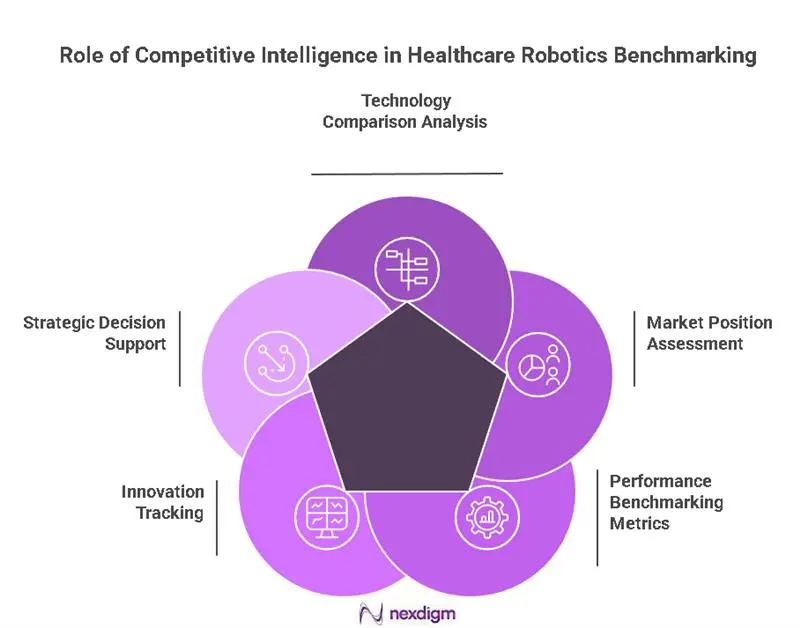
Technology Comparison Analysis
Evaluates robotic systems across hospitals to identify superior technologies, performance efficiency, and clinical effectiveness for strategic adoption decisions.
Market Position Assessment
Analyzes competitors’ robotics adoption levels, helping healthcare organizations understand their standing and identify leadership gaps in automation.
Performance Benchmarking Metrics
Uses indicators like accuracy, speed, safety, and cost efficiency to compare robotic healthcare solutions across institutions.
Innovation Tracking
Monitors emerging robotics technologies and trends, enabling organizations to stay competitive and adopt advanced healthcare automation solutions early.
Strategic Decision Support
Supports investment and procurement decisions by providing data-driven insights on robotics effectiveness and competitive advantages in healthcare systems.
Performance Analytics of Robotic Healthcare Solutions by Nexdigm
Performance analytics of robotic healthcare solutions by Nexdigm focuses on evaluating how effectively robotic systems operate across healthcare facilities. It involves assessing key metrics such as surgical precision, procedure time, error reduction, patient recovery rates, and operational efficiency. By combining data-driven insights with competitive intelligence, Nexdigm helps hospitals and healthcare providers identify performance gaps, optimize robotic utilization, and improve clinical outcomes while ensuring better cost efficiency and strategic technology adoption.
How does Nexdigm evaluate performance of robotic healthcare systems across hospitals?
Nexdigm evaluates robotic healthcare systems by analyzing clinical efficiency, surgical accuracy, cost performance, patient outcomes, and workflow integration across hospitals using data-driven benchmarking and competitive intelligence frameworks for strategic insights.
-
Clinical Efficiency Assessment
Measures surgical precision, procedure time, and error rates to evaluate how effectively robotic systems enhance clinical healthcare performance outcomes.
-
Operational Workflow Integration
Analyzes how seamlessly robotic systems integrate into hospital workflows, improving coordination, resource utilization, and overall operational efficiency.
-
Cost and ROI Evaluation
Examines investment costs, maintenance expenses, and financial returns to determine economic viability of robotic healthcare systems.
-
Patient Outcome Analysis
Evaluates recovery time, complication rates, and patient satisfaction to measure real-world impact of robotic-assisted healthcare treatments.
Nexdigm’s case:
Nexdigm supported a multispecialty hospital in benchmarking robotic healthcare systems across 12 peer institutions. The analysis improved operational efficiency and clinical workflows, leading to a 14% rise in patient satisfaction, 17% reduction in wait times, and 15–25% faster procedure turnaround, strengthening the hospital’s competitive position in advanced healthcare robotics integration.
To take the next step, simply visit our Request a Consultation page and share your requirements with us.
Harsh Mittal
+91-8422857704