

Healthcare robotics is moving beyond the operating room. Surgical systems remain the most visible application, but hospitals are increasingly evaluating robotics across pharmacy, laboratories, logistics, disinfection, and rehabilitation. The result is a market in which demand cannot be assessed through a single adoption rate or technology category. Each application has a different workload, buyer, infrastructure requirement, and return-on-investment equation.
The global healthcare robotics market is projected to grow from approximately USD 10.6 billion in 2026 to USD 16.7 billion by 2033, representing a 10.2% CAGR. Yet the more important commercial question is where this spending will occur. For robotics manufacturers and investors, growth will depend on identifying hospital processes where automation addresses a measurable capacity, labor, or clinical constraint.
Surgical Robotics Has Established the Investment Case
Surgical robotics remains the most commercially mature segment, particularly in minimally invasive procedures and orthopaedics. Hospitals can justify investment where procedure volumes are sufficiently high and robotic capability contributes to clinical differentiation, surgeon recruitment, or patient acquisition.
However, high capital expenditure and recurring instrument and maintenance costs make utilization critical. A system that does not generate sufficient procedural throughput can quickly become an underutilized capital asset.
This creates several variables for assessing demand:
- Procedure volumes and expected growth by specialty
- Existing robotic-system penetration
- Surgeon adoption and training capacity
- Competitive positioning of hospitals
- Capital availability and utilization thresholds
- Disposable instrument and maintenance economics
The opportunity is therefore concentrated in hospitals where procedure demand can support sustained system utilization rather than simply where robotic surgery is clinically relevant.
The Next Wave May Come From Less Visible Workflows
Outside the operating room, robotics is increasingly being considered for repetitive processes where labor availability and throughput directly affect hospital economics.
Pharmacy automation can address dispensing and compounding workflows, while laboratory automation can increase sample-processing capacity in high-volume facilities. Autonomous mobile robots can transport meals, linens, medications, and specimens, reducing the amount of time clinical staff spend on non-clinical movement.
These applications have a different investment rationale from surgical robotics. Their value depends less on patient acquisition and more on measurable operational improvements such as:
- Reducing manual handling and staff workload
- Increasing laboratory or pharmacy throughput
- Reducing dispensing or process errors
- Improving turnaround times
- Supporting operations amid persistent workforce constraints
This potentially creates a broader addressable customer base but also introduces a different barrier: hospital infrastructure.
Infrastructure Can Determine Whether a Robot Gets Purchased
A hospital may have a clear operational need for autonomous logistics but still be unable to deploy the technology efficiently. Elevators, automatic doors, charging areas, connectivity, and legacy information systems all influence deployment feasibility.
The same principle applies to pharmacy and laboratory automation. Retrofitting cleanrooms, redesigning workflows, or integrating equipment with existing electronic health-record and laboratory systems can materially increase implementation costs.
Consequently, technology suppliers need to assess more than the number of hospitals in a market. They need to understand whether those hospitals possess the physical and operational conditions required for deployment.
Rehabilitation Shows Why Demand Does Not Always Equal Commercial Opportunity
Rehabilitation robotics and exoskeletons illustrate another side of the market. Clinical applications may be promising, but adoption can remain constrained by reimbursement, therapist requirements, patient throughput, and the economics of deployment.
This creates a useful distinction across the robotics landscape: some applications are constrained primarily by technology and clinical acceptance, while others are constrained by hospital economics or infrastructure.
For manufacturers, identifying that constraint before entering a market can be more valuable than simply knowing that healthcare robotics demand is increasing.
How Nexdigm Identifies the Robotics Markets Worth Pursuing
A robust Healthcare robotics market demand analysis should therefore assess demand at the application and customer level rather than treating hospitals as a homogeneous buyer group.
Nexdigm can evaluate:
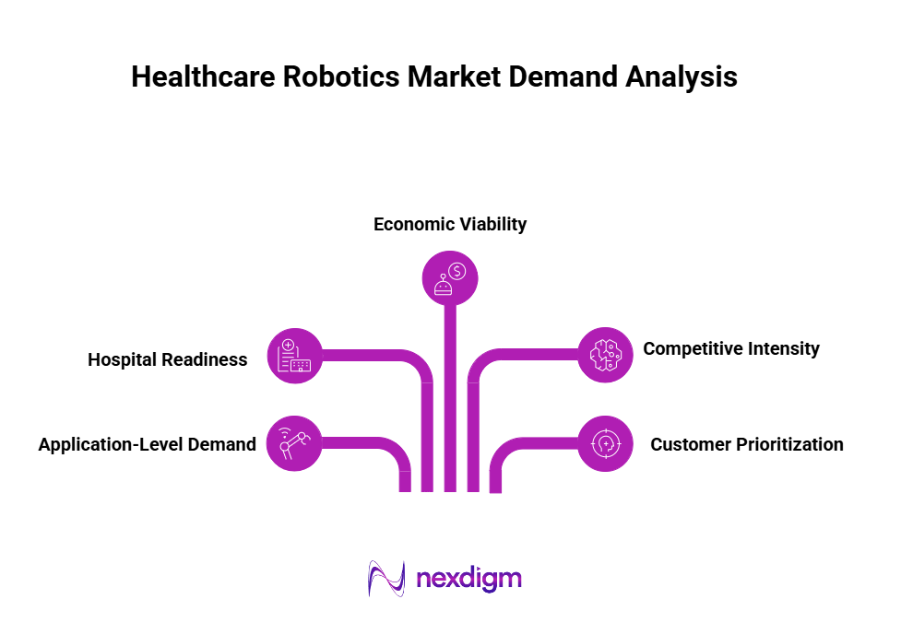
- Application-Level Demand: Identify procedures, workflows, and operational workloads that can support robotics adoption.
- Hospital Readiness: Benchmark infrastructure, staffing, technology integration, and existing automation capabilities.
- Economic Viability: Compare acquisition, implementation, maintenance, and consumable costs against measurable operational or clinical benefits.
- Competitive Intensity: Map installed systems, competing vendors, and adoption across relevant hospital catchments.
- Customer Prioritization: Identify hospitals and healthcare networks where workload, investment capacity, and operational pain create the strongest commercial fit.
This allows robotics companies to distinguish between markets where hospitals are interested in automation and markets where hospitals are positioned to buy it.
How Nexdigm Helped Prioritize Hospital Robotics Opportunities
A robotics manufacturer evaluated 120 hospitals across three regional markets. Although all three showed comparable automation interest, workflow volume and infrastructure analysis identified a 3.1× difference in addressable deployment potential, directing the client toward high-throughput hospital networks rather than broad geographic expansion.
To take the next step, simply visit our Request a Consultation page and share your requirements with us.
Harsh Mittal
+91-8422857704
[email protected]