

Healthcare utilization in India is changing as patients gain access to broader provider networks, digital consultations, diagnostics, insurance coverage, and more convenient care models. In 2025, the proportion of people reporting an ailment increased to 12.2% in rural areas and 14.9% in urban areas, indicating stronger health-seeking behaviour.
Digital care has also become a significant part of the healthcare journey. By August 2026, India’s eSanjeevani platform had facilitated more than 49 crore teleconsultations, demonstrating how remote care is increasingly complementing physical healthcare delivery.
Thus, understanding Healthcare service utilization trends can help providers, investors, and healthtech businesses determine how patients are accessing care and how demand may shift across inpatient, outpatient, and digital channels.
Nexdigm helps healthcare organizations analyze patient behavior, service usage, and operational data to identify how care patterns are changing and where new opportunities exist.
Changing Patterns in Inpatient and Hospital Care
Hospitals remain important for emergency treatment, surgeries, intensive care, and complex medical procedures. However, patient needs are shifting, and many healthcare systems are focusing on reducing unnecessary hospital visits through better preventive care and early intervention.
Organizations need to understand inpatient utilization patterns to allow healthcare providers to understand how patient demand is distributed across inpatient, outpatient, and digital care settings.
Growth of Outpatient Services
Outpatient care has become a major part of modern healthcare delivery. Patients are increasingly choosing clinics, ambulatory centers, and same-day treatment options because they offer easier access and shorter waiting times.
This shift is visible across healthcare markets. Similar trends are emerging in India as patients increasingly opt for convenient and cost-effective outpatient care models. Understanding these shifts helps providers and investors identify growth opportunities, analyze patterns, and optimize service delivery.
How Nexdigm Helps Track Healthcare Usage Patterns
As care delivery becomes more advanced across hospitals, clinics, diagnostics centres, and digital platforms, healthcare organizations need a comprehensive view of patient activity across the healthcare ecosystem. Nexdigm combines healthcare analytics with utilization insights to help organizations understand:
- How patient demand is changing
- Which services are experiencing growth
- Where healthcare access gaps exist
- How patients move between different care settings
By using Healthcare service utilization trends, providers can improve planning, optimize resources, and design services around actual patient behavior.
Nexdigm in Improving Healthcare Access and Service Utilization
Understanding healthcare usage patterns is important, but the actual value lies in turning these insights into actions that improve access, optimize resources, and support sustainable growth.
Nexdigm helps healthcare providers, investors, and operators evaluate how patients interact with the healthcare system and identify opportunities for more effective care delivery. Through its healthcare utilization assessments, Nexdigm helps organizations:
- Understand evolving patient demand across care settings
- Evaluate service utilization trends and growth opportunities
- Identify gaps in healthcare access and capacity
- Assess patient movement across care pathways
To achieve this, Nexdigm applies a structured framework that evaluates patient demand, care-seeking behaviour, utilization patterns, and healthcare capacity across the target market.
Nexdigm’s Healthcare Utilization Assessment Framework
Nexdigm evaluates Healthcare service utilization trends by examining how patient demand flows across different healthcare settings. It involves series of steps to determine and asses the demand flow:
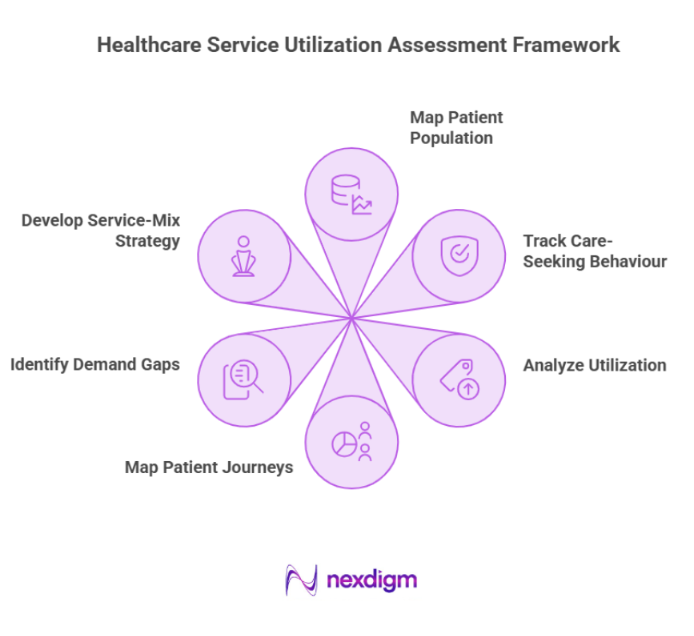
- Step 1 Map the Patient Population: Assess demographics, disease burden, affordability, insurance coverage, and healthcare needs across the target market.
- Step 2 Track Care-Seeking Behaviour: Understand where patients first seek care, which providers they prefer, and the factors influencing channel selection.
- Step 3 Analyze Utilization by Setting: Measure inpatient admissions, outpatient consultations, diagnostics, procedures, digital consultations, and other service volumes.
- Step 4 Map Patient Journeys: Identify how patients transition between primary care, diagnostics, specialists, hospitals, and digital channels.
- Step 5 Identify Demand & Capacity Gaps: Compare patient utilization with available facilities, specialties, infrastructure, and digital capabilities.
- Step 6 Develop the Service-Mix Strategy: Priorities physical capacity, outpatient formats, digital services, partnerships, specialties, and geographic expansion based on future utilization patterns.
Understanding healthcare usage patterns is essential for effective planning and resource allocation. By leveraging healthcare analytics and healthcare service utilization trends, Nexdigm helps organizations make informed decisions, improve patient access, and design services that align with evolving patient needs.
Nexdigm’s Case
Nexdigm supported a hospital client by analyzing patient preferences, competitor services, and clinical performance to strengthen its market positioning. The engagement helped the provider achieve a 25% increase in patient retention and 18% faster strategy alignment, supporting better service planning and responsiveness to changing healthcare utilization patterns.
To take the next step, simply visit our Request a Consultation page and share your requirements with us.
Harsh Mittal
+91-8422857704