

Healthcare software is becoming central to how hospitals manage clinical information, patient engagement, financial processes, workforce coordination, and operational workflows. Global healthcare and life sciences enterprise IT spending is forecast to reach $311 billion in 2025, with software spending expected to grow 9.8% during the year.
Adoption of core digital systems is already widespread. In 2024, more than 99% of U.S. non-federal acute care hospitals had adopted a certified electronic health record, while the use of the same EHR developer across inpatient and outpatient settings reached about 91%.
Interoperability is also becoming a key consideration. By 2025, 76% of U.S. hospitals engaged in all four measured health-information exchange activities, including sending, receiving, finding, and integrating information.
As hospitals evaluate increasingly interconnected software environments, healthcare software vendor analysis can help determine which vendors best align with clinical workflows, administrative requirements, integration needs, and long-term digital strategy.
Software Value Depends on Workflow Fit
Healthcare software can support very different functions, so vendor value depends on how effectively each platform fits the workflows it is expected to serve:
- Clinical Workflow Alignment: Assess documentation, decision support, care coordination, usability, and specialty-specific functionality against clinical requirements.
- Operational Integration: Examine how effectively software connects scheduling, billing, workforce, procurement, analytics, and other administrative processes.
- Technology Fit: Evaluate interoperability, scalability, implementation requirements, integration capabilities, and compatibility with existing systems.
A strong vendor evaluation therefore looks beyond feature volume to determine how effectively software supports connected clinical and administrative workflows.
Software Selection Is Becoming a Broader Enterprise Decision
As healthcare organizations connect more clinical, financial, operational, and patient-facing systems, software choices can have implications beyond individual departments. Integration requirements, data accessibility, implementation complexity, user adoption, scalability, and long-term support can influence the overall value of a platform. This makes vendor selection increasingly dependent on enterprise-wide fit rather than isolated functionality.
Nexdigm’s Trade-Off Lens for Software Vendor Selection
Software selection often involves balancing competing priorities rather than identifying a single vendor that leads across every criterion. Nexdigm can help organizations examine trade-offs between functional breadth and specialization, integration depth and implementation complexity, customization and standardization, scalability and cost, and platform consolidation and flexibility. This perspective helps decision-makers understand the implications of different vendor choices and select solutions that best match their operational priorities and technology strategy.
Nexdigm’s Healthcare-Centric Approach to Software Evaluation
Nexdigm can bring healthcare-specific context into software vendor evaluation, helping organizations assess platforms against the clinical, operational, regulatory, and technology requirements that shape healthcare environments:
- Clinical Workflow Understanding: Evaluate software against clinical documentation, care coordination, patient information, specialty workflows, and decision-support requirements to determine practical relevance across different healthcare settings.
- Healthcare Operations: Examine how platforms support scheduling, revenue cycle, workforce management, procurement, reporting, and other operational processes that influence hospital efficiency and administrative performance.
- Healthcare Technology Requirements: Assess interoperability, data exchange, integration capabilities, scalability, security considerations, and compatibility with existing healthcare systems to understand technology fit and implementation implications.
By combining healthcare domain understanding with vendor and technology analysis, Nexdigm can help organizations make software decisions that reflect the realities of healthcare delivery rather than relying solely on generic technology criteria.
Nexdigm’s Framework for Comparing Healthcare Software Vendors
Nexdigm can structure vendor comparisons across the dimensions that most directly influence software selection:
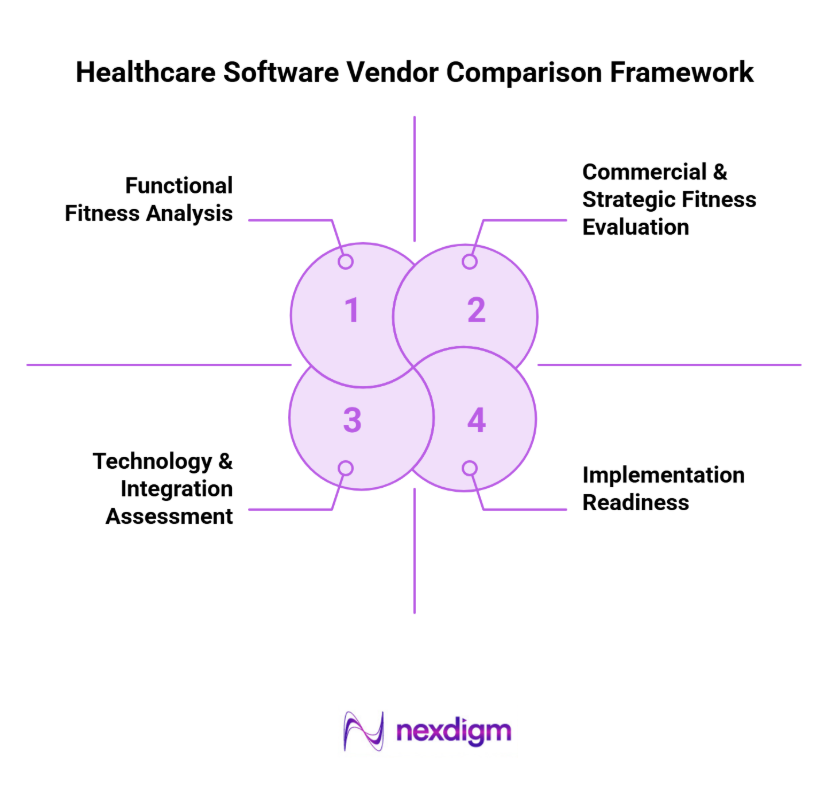
- Functional Fit: Compare clinical, administrative, analytical, and workflow capabilities against defined organizational requirements.
- Technology & Integration: Assess interoperability, APIs, data exchange, architecture, scalability, and compatibility with the existing technology environment.
- Implementation Readiness: Examine implementation complexity, customization needs, migration requirements, training, support, and deployment capabilities.
- Commercial & Strategic Fit: Evaluate licensing, total cost, vendor positioning, roadmap, scalability, and long-term alignment with the organization’s digital strategy.
This framework helps transform healthcare software vendor analysis into a structured comparison that highlights strengths, gaps, trade-offs, and the vendors most aligned with organizational priorities.
How Nexdigm’s Structured Framework Adds Value
Nexdigm’s structured assessment can help healthcare organizations turn complex software comparisons into clearer technology and procurement decisions:
- Sharper Vendor Shortlisting: Identify vendors that align most closely with clinical, administrative, integration, and strategic requirements.
- Better Decision Visibility: Bring functional capabilities, implementation considerations, commercial factors, and technology fit into one comparative view.
- Stronger Negotiation Position: Understand vendor strengths, competitive alternatives, and commercial differences before entering detailed discussions.
- Reduced Selection Risk: Identify capability gaps, integration challenges, implementation dependencies, and scalability considerations before committing to a platform.
This enables organizations to make more informed software decisions while balancing immediate workflow needs with longer-term technology and operational priorities.
Nexdigm’s Case
Nexdigm supported a healthcare organization in evaluating 30 software vendors across clinical and administrative workflows. The assessment identified 23% with stronger clinical capabilities, broader integration potential, and 20% with more favorable commercial positioning, helping the organization refine its shortlist and prioritize vendors for detailed technical and commercial evaluation.
To take the next step, simply visit our Request a Consultation page and share your requirements with us.
Harsh Mittal
+91-8422857704