

A healthcare product’s country of origin does not always reveal the company or network responsible for getting it to the buyer. Manufacturers may use contract producers, regional distributors, trading companies and logistics intermediaries before a medicine, device or component reaches a hospital or pharmacy.
Understanding these relationships matters for market entry, supplier qualification and competitive analysis. A company that appears to serve a market directly may depend on a distributor with several competing product lines, while multiple exporters may ultimately rely on the same upstream manufacturer.
From Trade Partners to a Supplier Network
Conventional trade statistics show which countries exchange products and in what amounts. Company-level shipment or customs records, where available, can add another layer by identifying importers, exporters, consignees, shipment frequency and product descriptions. The depth of information depends on the country and data source, so coverage needs to be checked before drawing conclusions.
A healthcare supplier network can include:
- Manufacturers: Original producers of finished medicines, devices, components or active ingredients.
- Contract manufacturers: Businesses producing goods for another company under a manufacturing agreement.
- Distributors and importers: Organisations handling local market access, warehousing, sales channels and sometimes regulatory responsibilities.
- Trading intermediaries: Companies that buy and resell products across borders, potentially obscuring the original production source.
- End-market buyers: Hospitals, laboratories, pharmacy chains, public procurement bodies and other organisations that create demand.
Mapping these roles helps companies distinguish the producer from the commercial route to market. It can also expose dependencies that are invisible in country-level trade totals.
Why Network Structure Matters in Healthcare
Pharmaceutical supply chains illustrate the importance of tracing beyond the immediate trading partner. A 2025 European Commission analysis found that approximately 75% of active pharmaceutical ingredient production sites supplying the EU were located outside the bloc, with India and China among the notable manufacturing locations. The figure concerns production-site location, not the share of all medicines imported, and should be interpreted accordingly.
For procurement teams, the lesson is to trace critical inputs and production locations rather than assume that a diversified list of vendors means a diversified supply base. Several suppliers may depend on the same API producer, component manufacturer, or geographic cluster.
For commercial teams, network structure can reveal potential routes into a market. An overseas manufacturer may have no direct local sales presence but may already supply a regional distributor. A new entrant may gain faster access through that distributor than by building its own channel from scratch.
Identifying Relationships Across the Healthcare Supply Network
Effective healthcare supplier network mapping connects manufacturers, contract producers, distributors, importers and end-market buyers to reveal how products move across borders. By examining recurring shipment relationships and shared upstream suppliers, companies can identify hidden dependencies, potential distribution partners and opportunities to diversify sourcing or enter new markets.
- Resolve company identities: Standardise company names, addresses and available identifiers so spelling variations do not create false competitors or duplicate suppliers.
- Trace recurring relationships: Compare shipment frequency, product categories, counterparties and trade direction to distinguish sustained relationships from isolated transactions.
- Identify network concentration: Determine whether multiple suppliers share an upstream producer, intermediary or transport route.
- Assess route-to-market strength: Review distributors’ product portfolios, geographic reach, regulatory role and potential conflicts with competing brands.
- Validate the relationship: Use company disclosures, regulatory records and direct diligence where available. A shipment record indicates a trade relationship, but does not necessarily establish ownership, exclusivity, or the terms of a contract.
This distinction prevents a common analytical error: treating every observed shipment as proof of a formal strategic partnership.
Nexdigm’s Healthcare Network Assessment Framework
Nexdigm can structure supplier mapping around four connected decisions:
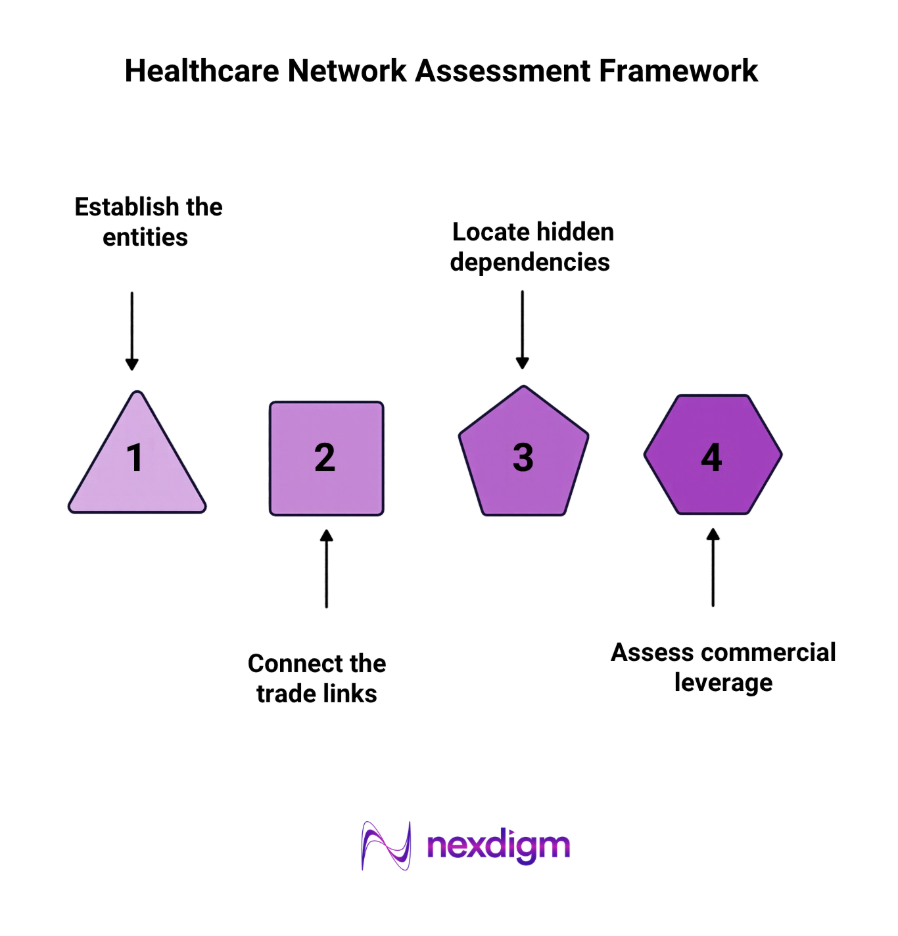
- Establish the entities: Build a clean company-level view of manufacturers, intermediaries, importers and buyers.
- Connect the trade links: Map recurring product flows and identify the strongest origin-destination relationships.
- Locate hidden dependencies: Trace shared upstream suppliers and geographic concentration across apparently separate vendors.
- Assess commercial leverage: Identify useful distributors, alternative suppliers and potential market-entry partners, then validate the most important relationships.
The output is a network view that supports sourcing resilience, partner selection and competitor assessment rather than a simple list of companies.
Case Study: Identifying Shared Supplier Exposure
A healthcare importer mapped 74 suppliers and intermediary records across 5 product categories. Entity matching consolidated 11 duplicate company records and revealed that 4 nominal suppliers shared two upstream producers. The procurement team prioritised alternative-source qualification for the three product lines most exposed to that concentration.
To take the next step, simply visit our Request a Consultation page and share your requirements with us.
Harsh Mittal
+91-8422857704