

Healthcare sustainability analysis has become increasingly important as the healthcare sector contributes towards global greenhouse gas emissions, driven by energy-intensive operations, medical waste generation, and complex supply chains. This growing environmental footprint is pushing hospitals and healthcare providers to adopt sustainable practices such as energy-efficient infrastructure, waste reduction, and digital transformation.
Healthcare sustainability analysis is gaining urgency as the sector contributes nearly 4–5% of global carbon emissions, exceeding aviation in some estimates. Hospitals generate about 15–20% of total healthcare emissions from energy use, while medical waste is projected to grow by 3–4% annually.
Studies show that implementing energy-efficient systems can reduce hospital energy consumption by up to 30%, and sustainable procurement practices can cut supply chain emissions by nearly 20–25%, strengthening ESG-driven competitive positioning.
In the context of competitive intelligence, healthcare sustainability analysis helps organizations benchmark their environmental performance against peers, identify best practices, and assess regulatory readiness. By integrating sustainability metrics into strategic decision-making, healthcare institutions can improve operational efficiency, reduce costs, and strengthen their competitive positioning while aligning with global ESG (Environmental, Social, and Governance) standards.
Future Outlook of Competitive Intelligence in Healthcare Sustainability
Competitive intelligence in healthcare sustainability will focus on emissions tracking, ESG benchmarking, and green innovation insights, enabling hospitals to enhance efficiency, meet regulations, and gain competitive advantage through sustainable practices.
-
AI-Driven Emissions Monitoring
AI tools will track hospital carbon emissions in real time, enabling precise benchmarking and sustainability performance optimization across facilities.
-
ESG Integration in Strategy
Healthcare organizations will embed ESG metrics into competitive intelligence frameworks, improving compliance, transparency, and long-term sustainability-driven decision-making processes.
-
Green Supply Chain Optimization
Future systems will benchmark suppliers based on sustainability performance, reducing carbon footprint across procurement and healthcare delivery networks.
-
Predictive Sustainability Analytics
Advanced analytics will forecast environmental impact trends, helping hospitals proactively adopt greener operations and reduce resource inefficiencies effectively.
-
Benchmarking Global Best Practices
Competitive intelligence will identify leading sustainable healthcare models worldwide, enabling replication of efficient, low-emission hospital operational strategies.
How does Nexdigm evaluate carbon emissions in healthcare facilities?
Nexdigm evaluates carbon emissions in healthcare facilities by conducting comprehensive healthcare sustainability analysis across energy consumption, medical waste generation, procurement activities, and facility operations. It uses benchmarking frameworks and ESG metrics to measure Scope 1, 2, and 3 emissions. By comparing performance with industry peers, Nexdigm identifies inefficiencies, quantifies environmental impact, and provides actionable insights to reduce emissions and improve sustainability performance in hospitals and healthcare systems.
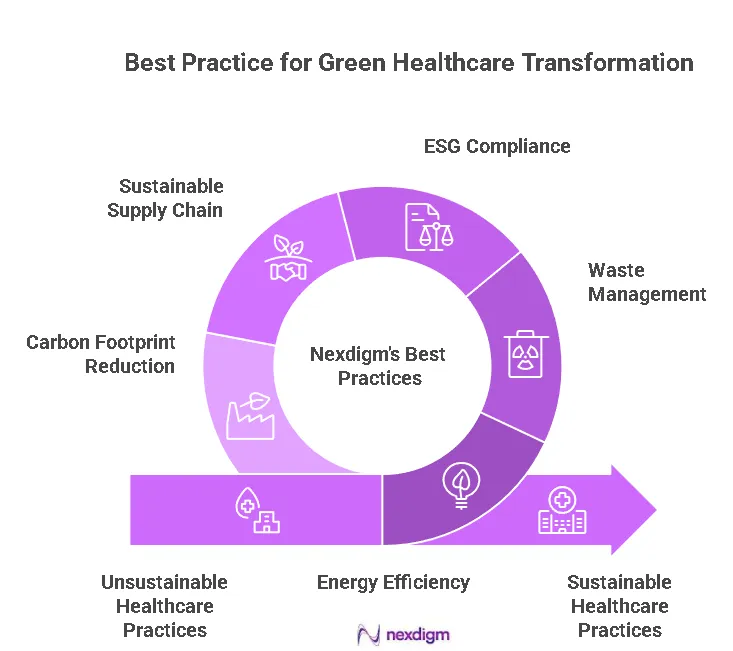
Nexdigm’s Best Practice for Green Healthcare Transformation
Nexdigm’s best practice for green healthcare transformation involves benchmarking sustainability metrics, reducing emissions, optimizing energy use, improving waste management, and aligning hospital operations with global ESG standards and competitive intelligence insights:
-
Energy Efficiency Optimization
Nexdigm identifies high-energy consumption areas in hospitals and recommends efficient systems to reduce operational costs and carbon emissions effectively.
-
Waste Management Improvement
Focuses on optimizing medical waste segregation, recycling processes, and reducing hazardous disposal impacts across healthcare facilities for sustainability.
-
ESG Compliance Integration
Ensures healthcare organizations align with global ESG standards, improving transparency, regulatory compliance, and long-term environmental responsibility frameworks.
-
Sustainable Supply Chain Design
Evaluates procurement practices and supplier sustainability to minimize environmental impact and strengthen green healthcare supply networks efficiently.
-
Carbon Footprint Reduction Strategy
Develops actionable decarbonization plans by analyzing emissions data and implementing low-carbon operational practices across healthcare institutions.
Nexdigm’s case:
A Nexdigm-led healthcare sustainability case involved a multinational hospital network seeking to reduce its carbon footprint across operations. Through ESG-based benchmarking and healthcare sustainability analysis, Nexdigm assessed energy use, waste generation, and supply chain emissions across multiple facilities. The study identified inefficiencies in high-energy departments and logistics. Recommendations led to a 22% reduction in operational emissions, improved waste segregation efficiency by 18%, and enhanced ESG compliance alignment across the network.
To take the next step, simply visit our Request a Consultation page and share your requirements with us.
Harsh Mittal
+91-8422857704