

Healthcare organisations increasingly depend on technology platforms to coordinate clinical workflows, manage patient information, support diagnostics and improve administrative efficiency. Hospital information systems, electronic medical records, picture archiving and communication systems, telehealth platforms and specialised clinical applications form part of a complex technology environment.
Selecting a vendor is rarely a straightforward software purchase. A platform must fit existing workflows, integrate with other systems, support the organisation’s growth and remain commercially viable over time. A hospital group operating across multiple locations may have very different requirements from a single-specialty clinic or diagnostic network.
Which Healthcare Technology Categories Should Buyers Compare?
The healthcare technology market includes several distinct platform categories:
- Hospital information systems (HIS): Support hospital administration, admissions, billing, scheduling and operational workflows.
- Electronic medical record systems (EMR): Manage patient histories, clinical documentation, medication records and related information.
- Picture archiving and communication systems (PACS): Store, retrieve and distribute medical imaging, often alongside radiology information systems.
- Telehealth platforms: Enable remote consultations, follow-ups and selected digital care services.
- Laboratory information systems (LIS): Manage laboratory workflows, sample tracking, test records and reporting.
- Clinical decision-support applications: Provide structured information and workflow assistance to healthcare professionals.
These platforms serve different purposes and should not be assessed using identical evaluation criteria. A PACS vendor, for example, requires a different technical assessment from an HIS provider.
Platform Capability and Integration
The first consideration is functional fit. Buyers should identify which workflows a platform supports natively, and which require custom development, third-party applications or manual intervention.
Important areas of comparison include:
- Clinical and administrative workflow coverage.
- Customisation and configuration capabilities.
- Integration with laboratory, imaging, pharmacy and billing systems.
- Support for relevant interoperability standards such as HL7, FHIR and DICOM.
- Data migration and legacy-system compatibility.
- Reporting, analytics and audit-trail functionality.
Interoperability is particularly important for multi-facility organisations. A platform that works well within one hospital may create additional complexity when connected to different systems across a wider network.
India’s digital health infrastructure is evolving towards greater interoperability. The Unified Health Interface launched in June 2026 as an open network within the Ayushman Bharat Digital Mission, supporting connections across different digital health platforms. Healthcare buyers should therefore examine how prospective vendors approach data exchange, consent, security and integration with evolving digital health infrastructure
Scalability, Deployment and Technical Support
A platform’s ability to support future growth is as important as its current functionality. Healthcare organisations may add facilities, specialties, users, diagnostic equipment and digital services over time.
Vendor evaluation should examine:
- Cloud, on-premises and hybrid deployment options.
- Infrastructure requirements and system performance.
- User and facility expansion capabilities.
- Data storage, backup and disaster recovery.
- Software upgrades and product roadmaps.
- Implementation timelines and migration support.
- Availability of local technical and application support.
Support quality should be assessed beyond the existence of a service desk. Buyers should examine service-level commitments, escalation processes, implementation resources, training arrangements and the availability of specialists for integration and troubleshooting.
Commercial Comparison and Total Cost of Ownership
Healthcare technology contracts can involve several cost components beyond initial licence or subscription fees. Implementation, integration, migration, training and ongoing support can materially influence the total investment.
A commercial comparison should include:
- Initial licence or subscription charges.
- Implementation and configuration costs.
- Integration and data-migration expenses.
- Hosting, storage and infrastructure requirements.
- Maintenance, upgrades and support fees.
- User-based, facility-based or transaction-based pricing.
- Contract duration, renewal terms and exit provisions.
Buyers should also assess how pricing changes as the organisation expands. A platform with a low entry price may become significantly more expensive when additional facilities, modules or users are introduced.
Mapping Healthcare Technology Vendors
The vendor landscape includes international companies such as Oracle Health, Epic, Philips, Siemens Healthineers, GE HealthCare and Sectra, alongside Indian healthcare technology providers such as CrelioHealth, MocDoc, Napier Healthcare and specialised digital health firms. These companies operate across different product categories and market segments, making direct comparison dependent on the application.
A useful healthcare technology vendor comparison should examine product capability, implementation experience, integration options, service presence and commercial structure together. It should also distinguish between platform developers, implementation partners, distributors and technology infrastructure providers.
Nexdigm’s market research can support vendor discovery, product and service mapping, regional market analysis and comparison of commercial positioning. This helps healthcare organisations understand the supplier landscape before conducting technical demonstrations, security assessments and institutional due diligence.
Healthcare Technology Vendor Evaluation Framework
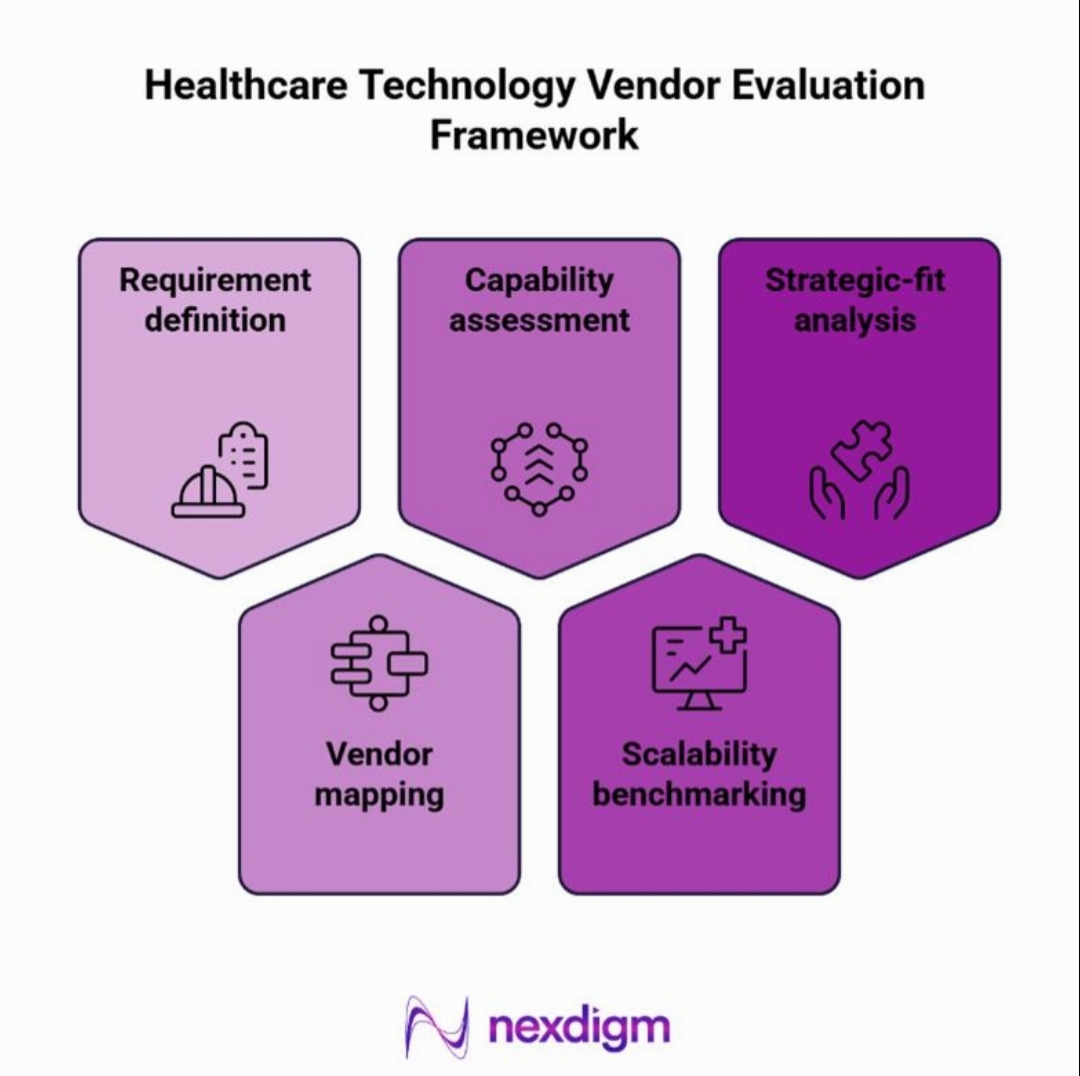
- Technology requirement definition: Map clinical and administrative workflows, user requirements, integration needs and expected organisational growth.
- Vendor and platform mapping: Identify relevant technology providers by product category, deployment model, customer segment and geographic presence.
- Capability and interoperability assessment: Compare functionality, standards support, integration architecture, data management and customisation.
- Scalability and support benchmarking: Examine deployment flexibility, infrastructure, implementation resources, service coverage and product roadmaps.
- Commercial and strategic-fit analysis: Compare pricing models, lifecycle costs, contractual conditions, vendor dependencies and long-term platform suitability.
Case Study: Comparing Healthcare Technology Platforms
A multi-location healthcare provider reviewing its digital infrastructure needed to compare hospital and diagnostic technology vendors. Nexdigm’s research mapped 20 providers across three markets, assessed platform categories and implementation footprints, and shortlisted six vendors for detailed functional, integration and commercial evaluation.
To take the next step, simply visit our Request a Consultation page and share your requirements with us.
Harsh Mittal
+91-8422857704