

Healthcare trade growth is uneven across products and countries. Pharmaceuticals move through regulatory approval systems and distribution networks; medical devices depend on hospital investment, technical support and reimbursement; large diagnostic equipment requires capital budgets, installation capacity and maintenance. A country importing more healthcare products may therefore represent a growth market, a supply-chain dependency or both.
Global trade expanded in 2025, with world trade in goods and commercial services increasing by 8% to US$34.89 trillion. That broader expansion creates a useful backdrop, but it does not establish that every healthcare category is growing at the same pace. Companies need product-level trade data to identify where demand is strengthening and whether suppliers can serve it profitably.
Why Healthcare Imports Need to Be Read by Product
A single healthcare trade total can conceal very different market conditions. Pharmaceutical preparations, active ingredients, diagnostic reagents, surgical instruments and imaging equipment serve distinct buyers and operate under different commercial constraints.
Three signals are especially useful:
- Import growth: Rising import value can indicate expanding demand, but it may also reflect price inflation, currency movements or a shift toward higher-value products.
- Supplier concentration: A market relying on a small number of exporting countries may offer opportunities for alternative suppliers, provided they meet local quality and registration requirements.
- Product mix: Growth in advanced diagnostic equipment has different implications from growth in consumables. Equipment sales may depend on hospital capital expenditure, while consumables can generate recurring demand linked to procedure volumes.
The World Trade Organization’s medical-goods classification separates pharmaceuticals, medical equipment, orthopaedic equipment, personal protective equipment and other medical supplies. This product-based approach helps companies avoid comparing unlike categories or mistaking a temporary surge in one segment for broad-based healthcare demand.
Where Import Patterns Can Reveal Commercial Opportunities
The most useful markets are not always those with the highest import values. A large, mature market may have entrenched distributors, strict tender requirements and limited room for new suppliers. A smaller market may be more accessible if imports are increasing; domestic production is limited, and procurement is fragmented.
Healthcare companies should examine trade flows alongside evidence of actual healthcare capacity and purchasing needs. The World Health Organization tracks diagnostic equipment availability, including MRI, CT, PET and radiotherapy units, by population. These indicators can help contextualise equipment imports: low installed capacity may signal an infrastructure gap, while high imports alongside established equipment density may reflect replacement cycles or movement toward more advanced systems.
However, an equipment gap does not automatically equal an addressable sales opportunity. Public procurement budgets, hospital financing, skilled operators, maintenance networks and reliable electricity can determine whether a product is practical to deploy. WHO has specifically noted that imported devices may fail to meet local needs when spare parts, technical support, affordability, or power backup are inadequate.
Applying Healthcare Trade Analysis to Market Prioritisation
A credible market screen combines trade momentum with the conditions required to convert imports into sustainable revenue. For a manufacturer or distributor, this means asking more than which countries buy the most.
A useful assessment examines:
- Demand durability: Compare multi-year import trends with healthcare investment, procedure volumes and replacement needs.
- Competitive structure: Identify the leading source countries, changes in their market shares and whether supply is concentrated in a few manufacturers.
- Market access: Test registration timelines, local certification, tender eligibility, tariffs and restrictions on public procurement.
- Commercial feasibility: Estimate landed cost, distributor margins, service requirements and payment risk rather than ranking markets by import value alone.
The analysis should also distinguish between a market-entry opportunity and a sourcing opportunity. Rising imports may support export expansion, while concentrated supply or frequent trade disruption may justify identifying alternative suppliers.
Nexdigm’s Healthcare Trade Opportunity Framework
Nexdigm’s healthcare trade analysis can translate cross-border trade signals into a practical market-entry or sourcing decision through four stages:
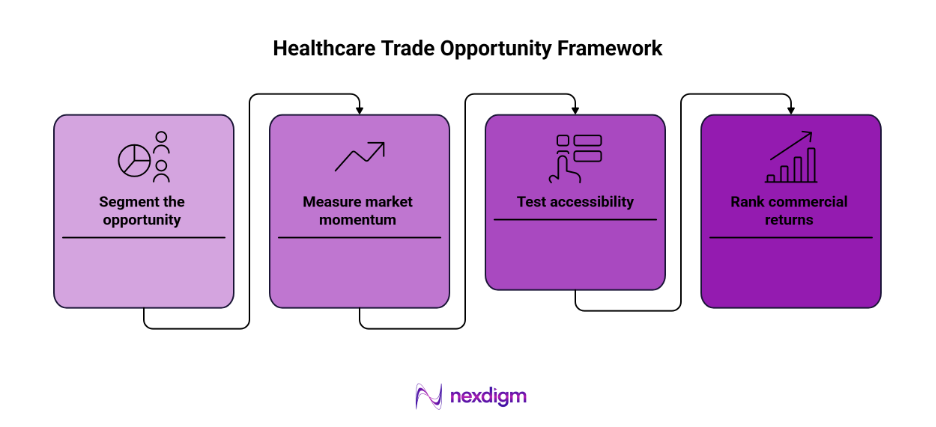
- Segment the opportunity: Define product codes at a level that separates high-value equipment, consumables, ingredients and finished medicines.
- Measure market momentum: Compare import values, quantities and supplier shares across multiple years to separate durable growth from price effects or one-off procurement.
- Test accessibility: Overlay regulatory requirements, procurement practices, distribution capacity and service obligations.
- Rank commercial returns: Compare achievable selling prices, landed costs, market-entry investment and supply risks to identify markets worth pursuing.
The output is a prioritised shortlist supported by evidence, with clear reasons to enter, monitor or exclude each market.
Nexdigm’s Case Study: Prioritising Healthcare Export Markets
A diagnostic-supplies manufacturer screened 14 destination markets using three-year import trends, supplier concentration, registration requirements and estimated landed margins. 6 markets showed sustained demand growth; further access and cost analysis reduced the shortlist to three. The company focused distributor outreach on two markets with the strongest risk-adjusted returns.
To take the next step, simply visit our Request a Consultation page and share your requirements with us.
Harsh Mittal
+91-8422857704