

Healthcare trade data can show where a country depends on foreign suppliers, where sourcing patterns are changing and which product categories may offer room for new entrants. The challenge is interpreting those signals correctly. High imports can reflect unmet domestic demand, specialised products unavailable locally, or simply the economics of global manufacturing.
For healthcare manufacturers, distributors and procurement teams, the strongest insights emerge when import and export flows are examined at product level and linked to supplier concentration, local production capability and market-access requirements.
Reading Import Dependence Without Misreading Demand
An import-dependent market can present a commercial opportunity, but dependence alone is not proof of a supply gap. Some products are imported because production requires specialised technology, regulatory scale or large manufacturing volumes. Others may be imported because local suppliers cannot provide the required quality, price or capacity.
A useful starting point is to separate three conditions:
- Structural dependence: Imports remain high over several years and originate from a narrow set of supplier countries.
- Shifting dependence: The source-country mix changes, suggesting price pressure, trade restrictions, new capacity or deliberate supply-chain diversification.
- Demand expansion: Import volumes rise alongside evidence of greater consumption, healthcare access or investment in treatment capacity.
These patterns call for different responses. Structural dependence may favour a long-term supply agreement or local manufacturing partnership. A shift in supplier shares may create an opening for exporters. Rising demand may justify distribution expansion, provided the additional volume is not explained solely by price increases.
What Supplier Concentration Reveals About Sourcing Risk
Aggregate import values often hide dependencies at the ingredient or product level. A country can import medicines from many trading partners while still relying on a limited number of origins for key active pharmaceutical ingredients or specialised components.
The European Commission’s 2025 analysis of dependencies in active pharmaceutical ingredients found that approximately 75% of API production sites supplying the EU were located outside the bloc. This is a useful reminder that the physical location of manufacturing can matter as much as the country from which a finished medicine is shipped. A finished product may arrive through one market while its critical ingredients originate elsewhere.
For buyers, the implication is practical: supplier diversification should be assessed at the level of the underlying input, not just the final product. An alternative exporter may still rely on the same upstream manufacturer, leaving the original dependency intact.
Using Healthcare Trade Data Intelligence to Find Market Gaps
Trade data becomes commercially useful when it is combined with evidence of what local producers can actually supply. A gap may exist where imports are rising, supplier options are limited and domestic production is insufficient. It may also exist where buyers need a different specification, shorter lead times or more reliable technical support.
The analysis should test:
- Import growth against local capacity: Determine whether imports are expanding because demand is rising faster than domestic output.
- Supplier substitution: Track whether one exporting country is gaining share at the expense of another and whether the shift is consistent across product categories.
- Unit values and quantities: A rise in import value without volume growth may reflect higher prices or a more premium product mix, not a larger addressable market.
- Supply resilience: Identify single-source exposure, long lead times and critical inputs for which qualified alternatives are scarce.
- Buyer requirements: Validate the apparent gap against regulatory approval, hospital purchasing practices, quality standards and distribution capabilities.
Nexdigm’s Healthcare trade data intelligence helps exporters avoid pursuing markets where a nominal import opportunity is commercially inaccessible and helps procurement teams avoid supplier diversification that changes the invoice address but not the underlying risk.
Nexdigm’s Import Dependency and Supply-Shift Framework
Nexdigm can structure the assessment around four decision tests:
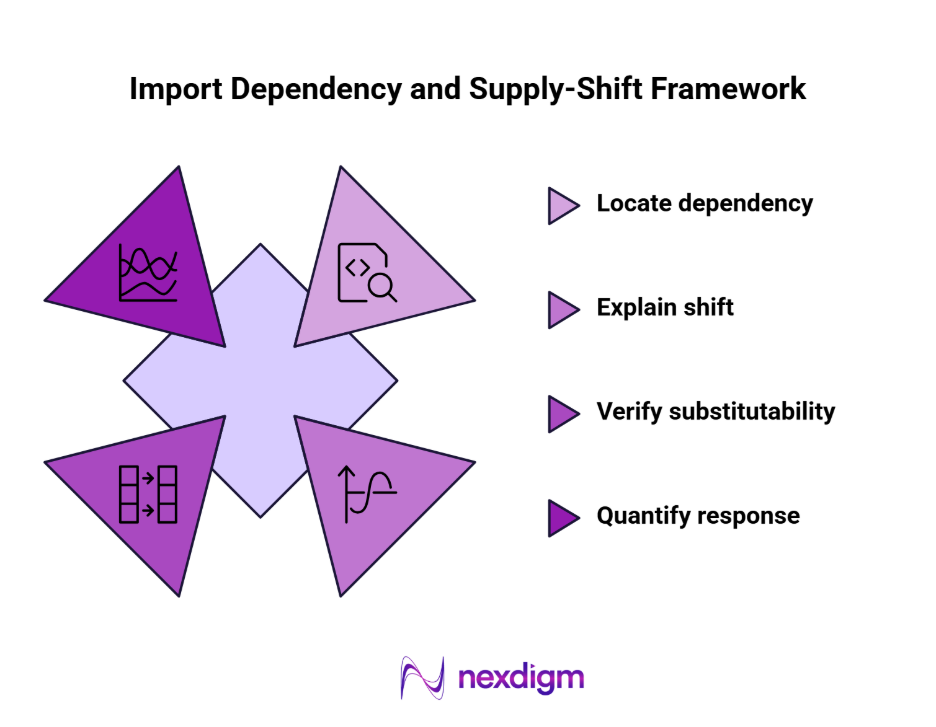
- Locate the dependency: Map import exposure by product, ingredient, origin country and supplier concentration.
- Explain the shift: Separate volume growth, price changes, new sourcing relationships and temporary disruptions.
- Verify substitutability: Test whether alternative suppliers have the necessary capacity, quality credentials, regulatory approvals and delivery reliability.
- Quantify the response: Compare alternative sourcing costs, qualification timelines and potential revenue from entering underserved product markets.
The resulting analysis can guide supplier diversification, export targeting or decisions about local partnerships and production.
Case Study: Reducing Single-Origin Exposure
A hospital-consumables importer reviewed 36 product lines sourced from 8 countries. Trade and supplier analysis identified 9 lines with concentrated origin exposure; qualification checks found 3 viable alternatives across two countries. The importer prioritised those lines for dual-sourcing negotiations and continuity planning.
To take the next step, simply visit our Request a Consultation page and share your requirements with us.
Harsh Mittal
+91-8422857704