

Healthcare trade data can reveal where medical products are moving, which countries supply them, and how sourcing relationships change over time. For exporters, manufacturers, and distributors, the value is not simply identifying countries that import large quantities. It is understanding which product flows are expanding, which suppliers are gaining share, and where existing trade patterns create a credible route to commercial growth.
Import and export statistics become more useful when analysed at product and trading-partner level. A country may import substantial volumes of pharmaceutical products but source most of them from a small group of established exporters. Another may import less overall while increasing purchases from new suppliers in a specific product category. These differences affect how companies prioritise distributors, develop export pipelines, and allocate sales resources.
Reading Healthcare Trade Beyond Headline Values
Customs data generally records the value and, where available, quantity of goods crossing borders. UN Comtrade provides annual and monthly merchandise trade statistics by product and trading partners, allowing analysts to compare import demand and supplier positions across markets.
However, rising import value does not automatically indicate stronger underlying demand. It may reflect higher prices, currency movements, changes in product mix or larger quantities. Comparing value with reported quantities helps separate these effects, although differences in units and product specifications can limit direct comparisons.
Product classification is equally important. Pharmaceuticals, medical devices, diagnostic reagents, hospital consumables, and medical equipment have different trade patterns. Aggregating them into a single healthcare category can conceal meaningful changes, such as declining imports of one product group alongside increased purchases of another.
A reliable analysis therefore begins with clearly defined product codes, consistent reporting periods, and comparable partner data. Re-exports, transshipment, and differences between the reporting country and the original manufacturing country must also be considered before drawing conclusions about supply origin.
Identifying Trade Flows with Commercial Potential
Effective healthcare trade flow potential analysis connects product-level import demand with export performance, supplier concentration and changes in trading relationships. The objective is to identify flows that merit further commercial investigation, rather than assume that a large import bill represents an accessible opportunity.
Several signals are particularly useful:
- Sustained import growth: Increasing imports across multiple periods can indicate a durable shift in purchasing, especially when quantities rise alongside value.
- Changing supplier shares: A supplier gaining share may be benefiting from pricing, capacity, product availability or improved market access. The underlying cause needs to be tested.
- Concentrated sourcing: Heavy reliance on a small number of origin countries can indicate exposure to production disruptions, logistics constraints or policy changes.
- Emerging trade relationships: New or expanding flows between countries may reveal changing procurement routes, although one-off shipments should not be mistaken for established demand.
- Export performance: Comparing a target market’s imports with exporters’ shipments to that destination can help identify active competitors and potential gaps in the supply network.
Trade data is strongest when these signals are read together. For example, import growth accompanied by rising quantities and a wider supplier base tells a different story from growth driven only by higher declared values from one incumbent supplier.
From Trade Signals to Export Decisions
A promising trade flow still needs commercial validation. Customs records do not establish whether a buyer is accessible, whether a product meets local regulatory requirements or whether the supplier can compete after freight, duties, distribution margins and service costs.
Companies should also distinguish between products already entering a market and products that could realistically be supplied by a new exporter. Existing flows demonstrate that a route is active, but they may also reflect long-standing contracts, approved suppliers or technical requirements that make entry difficult.
Shipment-level records, where available, can add detail by showing recurring transactions, named trading entities, and changes in shipment frequency. Such records vary by country and data provider, and they may not identify the final manufacturer or end user. Analysts should corroborate these signals with customs statistics, company disclosures, and regulatory information.
Nexdigm’s Healthcare Trade Flow Intelligence Framework
Nexdigm can structure trade-flow analysis around four linked steps:
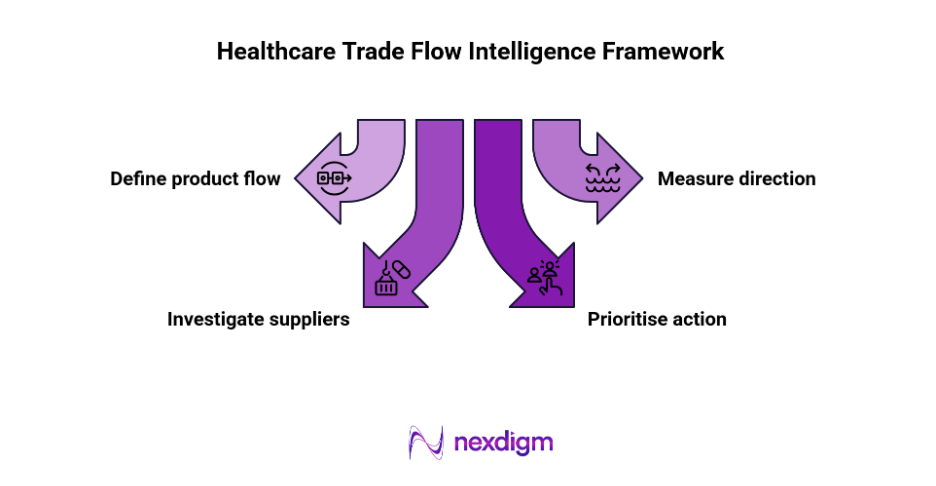
- Define the product flow: Establish relevant product codes, units, time periods, and reporting markets.
- Measure direction and momentum: Compare imports, exports, quantities and partner shares to distinguish sustained changes from short-term fluctuations.
- Investigate supplier relationships: Identify concentration, recurring trade routes, re-export hubs, and changes in the competitive landscape.
- Prioritise commercial action: Validate regulatory access, landed costs, distribution requirements and buyer fit before committing export resources.
This framework turns trade records into a practical shortlist of products, destinations and supplier relationships for further investigation.
Case Study: Prioritising Export Routes
A healthcare exporter reviewed 24 product-destination combinations across eight markets. Trade data identified six flows with sustained import growth and three markets with declining supplier concentration. After reviewing regulatory access and landed costs, the company shortlisted two destinations for distributor outreach and deferred one product pending documentation.
To take the next step, simply visit our Request a Consultation page and share your requirements with us.
Harsh Mittal
+91-8422857704