

Tariffs can change the economics of cross-border healthcare trade by increasing import costs, altering supplier price comparisons and changing the attractiveness of particular sourcing routes. Their effect depends on the product classification, country of origin, destination market, applicable trade agreement and any additional duties or exemptions. For healthcare companies, tariff intelligence is therefore a practical input into pricing, sourcing and export planning.
A tariff increase does not affect every supplier equally. One exporter may qualify for preferential treatment under a trade agreement, while another faces the standard applied rate. Even when two suppliers face similar duties, differences in freight, insurance, customs procedures and distribution costs can determine which product reaches the buyer at a competitive price.
Why Product Classification Comes First
Healthcare products span pharmaceuticals, active ingredients, diagnostic reagents, medical devices, laboratory supplies, and equipment. These products can fall under different HS codes, each with its own tariff treatment. A broad product description is not enough to establish the applicable duty.
The World Trade Organization’s Tariff and Trade Data platform provides information on applied tariffs, bound rates and trade flows by product and partner. Applied rates represent duties charged in practice, while bound rates are maximum commitments under WTO rules. The two should not be treated interchangeable.
Product classification also requires attention over time. In January 2026, the World Customs Organization announced new HS codes for vaccines and other essential medical goods, scheduled to take effect on 1 January 2028. Companies comparing historical and future trade data will need to account for classification changes when monitoring tariff exposure and shipment trends.
Measuring the Effect on Landed Costs
Effective healthcare trade tariff analysis combines applicable duty rates with product-level trade flows, origin rules and the other costs of getting goods to the buyer. The objective is to establish how policy changes affect the full import cost, not merely compare headline tariff percentages.
A landed-cost calculation should consider:
- Customs value: Establish the value used by the destination country to calculate duties, in line with its customs valuation rules.
- Applicable tariff: Confirm the product code, country of origin, import destination, preferential eligibility and any additional duties.
- Logistics costs: Include freight, insurance, handling and other relevant charges.
- Border and compliance costs: Account for customs brokerage, documentation, inspections and product-specific requirements.
- Downstream costs: Include warehousing, distribution, financing and any costs required to supply the customer.
The final comparison should use consistent assumptions across suppliers. A lower factory price does not necessarily produce a lower landed cost, while a higher tariff rate does not automatically make a supplier uncompetitive if its manufacturing costs or logistics advantages offset the difference.
Tracking Tariff Exposure Through Trade Flows
Tariff schedules explain the rules, while trade data shows where products are moving and how suppliers respond. Comparing imports by product and origin before and after a tariff change can help identify shifts in supplier shares, import values and reported quantities.
However, a change in trade flows does not prove that tariffs caused it. Companies should also consider exchange rates, demand, pricing, production capacity, regulatory approvals and changes in purchasing contracts. Where several policy changes occur together, the analysis should distinguish confirmed tariff effects from other possible explanations.
Origin is especially important. The country from which a product is shipped may not be the country where it originated for customs purposes. Preferential treatment generally depends on the relevant agreement’s rules of origin and supporting documentation, not simply the route used for transport.
Tariff scenarios can help companies compare alternative suppliers and destinations. They should test the current applicable rate, plausible changes in duty treatment and the commercial consequences of losing preferential access. For pharmaceuticals, product-specific exemptions and special measures may also apply, so policy announcements must be checked against the implementing rules and effective dates.
Nexdigm’s Healthcare Tariff Intelligence Framework
Nexdigm can connect tariff and trade information through four steps:
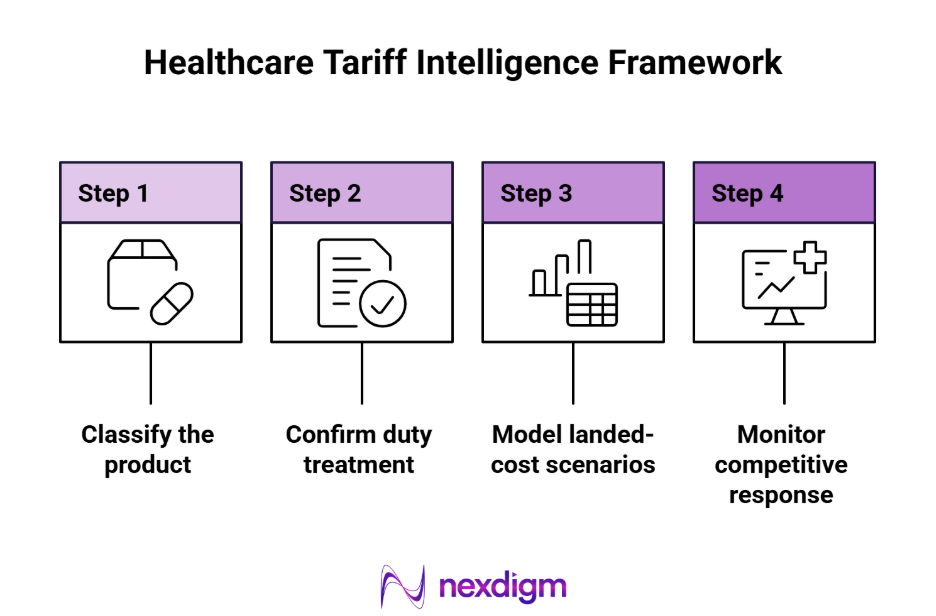
- Classify the product: Validate the relevant HS code and product description for each market.
- Confirm duty treatment: Compare applied rates, preferential rates, origin requirements and additional measures.
- Model landed-cost scenarios: Calculate the effect of duty changes alongside freight, insurance, compliance, and distribution costs.
- Monitor competitive response: Track changes in import volumes, supplier shares and trading routes, then investigate whether observed shifts align with tariff changes.
This framework helps commercial and procurement teams evaluate tariff exposure alongside actual trade movements, rather than relying on headline policy announcements alone.
Nexdigm’s Case Study: Recalculating Import Economics
A medical-products importer reviewed 12 product lines across three origin countries after a tariff change. Landed-cost modeling identified four lines where supplier rankings changed after duties and freight were included. The company reopened negotiations on two lines and reviewed origin documentation for the remaining products.
To take the next step, simply visit our Request a Consultation page and share your requirements with us.
Harsh Mittal
+91-8422857704