

Healthcare ventures are increasingly targeting high-growth markets driven by technology adoption, service innovation, and changing patient expectations. Opportunities are expanding across digital health, AI-enabled care, specialty services, diagnostics, remote monitoring, and patient engagement platforms. For investors, startups, and healthcare operators, success depends on identifying scalable segments, validating demand, assessing regulatory readiness, and building partnerships that support adoption.
A strong market entry strategy helps reduce risk by aligning investment decisions with market gaps, commercial models, and operational feasibility. Healthcare venture market entry strategy must connect innovation, capital deployment, compliance, and execution planning to create sustainable growth in competitive healthcare ecosystems.
The global digital health market was estimated at USD 347.4 billion in 2025 and is projected to reach USD 1,830.4 billion by 2033, growing at 23.4% CAGR. AI in healthcare is also projected to grow from USD 50.7 billion in 2026 to USD 505.6 billion by 2033, highlighting strong venture potential across innovation-led healthcare segments.
Market Opportunity Assessment for Technology-Led Healthcare Ventures
Market Opportunity Assessment for Technology-Led Healthcare Ventures helps evaluate demand, target segments, regulatory readiness, competition, adoption barriers, revenue potential, and scalability before entering high-growth digital health and innovation markets:
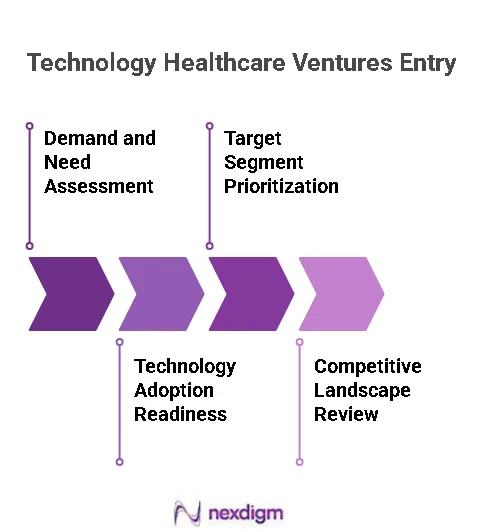
- Demand and Need Assessment: Evaluate patient, provider, and payer demand to identify where technology-led healthcare ventures can solve meaningful market gaps.
- Target Segment Prioritization: Define priority users, care settings, geographies, and customer groups most likely to adopt the solution.
- Technology Adoption Readiness: Assess digital maturity, workflow compatibility, infrastructure availability, and stakeholder willingness to use new healthcare technologies.
- Competitive Landscape Review: Benchmark existing digital health, AI, platform, and service innovation players to identify differentiation opportunities.
Nexdigm Market Roadmap for Healthcare Venture Expansion
Nexdigm Market Roadmap for Healthcare Venture Expansion helps healthcare ventures define priority markets, target customers, launch phases, partnership routes, pricing models, compliance needs, and scale-up actions. It supports structured expansion across digital health, AI, patient engagement, diagnostics, and service innovation segments while improving market entry readiness and commercial execution.
Nexdigm Commercial Strategy for Healthcare Innovation Ventures
Nexdigm Commercial Strategy for Healthcare Innovation Ventures helps ventures assess demand, pricing, revenue models, partnerships, competition, compliance, and adoption pathways to support scalable growth across technology-led healthcare markets.
- Revenue Model Design: Nexdigm evaluates subscription, licensing, enterprise, usage-based, and partnership-led models for sustainable commercial returns.
- Pricing Strategy: Nexdigm reviews willingness to pay, competitor pricing, reimbursement potential, and value-based pricing opportunities.
- Partnership Planning: Nexdigm maps hospitals, payers, technology partners, investors, and care networks for faster market access.
- Compliance and Risk Review: Nexdigm evaluates regulatory, data privacy, operational, and market risks before commercial launch.
Nexdigm’s case:
Nexdigm evaluated a healthcare innovation venture to build its commercial strategy by assessing 7 high-growth segments, benchmarking 15 digital health and AI competitors, and evaluating pricing, revenue, and partnership options. Nexdigm supported the company with demand validation, commercial model design, and scale-up planning, helping target 12 provider partnerships, 3 payer collaborations, and a projected 26% revenue growth pathway over three years.
To take the next step, simply visit our Request a Consultation page and share your requirements with us.
Harsh Mittal
+91-8422857704