

Heavy commercial vehicles (HCVs) play a critical role in supporting economic activity by enabling the movement of goods across industrial corridors, logistics networks, construction sites, ports, and distribution hubs. While heavy truck demand has traditionally been linked to economic expansion, today’s market dynamics are being shaped by a broader set of factors that extend beyond freight transportation alone.
A comprehensive Heavy commercial vehicle demand assessment indicates that demand is increasingly driven by the intersection of cargo movement requirements, infrastructure development programs, fleet modernization initiatives, and the need for improved operating efficiency.
Why is the Demand for Heavy Trucks Growing?
Heavy truck demand is being driven by a combination of economic expansion, infrastructure development, supply chain modernization, and fleet optimization efforts. As industries seek greater transportation efficiency and logistics networks continue to expand, demand for heavy commercial vehicles is increasing across multiple sectors.
The Four Key Drivers of Heavy Truck Demand
Heavy truck demand is being influenced by a combination of economic activity, infrastructure investments, fleet renewal strategies, and evolving operational priorities. It is important to understand where demand for heavy truck is coming from and how it is expected to evolve. This can be examined through the four key drivers influencing the heavy truck market, they are:
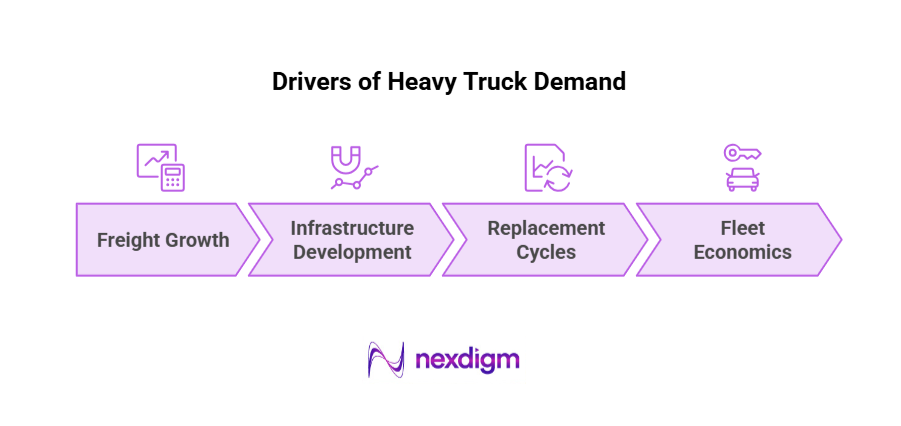
Freight Growth: The Fundamental Demand Engine
Freight movement remains the most important driver of heavy truck demand.
As industries expand production and consumers demand quicker deliveries, transportation networks must move increasing volumes of goods efficiently. The growth of e-commerce, manufacturing, retail distribution, and cross-border trade continues to drive freight activity across regional and national markets. Key freight-demand contributors include:
- E-commerce expansion
- Industrial production growth
- Retail distribution networks
- Warehousing expansion
- Agricultural transportation needs
- Import-export activity
Higher freight volumes increase vehicle utilization rates, prompting logistics companies and transport operators to expand fleet capacity. Any robust Heavy commercial vehicle demand assessment identifies freight growth as the foundational factor influencing truck sales.
Infrastructure Development: Creating New Demand Corridors
Infrastructure investments have emerged as a significant catalyst for heavy truck demand. Government spending on roads, highways, industrial corridors, ports, airports, rail connectivity, and urban development projects generates substantial transportation requirements throughout project lifecycles. Heavy trucks support infrastructure projects by transporting:
- Construction materials
- Cement and aggregates
- Steel products
- Heavy machinery
- Industrial equipment
Improved infrastructure also enhances freight efficiency, reduces transit times, and encourages economic activity, creating additional long-term demand for heavy commercial vehicles. As countries continue to invest in logistics modernization and transportation connectivity, truck demand is expected to benefit from both direct and indirect infrastructure-related opportunities.
Replacement Cycles: A Major Source of Market Stability
New vehicle demand is not solely generated by business expansion. A significant portion of truck sales comes from fleet replacement cycles. Operators periodically replace aging vehicles to:
- Reduce maintenance costs
- Improve fuel efficiency
- Enhance driver safety
- Meet regulatory requirements
- Increase fleet reliability
Market demand often strengthens when:
- Older vehicles become economically inefficient
- Regulatory standards become stricter
- New technologies offer significant operational benefits
Why Replacement Demand Matters
Replacement cycles create recurring demand regardless of broader economic fluctuations. For manufacturers, understanding fleet age profiles and replacement trends is critical when evaluating future sales opportunities.
Fleet Economics: The New Decision-Making Framework
Fleet operators increasingly evaluate trucks through the lens of profitability rather than acquisition cost alone. Modern purchasing decisions are heavily influenced by:
- Fuel consumption
- Maintenance expenses
- Vehicle uptime
- Payload efficiency
- Driver productivity
- Residual value
The focus has shifted from vehicle ownership to total business performance.
What Fleet Operators Are Looking For
Fleet managers increasingly prioritize:
- Lower total cost of ownership
- Higher fuel efficiency
- Predictive maintenance capabilities
- Connected vehicle technologies
- Improved operational uptime
As margins become more competitive, fleet economics often determine purchasing decisions more than technical specifications alone. It becomes a central purchasing criterion as it is important to examine the broader factors influencing demand across the heavy truck market.
Nexdigm in Transforming Market Demand into Strategic Opportunities
While demand drivers are becoming increasingly clear, businesses still face complex questions regarding investment priorities, market positioning, expansion strategies, and operational efficiency. This is where Nexdigm can support businesses across the heavy commercial vehicle value chain through the strategic measures:
Market Opportunity Assessment and Demand Forecasting
Understanding where heavy truck demand is growing is critical for strategic planning. Nexdigm can assist organizations with:
- Market sizing and segmentation
- Demand forecasting
- Growth corridor analysis
- Customer requirement assessments
- Regional opportunity identification
Accurate market intelligence helps manufacturers and investors focus resources on segments with the strongest growth potential.
Heavy Commercial Vehicle Demand Assessment and Fleet Analysis
A successful growth strategy requires a deeper understanding of fleet behavior and purchasing patterns. Nexdigm can support businesses through:
- Fleet utilization analysis
- Vehicle replacement trend evaluation
- Customer demand profiling
- Fleet economics assessment
- Industry-specific market studies
These insights enable organizations to align products and services with actual fleet requirements and investment priorities.
Go-to-Market and Expansion Strategy
As freight corridors evolve and infrastructure investments create new opportunities, organizations must evaluate expansion options carefully. Nexdigm can assist with:
- Market entry strategy
- Geographic expansion planning
- Distribution network assessment
- Dealer strategy development
- Business model evaluation
A structured market approach reduces risk and improves long-term growth outcomes.
Nexdigm’s Case
Nexdigm assisted an automotive player in assessing heavy truck demand as India’s truck market reached $20.4 billion in 2025, supported by freight growth, infrastructure activity, and fleet replacement. The study linked demand drivers, economics, and opportunities.
To take the next step, simply visit our Request a Consultation page and share your requirements with us.
Harsh Mittal
+91-8422857704