

Higher education demand is becoming more complex as students weigh affordability, career outcomes, programme relevance, and flexibility alongside academic reputation. The OECD reports that 48% of young adults across OECD countries now hold a tertiary qualification, while adults with tertiary education earn 54% more on average than those with only upper-secondary education.
Employment outcomes also vary by qualification: average employment reaches 86% for bachelor’s graduates and 90% for master’s graduates. These trends highlight why institutions need to understand not only how many students may enroll, but what motivates enrollment and which factors influence programme choice.
A structured higher education demand analysis can help universities assess enrollment intent, affordability thresholds, career expectations, preferred delivery formats, student segments, and competitive alternatives to identify areas of sustainable demand.
Understanding What Shapes Higher Education Demand
Higher education demand is influenced by demographics, participation rates, programme relevance, affordability, and mobility. UNESCO reports that global higher-education enrollment reached 269 million students in 2024, while the global participation rate reached 43%. Regional differences remain substantial, with participation ranging from 80% in Western Europe and Northern America to 9% in sub-Saharan Africa, highlighting significant differences in market potential.
Affordability and Career Outcomes Influence Student Choices
Affordability and expected career value remain important considerations when students evaluate higher education options. The World Bank notes that tertiary education supports employability, productivity, and higher wages, while UNESCO data shows that international mobility has more than tripled over two decades, reaching nearly 7.3 million students studying abroad in 2024. These trends make affordability, career pathways, mobility, and programme outcomes important demand indicators.
Nexdigm’s View on Higher Education Demand
Understanding these changing expectations requires institutions to connect student behavior with broader market conditions. Nexdigm brings expertise in market intelligence, education-sector research, demand assessment, competitive analysis, and strategic advisory to help institutions evaluate how higher education markets are evolving.
Nexdigm’s approach can examine student demographics, enrollment patterns, programme preferences, affordability, career expectations, mobility, competitor offerings, and delivery models. By bringing these factors together, institutions can develop a more comprehensive view of where demand exists, what is driving it, and how it may evolve.
Nexdigm’s Higher Education Demand Analysis
Nexdigm’s Higher education demand analysis can help institutions translate student and market signals into actionable opportunities. Rather than measuring demand through enrollment volumes alone, the assessment considers the underlying factors that influence students’ decisions. Such factors are:
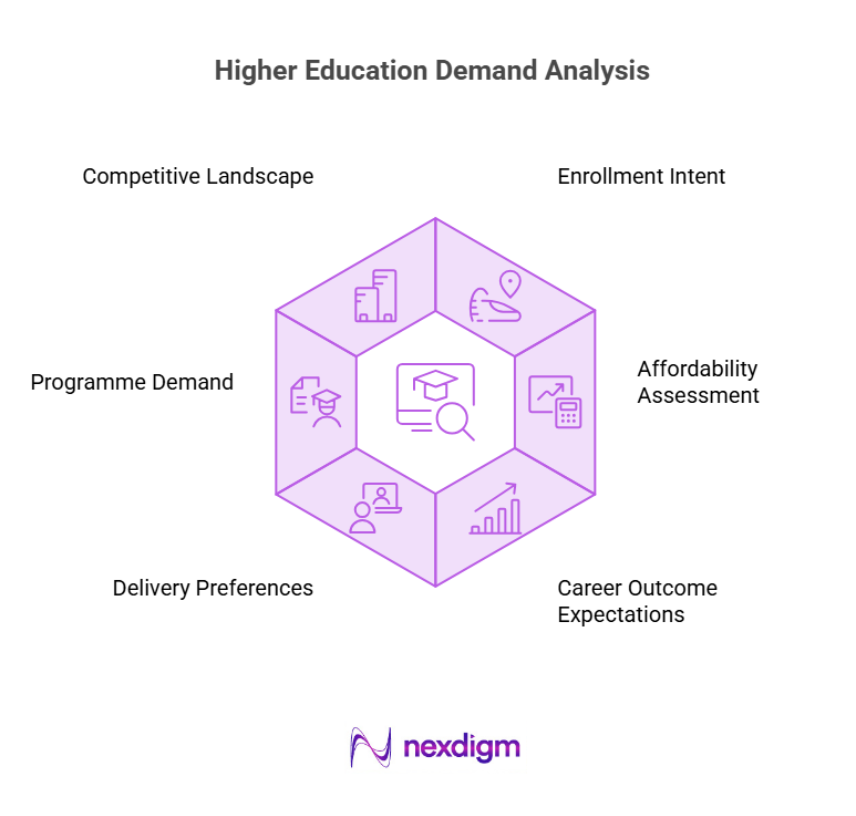
- Enrollment Intent: Assess prospective student interest by geography, demographic profile, programme type, and study level.
- Affordability Assessment: Examine tuition expectations, financing preferences, scholarship sensitivity, and willingness to pay across student segments.
- Career Outcome Expectations: Evaluate how employability, salary potential, industry connections, and career pathways influence programme selection.
- Delivery Preferences: Assess preferences for on-campus, online, hybrid, flexible, and accelerated learning formats.
- Programme Demand: Identify disciplines and qualifications where student interest aligns with market and workforce requirements.
- Competitive Landscape: Compare institutions, programmes, fees, positioning, delivery models, and student value propositions.
This framework helps institutions distinguish between apparent demand and commercially or strategically actionable demand.
Nexdigm’s Analysis in Turning Demand Insights Into Institutional Decisions
The value of demand analysis lies in connecting findings with practical institutional choices. Nexdigm can help translate market evidence into decisions around programme portfolios, student recruitment, capacity, partnerships, and geographic expansion.
- Programme Development: Identify opportunities to introduce, modify, or expand programmes based on emerging student needs.
- Market Prioritization: Compare geographies according to student pools, affordability, competition, mobility, and growth potential.
- Recruitment Strategy: Identify the student segments and value propositions most relevant to target markets.
- Delivery Strategy: Determine where flexible or digitally enabled formats may complement traditional campus offerings.
- Growth Planning: Use demand insights to support decisions around new campuses, partnerships, capacity additions, and market entry.
How Nexdigm’s Strategic Approach Helps Institutions
A higher education market can appear attractive based on population or enrollment growth while presenting challenges around affordability, competition, or student conversion. Nexdigm’s integrated approach helps institutions evaluate these factors together, creating a more balanced view of market attractiveness. The result is a clearer basis for deciding which student segments to target, which programmes to prioritize, which markets to enter, and how to align institutional offerings with evolving expectations.
Nexdigm’s Case Study
Nexdigm supported an education institution assessing demand across multiple programme categories and student markets. The engagement evaluated 15+ student segments, analyzed 30+ demand indicators, and identified 5 priority opportunities, helping narrow the initial opportunity pool by 35% and supporting more focused programme and recruitment planning.
To take the next step, simply visit our Request a Consultation page and share your requirements with us.
Harsh Mittal
+91-8422857704