

Higher education expansion is increasingly about finding where additional capacity can create sustainable demand, rather than simply following enrollment growth. UNESCO estimates that global higher-education enrollment reached 269 million students in 2024, while participation remains highly uneven around 80% in Western Europe and Northern America compared with 9% in sub-Saharan Africa. These differences point to very different levels of market maturity and expansion potential.
For universities considering new campuses, additional seats, new programmes, or alternative delivery models, the challenge is determining which markets offer the strongest combination of demand and opportunity. A Higher education expansion opportunity study can help compare student pools, capacity gaps, competitive intensity, affordability, location dynamics, and institutional fit before major resources are committed.
The Expansion Opportunity Starts With Demand
Growing enrollment does not necessarily mean a market needs another institution. The opportunity becomes more compelling when student demand is increasing alongside constrained capacity, underserved programmes, or limited access to relevant institutions.
Nexdigm can help institutions examine demographic trends, participation rates, enrollment patterns, student preferences, and programme demand to determine where additional capacity could generate incremental enrollment.
Where Supply Falls Behind Student Demand
Capacity gaps can emerge when student populations grow faster than institutional supply or when existing programmes fail to meet changing preferences. These gaps may be particularly relevant in fast-growing cities, emerging education hubs, or markets experiencing increased participation.
Nexdigm can compare student demand with institutional capacity to identify potential supply shortages and determine whether they represent genuine expansion opportunities or temporary market imbalances.
Competition Determines How Much Opportunity Remains
A market with strong demand may still be difficult to enter when established universities have substantial capacity, strong reputations, extensive programme portfolios, and well-developed recruitment networks.
Nexdigm can benchmark institutions across capacity, programmes, tuition, positioning, reputation, location, and student segments. This helps identify both crowded markets and spaces where differentiation could create an opportunity for entry.
Nexdigm’s Support Towards Higher Education Expansion
Nexdigm brings expertise in market intelligence, education-sector research, competitive analysis, location assessment, and strategic advisory to support institutional expansion decisions.
Its approach connects student demand with market supply, competitive conditions, programme attractiveness, affordability, infrastructure, and institutional capabilities. This helps stakeholders assess not just whether a market is growing, but whether it is strategically suitable for their specific expansion model.
Nexdigm’s Higher Education Expansion Opportunity Assessment
Nexdigm’s Higher education expansion opportunity study evaluates potential markets through a structured set of indicators, helping institutions identify sustainable growth opportunities, understand demand dynamics, assess competition, and support informed investment decisions. The assessment focuses on:
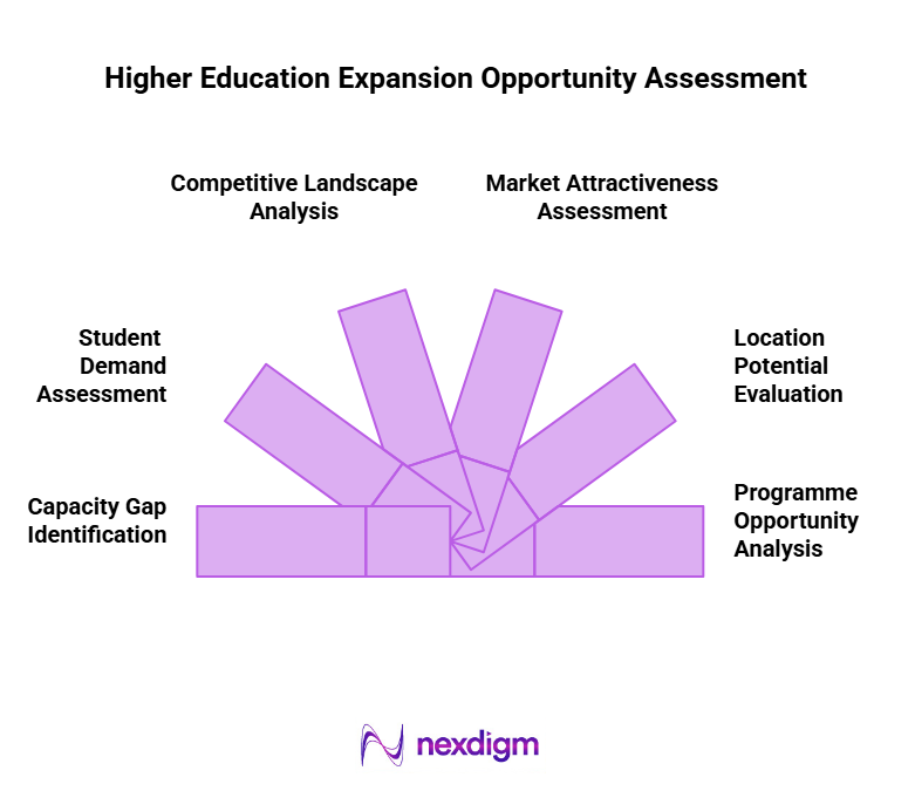
- Student Demand: Measure current and projected student pools across target geographies and academic segments.
- Capacity Gap: Compare available institutional seats with current and projected enrollment demand.
- Competitive Landscape: Benchmark competing universities by programmes, fees, capacity, positioning, and geographic reach.
- Market Attractiveness: Evaluate demographics, participation, affordability, economic conditions, and education-market maturity.
- Location Potential: Assess student concentration, accessibility, catchment areas, infrastructure, and surrounding education ecosystems.
- Programme Opportunity: Identify disciplines where demand and institutional capabilities support additional capacity.
Together, these factors provide a market-level view of where expansion could create the strongest strategic opportunity.
Nexdigm’s Higher Education Expansion Assessment Creating Sustainable Value
Nexdigm’s assessment is designed to support decisions beyond the initial expansion opportunity. By linking demand forecasts with capacity, competition, programme fit, and institutional capabilities, it helps institutions with:
- Smarter Investment: Direct capital toward markets where demand, capacity gaps, competitive conditions, and institutional capabilities indicate stronger potential for sustainable enrollment and long-term returns.
- Scalable Capacity: Align infrastructure, faculty, programmes, and student capacity with realistic enrollment expectations, allowing institutions to expand progressively without creating unnecessary excess capacity.
- Stronger Positioning: Develop programmes and institutional offerings around underserved student needs, competitive gaps, local preferences, and areas where the institution can establish meaningful differentiation.
- Lower Expansion Risk: Test assumptions around demand, competition, affordability, location, and enrollment potential before committing substantial financial and operational resources to expansion.
- Long-Term Growth: Create a structured roadmap for phased campus development, programme additions, partnerships, capacity expansion, and entry into additional markets as demand develops.
By connecting market opportunity with institutional readiness, Nexdigm helps transform expansion planning into a more disciplined, evidence-based growth strategy. The assessment enables institutions to prioritize viable markets, manage investment risks, build capacity progressively, and create an expansion pathway that can adapt to changing demand and competitive conditions.
Nexdigm’s Case Study
Nexdigm supported an education institution evaluating expansion across multiple regions. The engagement assessed 14 potential markets, benchmarked 30+ competing institutions, and compared three expansion models, identifying four priority markets where student demand, capacity gaps, and competitive conditions supported further investment evaluation.
To take the next step, simply visit our Request a Consultation page and share your requirements with us.
Harsh Mittal
+91-8422857704