

India’s higher education system has expanded substantially over the past decade, but expansion at the system level does not automatically make every new campus or programme commercially viable.
AISHE 2023–24 recorded 4.50 crore students in higher education, up from 3.42 crore in 2014–15. The gross enrolment ratio reached 30.0% in 2023–24, compared with 23.7% in 2014–15. The number of universities also increased from 760 to 1,289 over the same period.
For an institution considering a new campus, programme or delivery model, the relevant question is therefore narrower: can the target market generate sufficient enrolment at an economically sustainable fee level, and can the institution deliver an outcome that remains competitive?
A Large Student Pool Does Not Guarantee Enrolment
Higher education demand is increasingly segmented by programme, geography, affordability and career objective.
Undergraduate students accounted for 3.45 crore of India’s higher-education enrolment in 2023–24, while postgraduate enrolment stood at 57.85 lakh. PhD enrolment reached 3.43 lakh, compared with 1.17 lakh in 2014–15.
These different segments have very different economics.
A university evaluating a new undergraduate programme may need to attract a large student volume to justify faculty and infrastructure costs. A specialised postgraduate or doctoral programme may operate at a smaller scale but require stronger academic credentials, specialist faculty and research infrastructure.
Feasibility therefore begins with defining the specific student market rather than applying overall higher-education growth to an individual programme.
The Economics Need to Work Before the Campus Does
A programme can show strong student interest and still produce weak economics if its delivery costs are too high.
The assessment should examine:
- expected enrolment by programme and year;
- tuition and other student revenue;
- faculty and administrative costs;
- infrastructure and laboratory requirements;
- marketing and student-acquisition costs;
- scholarships and fee discounts;
- regulatory and accreditation requirements; and
- capacity utilisation over the investment period.
The resulting model can show whether the proposed programme reaches sustainable utilisation and when the investment could reasonably move toward operating break-even.
This is particularly important for programmes requiring specialist facilities. Engineering, medicine, laboratory-based sciences and other technical disciplines may have substantially different capital and faculty requirements from classroom-based programmes.
Competition Has to Be Measured at Programme Level
The relevant competitor is rarely every university in a state.
Students comparing an engineering programme may consider institutions with similar fees, location, accreditation, placement records and specialisations. A management programme may compete across a different institutional set. Online and hybrid providers can also widen the competitive field beyond the immediate geographic market.
India’s higher education network included 48,246 colleges in 2023–24.
A feasibility study should therefore map competing programmes rather than simply count institutions. Seat capacity, enrolment, fee levels, faculty profiles, infrastructure and positioning can reveal whether a market is underserved or already crowded.
Graduate Outcomes Complete the Demand Assessment
Student demand is increasingly connected to what happens after graduation.
AISHE reported higher-education out-turn of more than 1.09 crore students in 2023–24, compared with 88.28 lakh in 2014–15.
For prospective students, the value of a programme can depend on employment prospects, further-study pathways, professional recognition and the reputation of the institution.
For a new programme, this means graduate outcomes should be treated as part of the market proposition. Employer demand, relevant occupations, internship availability and placement performance can help determine whether projected student demand is likely to translate into sustained enrolment.
From Enrolment Forecasts to Investment Decisions
For institutions evaluating higher education market feasibility study requirements, Nexdigm can connect student demand with programme economics, competition and outcome expectations to determine whether a proposed expansion has a defensible commercial case.
Nexdigm’s Higher Education Feasibility Framework
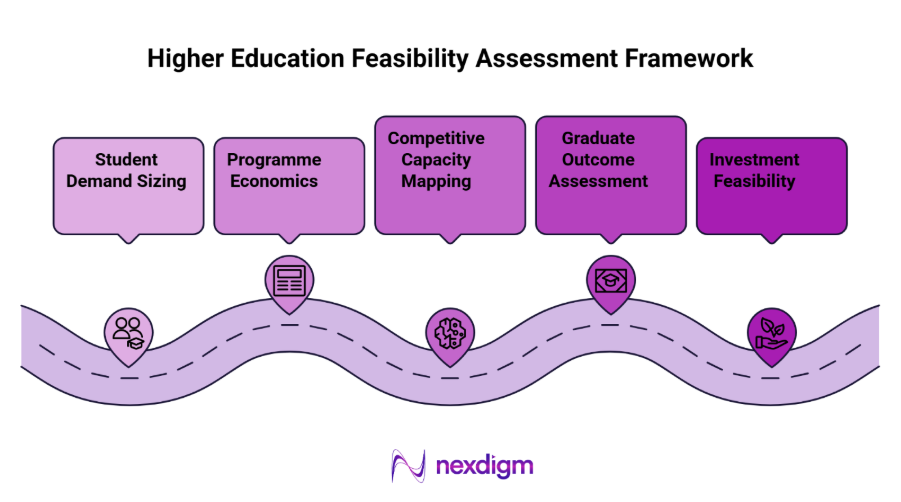
- Student Demand Sizing
Define the relevant student population by geography, academic background, programme preference and affordability. - Programme Economics
Model enrolment, tuition revenue, faculty requirements, infrastructure costs and operating expenses. - Competitive Capacity Mapping
Assess comparable institutions and programmes by fees, capacity, positioning, facilities and student outcomes. - Graduate Outcome Assessment
Examine employment pathways, employer demand, placement performance and further-study opportunities relevant to the proposed programme. - Investment Feasibility
Test enrolment, pricing and cost scenarios to assess capacity requirements, financial sustainability and expansion priorities.
Case Study: Assessing an International School Entry Market
A leading UK-based educational institute engaged Nexdigm to assess India’s international-school landscape before expansion. Nexdigm conducted qualitative and quantitative research and interviewed 25+ ecosystem stakeholders, including government representatives, school executives, parents and associations. The study assessed programmes for ages 5–17, competitors, business models, fees, curriculum and regulatory requirements, supporting the client’s India entry strategy.
Higher education feasibility ultimately requires more than a student-count forecast. The investment case depends on whether sufficient demand exists for the proposed programme, whether the institution can compete for that demand and whether the resulting economics justify the required capacity.
Nexdigm can support institutions and education investors with demand sizing, programme assessment, competitive research, financial feasibility and market-entry analysis.
To take the next step, simply visit our Request a Consultation page and share your requirements with us.
Harsh Mittal
+91-8422857704