

The hospital equipment market is expanding as healthcare providers invest in diagnostics, critical-care infrastructure, surgical technologies, monitoring systems, and connected equipment. The global hospital equipment and supplies market was estimated at $110.3 billion in 2025 and is projected to reach $156.4 billion by 2032, representing a 6.9% CAGR. Asia-Pacific is expected to be the fastest-growing region during this period.
Demand is also being shaped by rising hospital activity and higher equipment costs. In 2025, hospital inpatient volumes increased by 5.3%, while spending on hospital supplies increased by 9.9%. Hospitals also spent more than $10 billion on surgical and medical instruments and nearly $1.4 billion on diagnostic imaging equipment in the latest available data.
With suppliers spanning multiple equipment categories and geographic markets, hospital equipment vendor landscape analysis can help organizations understand who operates in the market, what they offer, how extensively they serve customers, and where meaningful supplier differences exist.
The Hospital Equipment Market Is Broad and Fragmented
Hospital equipment encompasses a wide range of products, from patient monitoring and diagnostic imaging to surgical systems, critical-care equipment, sterilization technologies, and hospital infrastructure. Suppliers may specialize in one category or maintain broad portfolios across multiple clinical areas. This makes supplier comparison more complex than simply identifying the largest vendors. Organizations need to understand portfolio depth, manufacturing scale, geographic reach, service infrastructure, and category-specific capabilities to determine which suppliers are relevant for different sourcing needs.
Supplier Diversity Adds Another Layer to the Market
The hospital equipment market includes global manufacturers, regional specialists, niche technology providers, and emerging suppliers. Their capabilities can differ significantly by equipment category, geography, and service model. For procurement teams, understanding this diversity can reveal alternative sourcing options, category-specific specialists, and potential gaps in supplier coverage, making the vendor landscape more useful for both immediate sourcing and longer-term procurement planning.
How Nexdigm Brings Clarity to a Diverse Supplier Market
With suppliers differing in scale, specialization, geography, and service capabilities, Nexdigm can help organizations organize the market into a more actionable supplier view:
- Segment the Supplier Base: Classify vendors by equipment category, portfolio breadth, geographic presence, scale, and specialization.
- Map Capability Differences: Assess where suppliers have stronger manufacturing, technology, distribution, or service capabilities.
- Identify Relevant Alternatives: Highlight regional specialists, niche manufacturers, and emerging suppliers that may expand sourcing options.
- Assess Market Coverage: Identify categories or regions where supplier availability, service infrastructure, or competitive choice may be limited.
- Support Supplier Prioritization: Translate the landscape into a focused universe of vendors aligned with specific procurement requirements.
Through hospital equipment vendor landscape analysis, Nexdigm can help turn a fragmented supplier market into a structured view of relevant vendors, competitive gaps, and potential sourcing opportunities.
Nexdigm’s Supplier Landscape Analysis
A mapped supplier base becomes more valuable when it informs actual procurement choices. Nexdigm can help organizations use hospital equipment vendor landscape insights to support decisions across the sourcing cycle:
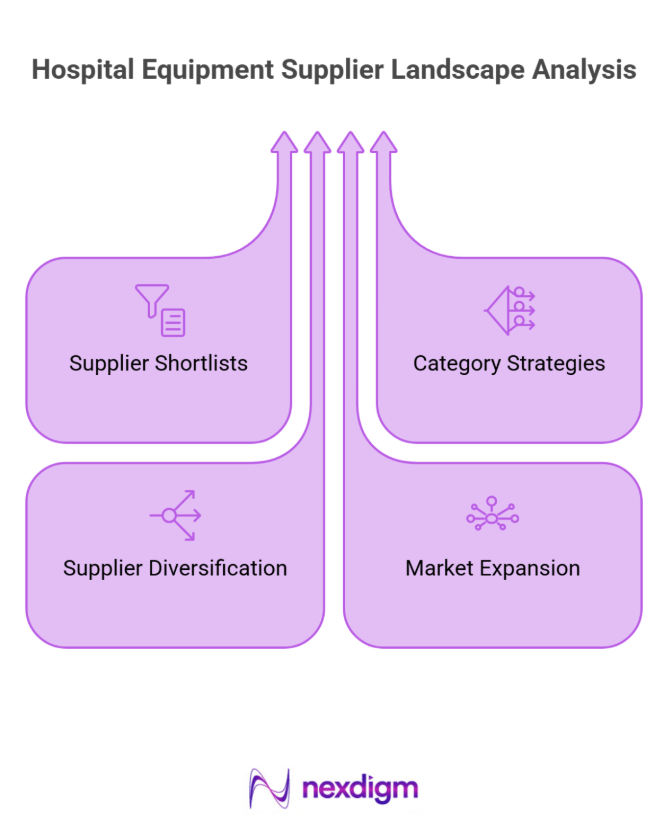
- Build Supplier Shortlists: Narrow a broad market universe to vendors that meet defined product, geographic, service, and capability requirements.
- Plan Category Strategies: Understand whether categories are better suited to multi-sourcing, specialist suppliers, regional sourcing, or broader supplier partnerships.
- Support Supplier Diversification: Identify credible alternatives where current sourcing is concentrated among a limited number of vendors.
- Guide Market Expansion: Assess suppliers that can support new facilities, regions, equipment categories, or evolving healthcare requirements.
This allows Nexdigm to connect supplier landscape intelligence with practical procurement planning, making the analysis useful beyond market mapping.
How Nexdigm’s Vendor Landscape Analysis Creates Significant Impact
Nexdigm’s structured hospital equipment vendor landscape can give procurement and business teams a clearer basis for evaluating the market and making sourcing decisions:
- Greater Supplier Visibility: Create a consolidated view of relevant manufacturers, specialists, regional players, and emerging vendors.
- Better Supplier Discovery: Identify suppliers that may not appear through existing procurement channels but have relevant products or capabilities.
- Stronger Sourcing Choices: Compare portfolio breadth, scale, service coverage, and geographic presence before narrowing the supplier universe.
- Reduced Supplier Dependence: Identify alternative vendors and regional options where sourcing is concentrated among a limited supplier group.
- More Informed Market Decisions: Use supplier intelligence to support category planning, market entry, expansion, and longer-term sourcing strategies.
Overall, the analysis helps organizations move from knowing who operates in the market to understanding which suppliers are relevant, differentiated, and strategically valuable.
Nexdigm’s Case
A healthcare organization mapped 45 hospital equipment suppliers across four markets using Nexdigm’s hospital equipment vendor landscape approach. The analysis identified 22% of suppliers with broad multi-category capabilities, while 19% demonstrated stronger regional service coverage. The findings helped procurement expand its supplier universe and refine its sourcing strategy across key equipment segments.
To take the next step, simply visit our Request a Consultation page and share your requirements with us.
Harsh Mittal
+91-8422857704