

Healthcare infrastructure investment is now about maximizing operating returns. Hospitals can expand through construction, redevelopment, acquisitions, specialty additions, or technology upgrades, each addressing different constraints. New builds suit markets short on beds, while modernization and throughput improvement add value where space exists.
ICRA projects 18 large Indian hospital chains will add over 34,000 beds between FY2026 and FY2030, a 48–50% capacity increase with investments exceeding ₹40,000 crore. Notably, 38–40% of these additions are planned in Tier II and III cities.
Capacity Expansion Is Becoming More Selective
The need for additional beds remains significant, but national averages provide limited guidance on where they should be added. A hospital can operate in a market with adequate aggregate capacity while still facing shortages in critical care, oncology, cardiac care, diagnostics, or high-volume surgical specialties.
This makes infrastructure planning increasingly dependent on the local demand-capacity relationship:
- Catchment population and demographic growth
- Current and projected bed capacity
- Occupancy and patient throughput
- Specialty-level demand and unmet need
- Referral flows into and out of the market
- Existing provider quality and positioning
ICRA’s latest hospital-sector assessment indicates that private hospitals already account for approximately 59–60% of available hospital beds in India, while continued capacity expansion is being driven by sustained demand and the relative limitations of public infrastructure.
Greenfield Projects Work When the Market Can Absorb Them
Greenfield hospitals provide the greatest design flexibility. Developers can determine the location, bed mix, operating model, diagnostics footprint, critical-care capacity, and technology architecture from the outset. This can be particularly valuable when entering a growing catchment with limited organized healthcare capacity.
However, the economy depends heavily on ramp-up. Land, construction, equipment, clinical recruitment, licensing, financing, and pre-opening expenses are incurred before the facility reaches mature utilization.
Recent expansion plans demonstrate the range of capital involved. Apollo Hospitals, for example, has outlined projects spanning greenfield facilities, brownfield expansions, acquisitions, and leased assets across multiple Indian markets. Its disclosed expansion portfolio illustrates why infrastructure decisions increasingly need to be evaluated at the individual project level rather than through a single per-bed benchmark.
Existing Assets Can Offer a Faster Route to Capacity
Brownfield expansion and asset acquisition can make more sense where demand already exists but the existing network lacks sufficient capacity. Expanding an operating hospital can preserve its catchment, physician relationships, brand recognition, and referral base while adding beds or strengthening high-value service lines.
The economics can also differ materially from a new facility because the operator may already possess supporting infrastructure, clinical teams, diagnostics, and patient acquisition channels.
The trade-off is operational complexity. Construction within an active hospital can disrupt patient flows, constrain layouts, and require phased implementation. The investment case therefore depends on whether additional capacity can materially improve utilization and revenue without compromising existing operations.
Infrastructure Is Also About Throughput
Hospitals may not need more floor space to expand capacity, since bottlenecks in operating rooms, emergency departments, diagnostics, pharmacy, discharge, or bed turnover often constrain output. Digital infrastructure can unlock this latent capacity. The digital healthcare supply‑chain market is projected to grow from USD 3.5 billion in 2025 to USD 6.7 billion by 2033, driven by investments in visibility, inventory management, cloud platforms, and analytics. For operators, the key question is whether technology such as predictive bed management, automated inventory, workflow digitization, and integrated clinical systems can boost utilization before new buildings are required.
The Investment Decision Should Follow the Constraint
The most attractive infrastructure project is therefore not necessarily the largest or newest facility. It is the project that addresses the binding constraint in a market and produces an economically viable increase in capacity or productivity.
A Hospital infrastructure market study should connect four questions:
- Where is demand growing? Assess catchment demographics, income, disease burden, insurance coverage, patient mobility, and referral patterns.
- Where is capacity constrained? Benchmark beds, occupancy, specialty capacity, diagnostics, operating rooms, ICU availability, and competing facilities.
- What type of investment resolves the constraint? Compare greenfield construction, brownfield expansion, acquisition, specialty centers, ambulatory facilities, and digital modernization.
- Which option produces the strongest economics? Model capex, ramp-up, utilization, revenue per occupied bed, operating margins, financing requirements, and expected returns.
Nexdigm’s Hospital Infrastructure Investment Lens
The analysis begins at the catchment level rather than assuming that national bed shortages automatically translate into viable projects.
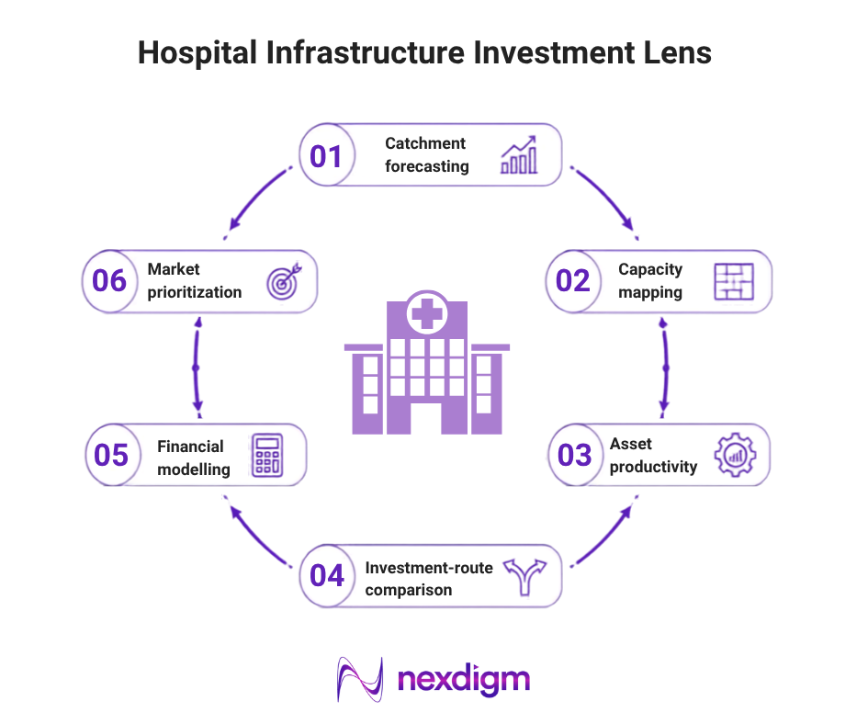
- Catchment forecasting: Project population, income, demographics, disease burden, and healthcare utilization to estimate future demand.
- Capacity mapping: Benchmark existing beds, specialties, occupancy, diagnostics, ICU capacity, and planned additions by competitor.
- Asset productivity: Identify whether low throughput results from insufficient infrastructure or operational constraints within existing facilities.
- Investment-route comparison: Evaluate greenfield, brownfield, acquisition, specialty, and ambulatory models against cost, timeline, and capacity potential.
- Financial modelling: Estimate capex, ramp-up, utilization, revenue, operating margins, payback, and return potential.
- Market prioritization: Rank locations and projects according to demand visibility, competitive intensity, infrastructure gaps, and investment attractiveness.
This approach allows investors and operators to distinguish between markets that genuinely require new physical capacity and assets where modernization can create more value.
How Nexdigm Prioritizes the Right Infrastructure Path
A hospital operator evaluated 20 potential expansion locations and existing facilities. Nexdigm’s assessment separated markets requiring greenfield capacity from those where brownfield expansion or modernization could address the underlying constraint. The resulting prioritization directed capital toward markets with stronger demand visibility and faster capacity ramp-up.
For healthcare operators, investors, and infrastructure funds, the objective is not simply to add capacity. It is to determine which capacity, in which market, through which investment model, and at what level of capital intensity.
To take the next step, simply visit our Request a Consultation page and share your requirements with us.
Harsh Mittal
+91-8422857704
[email protected]