

Hospital IT procurement is increasingly shaped by the need to connect clinical systems, administrative platforms, patient-facing technologies, analytics, and emerging digital tools. As of 2024, more than 99% of U.S. non-federal acute care hospitals had adopted certified electronic health records, establishing a broad digital foundation across the sector.
Interoperability is also becoming a core procurement consideration. In 2025, 76% of U.S. hospitals engaged in all four measured health-information exchange activities, including sending, receiving, finding, and integrating health information.
At the same time, technology environments are becoming more interconnected. In 2024, 91% of hospitals integrated data from third-party technology for at least one clinical purpose, while 87% did so for at least one administrative purpose.
For hospitals, therefore, hospital IT procurement research needs to go beyond identifying technology vendors. It must connect technology requirements with vendor capabilities, integration considerations, implementation readiness, and long-term procurement value.
Hospital IT Procurement Is Becoming More Interconnected
Technology procurement is no longer limited to selecting an individual software application or infrastructure component. Hospitals increasingly need to consider how new technologies interact with existing EHRs, departmental applications, analytics platforms, patient-facing systems, and administrative tools. This makes technology compatibility, interoperability, scalability, implementation complexity, and lifecycle value important parts of procurement planning.
Questions That Guide the Procurement Process
Before comparing vendors, hospitals can establish a clearer view of what the technology investment needs to accomplish:
- What Does the Hospital Need? Define clinical, administrative, operational, data, security, integration, and user requirements before approaching the vendor market.
- Which Vendors Can Deliver? Map providers according to functionality, technology capabilities, healthcare experience, implementation resources, scalability, and market presence.
- Can the Organization Implement It? Evaluate integration complexity, migration, infrastructure, training, change management, support, and internal readiness.
Together, these questions help procurement teams move from technology discovery toward a more practical and implementation-ready sourcing strategy.
Nexdigm’s Approach to Hospital IT Procurement Research
Nexdigm can combine market research, technology intelligence, vendor assessment, procurement analysis, and healthcare-sector expertise to help hospitals structure complex IT procurement decisions.
Through hospital IT procurement research, Nexdigm can examine technology requirements, vendor landscapes, functional capabilities, interoperability, implementation readiness, commercial models, and market positioning.
The approach can help organizations understand not only which technologies are available, but also which vendors are relevant, what implementation considerations may arise, and where procurement opportunities exist.
Nexdigm’s Technology Needs Mapping
A strong procurement process begins with a clear understanding of the technology environment. Nexdigm can help map requirements across:
- Clinical Systems: Identify requirements for EHRs, clinical applications, diagnostic systems, decision support, patient engagement, and care coordination.
- Administrative Systems: Assess needs across finance, revenue cycle, scheduling, workforce, procurement, supply chain, and enterprise management.
- Data & Analytics: Identify requirements for reporting, business intelligence, data platforms, analytics, interoperability, and information exchange.
- Infrastructure & Security: Consider cloud, networks, cybersecurity, storage, infrastructure resilience, access controls, and technology support requirements.
- Integration Requirements: Map dependencies between new technology and existing systems to identify interfaces, APIs, data flows, and interoperability needs.
This creates a technology requirements baseline against which potential vendors can subsequently be evaluated.
Nexdigm’s Expanded View of the Hospital IT Procurement Analysis
Nexdigm can broaden the vendor search beyond established market leaders by mapping providers according to the hospital’s specific technology requirements and procurement priorities:
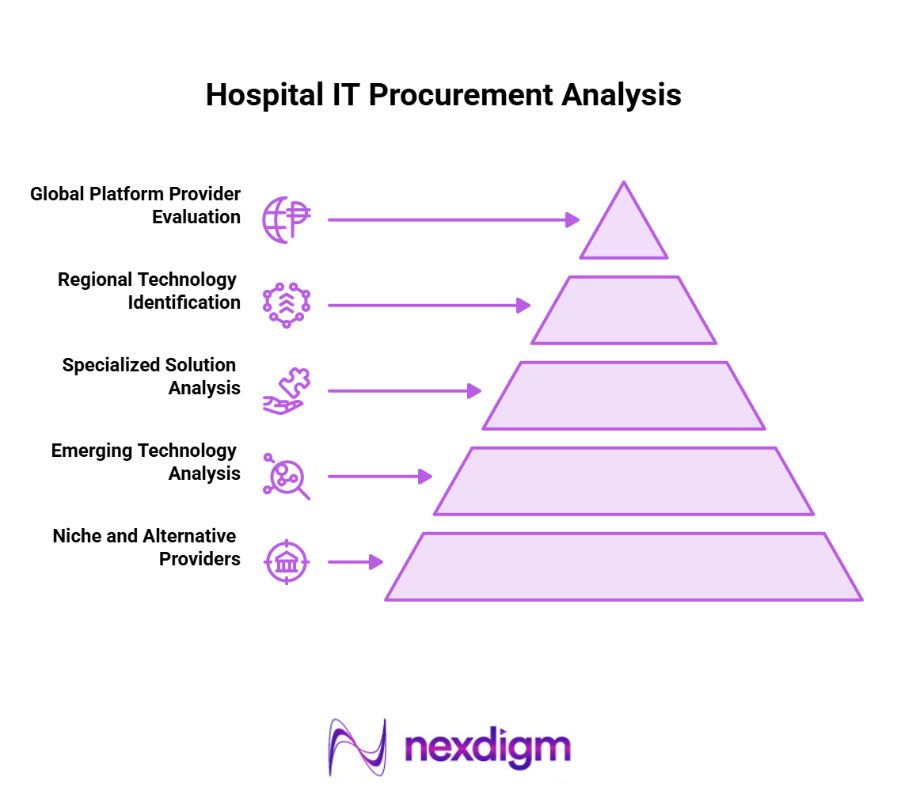
- Global Platform Providers: Assess large vendors offering broad technology portfolios, established healthcare presence, extensive implementation resources, and multi-functional platforms.
- Regional Technology Providers: Identify vendors with stronger geographic relevance, localized support capabilities, market knowledge, and potentially greater flexibility for specific hospital environments.
- Specialized Solution Providers: Evaluate niche vendors offering deeper functionality for particular clinical, administrative, analytical, or operational requirements that broader platforms may not fully address.
- Emerging Technology Companies: Identify newer providers introducing innovative solutions, specialized capabilities, or alternative technology models that could address evolving hospital requirements.
- Niche and Alternative Providers: Explore smaller or highly focused vendors where specialized functionality, implementation flexibility, or category-specific expertise may offer a better fit.
This broader mapping gives hospitals a more complete view of the available supplier landscape, helping them compare alternatives based on relevance, capability, implementation fit, and procurement priorities rather than relying only on incumbent or familiar vendors.
How Nexdigm’s Procurement Analysis Adds Value
Nexdigm’s broader vendor mapping can help hospitals move beyond familiar suppliers and identify relevant alternatives, capability gaps, sourcing opportunities, and potential implementation of trade-offs. By comparing providers across technology fit, specialization, geographic presence, implementation capability, and commercial positioning, the analysis can strengthen vendor shortlisting and give procurement teams a broader basis for negotiations and technology investment decisions.
Nexdigm’s Case
Nexdigm supported a healthcare organization in assessing hospital IT vendors across technology capabilities, implementation readiness, and commercial fit. The analysis found 29% with strong technology alignment, 22% with higher implementation readiness, and 15% with competitive commercial models, helping the organization narrow its vendor pool and prioritize the most relevant technology options.
To take the next step, simply visit our Request a Consultation page and share your requirements with us.
Harsh Mittal
+91-8422857704