

Improving hospital operational efficiency has become a critical part to focus for organizations striving to reduce costs while maintaining high-quality patient care in today’s competitive healthcare landscape. A Hospital Operational Efficiency Analysis reveals that even modest improvements in operational processes can lead to significant financial savings. By leveraging competitive intelligence, hospitals can identify areas for optimization, streamline workflows, and enhance resource management.
Hospitals with efficient operations can save up to 15% of their annual operating costs. Nexdigm found that optimizing hospital workflows can reduce labor costs by 10-15%, while better supply chain management can yield savings of up to 20%. Additionally, The Healthcare Financial Management Association (HFMA) reports that automation and process improvements have led to an average cost reduction of 5-10% in hospitals across the U.S.
This data-driven approach allows hospitals to stay ahead of industry trends, better allocate their resources, and outperform competitors. Through strategic improvements, hospitals can achieve up to 15% in cost savings, ultimately driving both financial sustainability and improved patient outcomes.
Using Competitive Intelligence to Identify Cost-Saving Opportunities
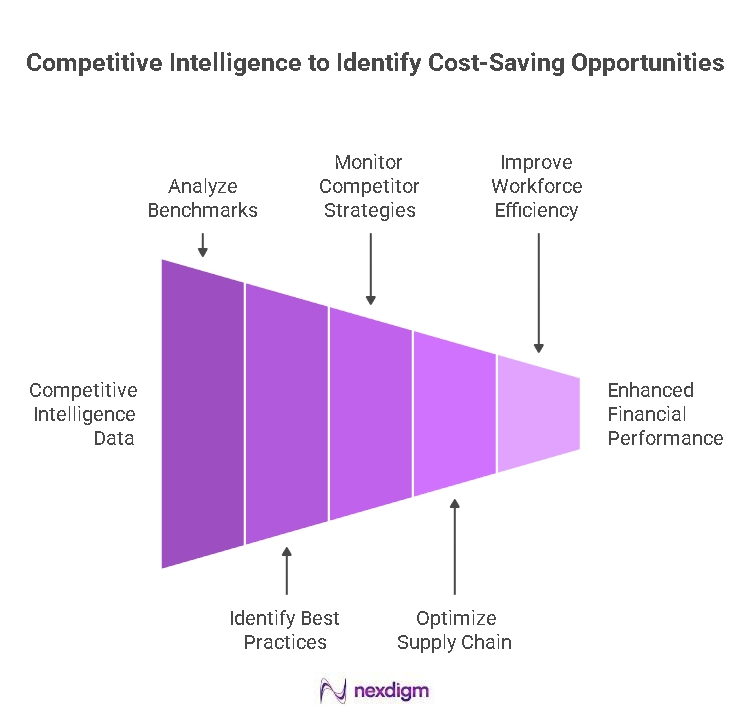
Using competitive intelligence, hospitals can analyze industry trends, competitor strategies, and operational benchmarks to identify inefficiencies, optimize resource allocation, and uncover cost-saving opportunities, ultimately improving financial performance and operational effectiveness:
-
Analyzing Industry Benchmarks for Efficiency Gains
Comparing performance metrics with industry standards helps identify areas where hospitals can improve efficiency and reduce costs.
-
Identifying Best Practices through Peer Comparisons
Studying peer organizations allows hospitals to adopt best practices in areas like staffing, supply chain, and technology use.
-
Monitoring Competitor Strategies for Cost Reduction
Tracking competitors’ successful cost-saving strategies enables hospitals to adopt best practices and stay competitive in operational performance.
-
Optimizing Supply Chain Management
Competitive intelligence on suppliers’ pricing and inventory systems helps hospitals negotiate better contracts and reduce supply chain costs.
-
Improving Workforce Efficiency
Competitive intelligence tools can help assess staffing trends, optimize scheduling, and reduce labor costs without sacrificing care quality.
Utilizing Nexdigm’s Technological Expertise to Streamline Hospital Operations
Nexdigm’s technological expertise helps hospitals streamline operations by integrating advanced solutions like automation, data analytics, and AI-driven tools. These technologies enhance workflow efficiency, reduce manual errors, and improve decision-making processes. By leveraging Nexdigm’s services, hospitals can optimize administrative tasks, improve patient care delivery, and enhance overall operational effectiveness, leading to significant cost savings. Their tailored technology solutions ensure hospitals stay competitive while improving productivity and resource management.
Nexdigm’s Comprehensive Healthcare Solutions for Cost Reduction
Nexdigm offers comprehensive healthcare solutions focused on cost reduction through process optimization, advanced data analytics, automation, and strategic insights. Their tailored services help hospitals streamline operations and maximize resource efficiency, driving significant savings.
-
Data Analytics for Informed Decision-Making
Nexdigm uses data analytics to identify inefficiencies, optimize resource allocation, and uncover opportunities for significant cost reduction.
-
Automation of Administrative Processes
Streamlining administrative tasks like billing and scheduling through automation reduces labor costs and minimizes human errors in healthcare settings.
-
Supply Chain Optimization
Nexdigm improves supply chain management, reducing waste and ensuring cost-effective procurement, inventory management, and distribution of medical supplies.
-
Workforce Optimization and Management
By optimizing staffing and workforce scheduling, Nexdigm helps hospitals minimize overtime and labor costs without compromising patient care quality.
Nexdigm’s case:
In a recent Nexdigm healthcare engagement, a global eye‑care company underwent end‑to‑end digitization of cross‑functional processes. The solution cut turnaround time for distributor claims from 30 days to 5, reduced accrual effort by 95%, and delivered 30% cost efficiency to the client. It also improved data accuracy to 100% and reduced rework by 60%, demonstrating measurable operational and financial impact.
To take the next step, simply visit our Request a Consultation page and share your requirements with us.
Harsh Mittal
+91-8422857704