

Hospital service benchmarking has become a crucial tool for healthcare institutions to stay competitive in an increasingly demanding environment. As patient expectations continue to rise, particularly in urban hospitals, institutions are turning to benchmarking to measure and improve their services. By comparing key performance indicators (KPIs) such as patient satisfaction, treatment times, and facility cleanliness, hospitals can identify strengths and areas for improvement.
A 70% of urban hospitals are actively engaging in service benchmarking to keep up with rising patient demands. According to a report, over 60% of patients now rate hospital experiences based on factors like speed of service and personalized care. Additionally, 75% of healthcare providers acknowledge that enhancing service quality through benchmarking is essential for maintaining patient loyalty and competitiveness.
This process, rooted in competitive intelligence, allows hospitals to adapt, innovate, and provide high-quality care, ensuring they meet rising expectations while remaining competitive in a rapidly evolving healthcare landscape. This shift highlights the growing importance of data-driven decisions in improving hospital performance and meeting patient expectations.
How Competitive Intelligence Drives Hospital Service Improvements
Competitive intelligence helps hospitals identify industry trends, assess competitors’ strengths, and pinpoint service gaps. By using this data, hospitals can improve care quality, optimize operations, and meet rising patient expectations effectively:
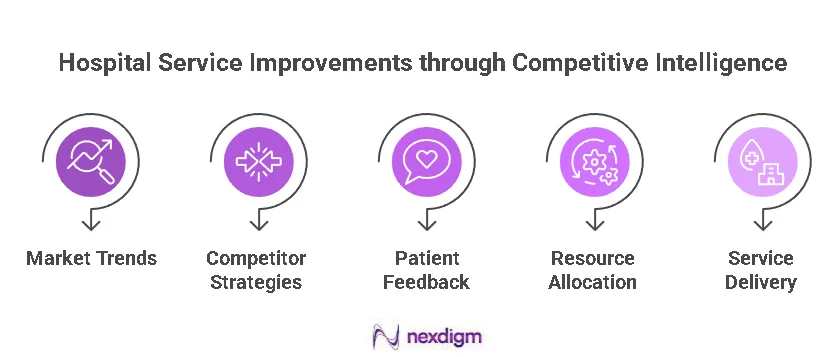
- Identifying Market Trends: Competitive intelligence reveals emerging healthcare trends, enabling hospitals to adapt services and stay ahead of patient needs.
- Analyzing Competitor Strategies: Hospitals track competitors’ service offerings, allowing them to adopt best practices and differentiate their services effectively.
- Assessing Patient Feedback: By evaluating competitor patient reviews, hospitals can identify areas for improvement and enhance their own patient experience.
- Optimizing Resource Allocation: Competitive intelligence helps hospitals allocate resources efficiently, ensuring faster service delivery and higher patient satisfaction.
- Innovating Service Delivery: Insights from competitive intelligence guide hospitals in implementing innovative technologies and practices to improve service quality and efficiency.
Nexdigm’s Services to Meet Rising Patient Expectations
Nexdigm offers tailored competitive intelligence and benchmarking solutions to help hospitals address rising patient expectations. By leveraging data-driven insights, Nexdigm enables healthcare providers to assess competitors, optimize service delivery, and improve patient satisfaction. Their services help hospitals stay competitive by identifying trends, enhancing operational efficiency, and adopting innovative practices that meet and exceed evolving patient demands.
Nexdigm’s Advanced Analytics for Healthcare Performance Improvement
Nexdigm’s advanced analytics provide hospitals with actionable insights to enhance healthcare performance. By analyzing key healthcare performance metrics, they help improve operational efficiency, optimize patient care, and drive better decision-making for service improvement.
- Data-Driven Decision Making: Nexdigm’s analytics empower hospitals to make informed decisions, improving care quality and operational efficiency based on real-time data insights.
- Performance Metrics Optimization: By analyzing key performance indicators, Nexdigm helps hospitals identify bottlenecks, streamline workflows, and enhance service delivery.
- Predictive Analytics for Healthcare Trends: Nexdigm uses predictive models to forecast patient needs, helping hospitals stay proactive in service planning and resource allocation.
- Cost Reduction through Analytics: By identifying inefficiencies, Nexdigm’s analytics support hospitals in reducing unnecessary expenses while maintaining high-quality patient care.
Nexdigm’s case:
Nexdigm engaged to benchmark performance against 12 competitior institutions using competitive intelligence and service metrics. After redesigning workflows and patient engagement processes, the hospital achieved a 14% improvement in patient satisfaction and a 17% reduction in average wait times within four months.
To take the next step, simply visit our Request a Consultation page and share your requirements with us.
Harsh Mittal
+91-8422857704