

Enterprises rarely operate entirely within a single technology environment. Many continue to run critical applications and sensitive workloads in private infrastructure while using public cloud platforms for scalability, analytics, development and digital services. Hybrid cloud has consequently become an important consideration for organisations modernising their IT architecture without abandoning existing investments.
For technology buyers, however, the hybrid cloud market is not made up of one clearly defined supplier category. It includes hyperscale cloud providers, private cloud platform vendors, infrastructure manufacturers, managed service providers and systems integrators. Their capabilities overlap, but their roles in a hybrid environment can be very different.
A structured hybrid cloud supplier landscape research exercise helps enterprises understand this ecosystem, identify relevant providers and assess which combinations of services can support their infrastructure strategy.
Why Hybrid Cloud Procurement Requires an Ecosystem View
Hybrid cloud environments connect private infrastructure with public cloud services through networking, management, security and workload orchestration capabilities. The objective is to allow applications and data to operate across environments while maintaining appropriate controls over performance, cost and governance.
The demand for cloud services continues to expand. Eurostat reported that 52.7% of EU enterprises used paid cloud computing services in 2025, with adoption reaching approximately 84.7% among large enterprises. These figures illustrate the growing importance of cloud capabilities in enterprise technology planning, although adoption rates alone do not indicate which architecture is most suitable for a particular business.
Hybrid cloud decisions are especially relevant where organisations need to retain legacy applications that are difficult or expensive to migrate, keep selected data within controlled environments, expand computing capacity during periods of variable demand, support low-latency workloads close to operational locations or maintain flexibility across different cloud platforms.
These requirements create demand for suppliers that can integrate environments rather than simply provide infrastructure.
Mapping the Hybrid Cloud Supplier Landscape
The market can be divided into five broad supplier groups. Understanding their respective roles prevents procurement teams from comparing fundamentally different offerings as if they were interchangeable.
- Public cloud infrastructure providers offer computing, storage, networking and managed services that can connect with enterprise data centres. Their strengths often include service breadth, geographic reach and access to advanced cloud-native capabilities.
- Private cloud and virtualisation platform providers support infrastructure hosted within enterprise facilities or dedicated environments. Their offerings may include virtualisation, private cloud management, automation and workload portability.
- Hybrid cloud management and orchestration providers help organisations manage applications, resources, policies and workloads across multiple environments. These capabilities are particularly relevant where enterprises need consistent governance and visibility.
- Infrastructure and data centre suppliers provide servers, storage, networking, power and other physical components required to operate private infrastructure.
- Managed service providers and systems integrators support architecture design, migration, integration, monitoring and ongoing operations. Their role can be significant for enterprises without sufficient in-house cloud engineering capacity.
What Separates Leading Suppliers?
Supplier leadership should be evaluated according to the specific capabilities an enterprise needs, not simply the size of a provider’s cloud business.
The comparison should examine four areas. First, architecture compatibility: can the provider integrate with existing infrastructure and applications? Second, workload mobility: what tools support migration, portability and workload management? Third, governance and security: can policies, access controls and compliance requirements be managed consistently? Finally, commercial flexibility: are costs transparent across private infrastructure, public cloud and managed services?
Interoperability deserves particular attention. A hybrid environment can become difficult to manage if tools, APIs, identity systems and monitoring platforms do not work effectively across providers.
Enterprises should also examine the practical limits of portability. Some applications depend on proprietary databases, managed services or platform-specific tools. Moving these workloads may require redevelopment rather than a simple infrastructure transfer.
Comparing Commercial and Operational Models
Hybrid cloud costs are distributed across different parts of the technology environment. Public cloud consumption charges may sit alongside private infrastructure investments, software licences, network connectivity, support contracts and managed services.
A provider offering lower infrastructure pricing may require additional integration or management expenditure. Similarly, a managed service arrangement may reduce internal operational demands but introduce recurring service fees.
Procurement teams should compare the total cost of the hybrid operating model, including private infrastructure acquisition and maintenance, public cloud consumption and data transfer, platform licensing, connectivity, security, integration, migration and ongoing administration.
This provides a more realistic view of supplier economics than comparing individual service rates.
Nexdigm’s Hybrid Cloud Supplier Landscape Assessment Framework
A practical supplier assessment should answer six questions:
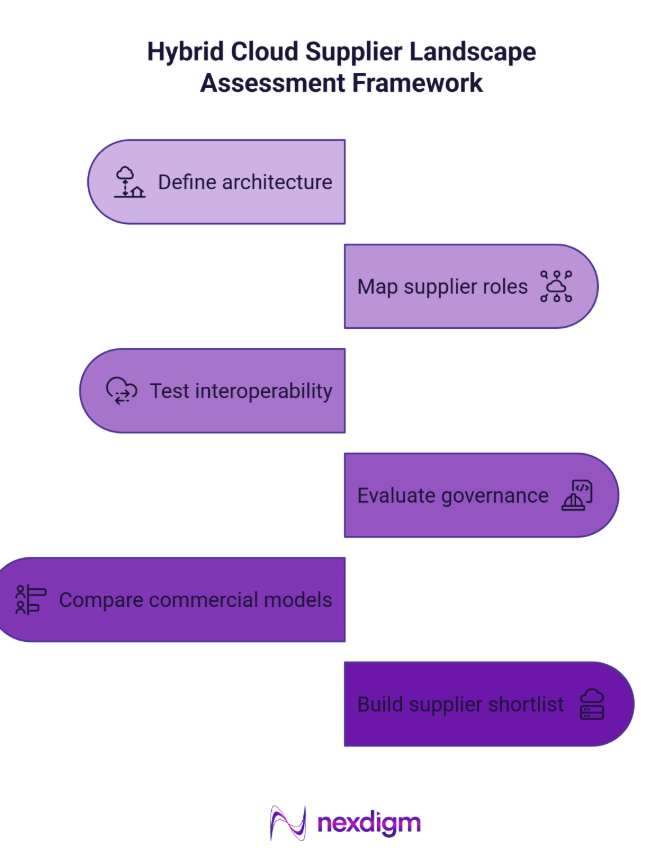
- Define the architecture: Identify which workloads require private infrastructure, public cloud services or a combination of both.
- Map supplier roles: Separate infrastructure vendors, cloud platforms, orchestration providers and managed service partners.
- Test interoperability: Assess integration, portability, identity management, monitoring and data movement capabilities.
- Evaluate governance: Compare security controls, compliance support, data residency and operational accountability.
- Compare commercial models: Calculate infrastructure, licensing, connectivity, management and migration costs across providers.
- Build the supplier shortlist: Match each provider’s strengths to the enterprise architecture and identify gaps requiring additional partners.
Nexdigm can support organisations through hybrid cloud market mapping, supplier intelligence, competitive benchmarking and technology procurement research. This helps technology buyers understand provider positioning, identify capability gaps and evaluate sourcing options across the hybrid cloud ecosystem.
Nexdigm’s Case Study: Mapping Hybrid Cloud Supplier Capabilities
Nexdigm evaluated 14 hybrid cloud suppliers across 5 capability segments, comparing private cloud, public cloud integration, orchestration and managed services. The research mapped 6 supplier categories, identified 4 capability gaps and shortlisted 5 providers for enterprise evaluation.
To take the next step, simply visit our Request a Consultation page and share your requirements with us.
Harsh Mittal
+91-8422857704