

Seed demand across Indian agriculture is expanding, but the opportunity is not distributed evenly across crops or regions. India’s commercial seed sector was valued at approximately $3.91 billion in 2023 and is projected to reach $6.08 billion by 2029, representing a CAGR of 7.41%. Yet market growth alone does not indicate where hybrid seed adoption can accelerate. The more important question is whether the additional yield generated by a hybrid is sufficient to justify its higher seed cost and perceived production risk.
The Hybridization Gap Reveals Where Adoption Has Room to Expand
Hybrid adoption already varies substantially across crops. Bt cotton has reached almost complete hybrid penetration across major growing belts, while commercial maize hybrids account for roughly 70% to 78% of the market. Pearl millet has hybrid penetration of approximately 55% to 60%.
Rice presents a different picture. Commercial hybrid rice penetration remains below 10% despite approximately 45 million hectares under paddy cultivation. Wheat remains predominantly varietal, with no meaningful hybrid market.
These differences suggest that acreage alone cannot determine the size of a hybrid opportunity. A large crop with low hybrid penetration may represent a much larger addressable market than a smaller crop where hybrid adoption is already mature.
Yield Advantage Has to Survive the Seed-Cost Test
Farmers ultimately evaluate the additional economics created by a hybrid.
In irrigated maize, premium hybrid seed packages costing around INR 2,200 to INR 2,600 per acre can support yields of approximately 25 to 30 quintals per acre. Where the yield advantage over open-pollinated selections reaches 25% to 35%, the additional output can more than compensate for the higher seed expenditure.
Rice presents a more complicated equation. Hybrid varieties can generate a physical yield advantage of around 15% to 20%, but higher seed costs, local grain-quality preferences and disease susceptibility can reduce the resulting margin. A technically superior variety therefore does not necessarily translate into stronger farmer adoption.
The relevant commercial metric is incremental farmer income after accounting for the complete cost of adoption.
Irrigation Separates Potential from Actual Demand
Hybrid seeds generally require better moisture and nutrient management to deliver their genetic potential. This creates a significant divide between irrigated and rainfed markets.
Commercial maize belts with dependable tubewell irrigation and established industrial buyers have created conditions for rapid hybrid adoption. Districts across northern Bihar, Karnataka and Telangana demonstrate how irrigation, commercial cropping and private distribution networks can reinforce one another.
Rainfed regions face a different calculation. A farmer may recognise the potential yield advantage of a hybrid but still prefer a lower-cost, more resilient seed if a failed monsoon could eliminate the expected return.
Adoption Is Also a Distribution and Trust Problem
Seed availability influences adoption as much as agronomy. Seasonal shortages, inconsistent dealer coverage, counterfeit products and differences in retailer incentives can create distrust around unfamiliar varieties.
For seed companies, this means that entering an attractive crop market requires more than developing a high-performing variety. The commercial model must account for dealer economics, seasonal inventory, farmer credit, product demonstration and replacement behaviour.
This is particularly important in markets where farmers depend heavily on local retailers or neighbouring farms for product recommendations.
The Next Growth Pools Are Likely to Be Uneven
The most interesting opportunities may sit between mature hybrid markets and completely uncommercialised crops.
Western Rajasthan, for example, offers potential for drought-tolerant pearl millet hybrids where fodder pressure and climatic stress increase the value of yield stability. Rice markets in Chhattisgarh, coastal Andhra Pradesh and eastern Uttar Pradesh could also provide room for adoption if varieties address regional preferences around grain quality and cooking characteristics.
The opportunity therefore needs to be assessed at the crop-region level rather than through national market size alone.
Turning Crop Potential into a Commercial Market Map
A structured hybrid seed market assessment can connect agronomic performance with commercial viability. Nexdigm can evaluate:
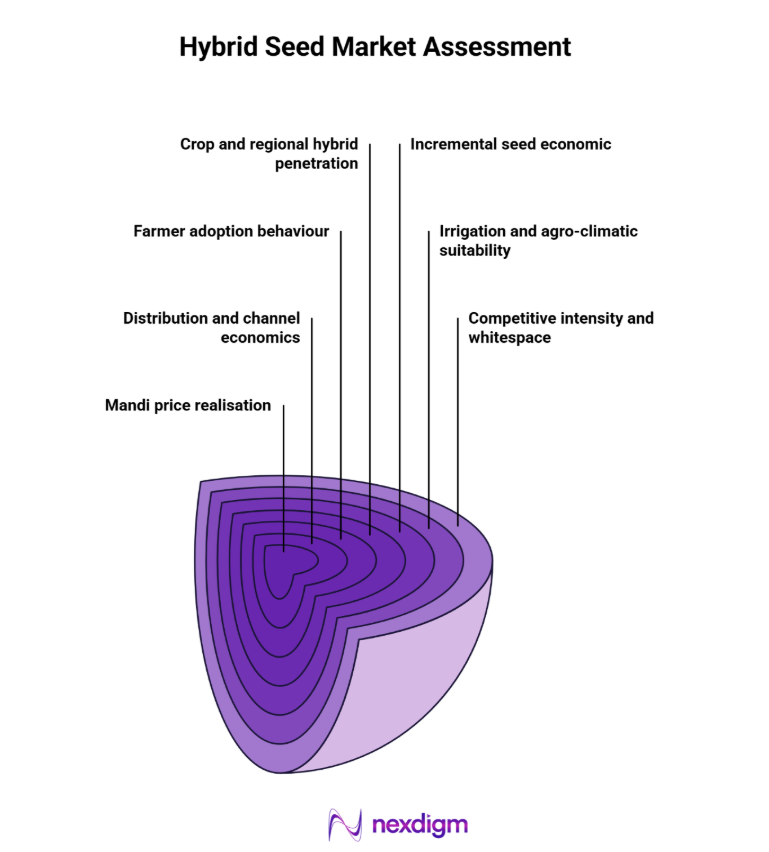
- Crop and regional hybrid penetration: Measure current adoption and seed replacement rates across crops and geographies to identify markets with sufficient headroom for hybridisation.
- Incremental seed economics: Compare the additional cost of hybrid seed with expected yield gains, gross revenue and farmer-level payback to determine whether the value proposition is financially compelling.
- Farmer adoption behaviour: Assess purchasing patterns, repeat usage, varietal preferences and the factors that influence switching from farm-saved or open-pollinated seeds to commercial hybrids.
- Irrigation and agro-climatic suitability: Examine water availability, soil conditions, drought exposure, heat stress and disease pressure to determine whether hybrids can deliver consistent performance under local growing conditions.
- Mandi price realisation: Evaluate whether differences in grain quality, texture, starch content or consumer preferences could affect the price farmers receive and reduce the effective benefit of higher yields.
- Distribution and channel economics: Assess dealer coverage, retailer margins, seasonal inventory requirements, farmer credit and seed availability to understand whether the product can reach target farmers efficiently.
- Competitive intensity and whitespace: Map incumbent seed brands, varietal portfolios, pricing and geographic presence to identify underserved crop-region combinations where a new product could establish a defensible position.
The resulting analysis can help identify where a seed portfolio should expand, which farmer segments to prioritise and where product economics may not support commercial entry.
Case Study: Finding the Profitable Adoption Pocket
A seed company evaluating three northern and western Indian markets compared five crops across 18 districts. The assessment identified a pearl millet cluster covering 2.1 million acres where hybrid penetration was 42%, compared with 58% across the broader target region. A drought-tolerant hybrid priced at INR 1,150 per acre generated an estimated 23% yield improvement and INR 3,900 additional gross income per acre. A targeted two-season rollout was projected to generate INR 82 crore in incremental annual seed sales at 18% market penetration.
To take the next step, simply visit our Request a Consultation page and share your requirements with us.
Harsh Mittal
+91-8422857704