

Hybrid seeds are purchased with a performance expectation. Buyers look for varieties that can deliver suitable yield potential, uniform crop establishment, relevant resistance traits and consistency across the environments in which they will be cultivated. Yet the commercial success of a hybrid seed supplier depends on more than the characteristics of its product. Availability, pricing, technical support, distribution reach and the ability to maintain quality across seed batches also influence its position in the market.
For agribusinesses, distributors and institutional buyers, hybrid seed supplier benchmarking provides a way to compare suppliers across both agronomic and commercial dimensions. The exercise should identify which providers offer the strongest fit for specific crops, production environments and sourcing requirements rather than assume that one supplier will lead across every category.
What Makes a Hybrid Seed Supplier Competitive?
Hybrid seed suppliers operate in a market where product development, field performance and distribution capabilities are closely connected. Their competitiveness depends on how effectively they translate breeding and research capabilities into commercially available products.
A supplier with a large research programme may have a strong pipeline of new hybrids, but buyers also need evidence that these varieties perform consistently under relevant field conditions. Similarly, a competitively priced hybrid may not represent good value if it requires additional agronomic support or produces inconsistent results across locations.
A useful benchmarking exercise separates supplier performance into four areas.
- Agronomic performance includes yield potential, observed field results, germination, vigour, crop establishment, maturity duration and resistance or tolerance to relevant pests, diseases and environmental stresses. Stability across different soil types, weather conditions and cultivation practices should also be considered.
- Product development capabilities cover breeding programmes, research infrastructure, trial networks, varietal pipelines and the supplier’s ability to introduce products suited to changing climatic and regional requirements.
- Commercial competitiveness includes seed pricing, distributor margins, credit arrangements, minimum order quantities, seasonal availability and promotional support. The comparison should consider the full commercial proposition rather than only the packet price.
- Market and field support involves technical advisory services, demonstration plots, dealer training, farmer engagement, complaint resolution and the availability of reliable agronomic information.
The Importance of Crop-Specific Benchmarking
A hybrid that performs strongly in one crop segment cannot automatically be treated as a leading product across the entire seed market. Maize, cotton, rice, pearl millet, sunflower and vegetable hybrids have different agronomic requirements, customer profiles and commercial dynamics.
For instance, a buyer evaluating maize hybrids may prioritise yield performance, maturity period, lodging resistance and suitability for different planting conditions. Cotton sourcing may require closer attention to hybrid characteristics, pest-management requirements, crop duration and applicable regulatory provisions. Vegetable seed procurement may place greater emphasis on fruit quality, uniformity, market preferences and resistance characteristics.
Supplier comparisons should therefore be conducted within clearly defined crop categories and growing environments. Field trial evidence should be reviewed alongside product specifications, with attention to the number of locations, seasons and conditions represented.
Building a Supplier Performance Scorecard
A structured scorecard makes it easier to compare providers without allowing one attractive feature to dominate the evaluation. The weighting should reflect the buyer’s crop portfolio, target markets and procurement priorities.
For example, a buyer sourcing hybrids for a large commercial farming operation may place greater emphasis on field performance, batch consistency and supply reliability. A distributor may prioritise product demand, dealer margins, seasonal availability and technical support.
The scorecard can examine:
- Agronomic performance: Yield evidence, crop establishment, stability and crop-specific traits.
- Research strength: Breeding investment, trial infrastructure and product development pipeline.
- Quality assurance: Germination, purity, seed health and batch consistency.
- Commercial strength: Pricing, availability, margins and contract flexibility.
- Market support: Dealer reach, field assistance and farmer engagement.
Supplier self-assessments should not be treated as conclusive evidence. Trial data, quality certificates, distributor feedback, procurement records and customer references can help validate the results.
Commercial Performance Should Be Measured Over the Full Season
Seed procurement is influenced by seasonal demand, and the commercial performance of a supplier can vary between planting cycles. Buyers should examine whether the supplier can fulfil orders within agreed timelines, maintain adequate inventory and respond when demand changes.
The assessment should also consider how pricing compares with the product’s agronomic value. A higher-priced hybrid may justify its premium if it offers relevant performance advantages and dependable availability. Conversely, a lower-priced product may carry additional risks if field evidence is limited or the supplier has inconsistent quality controls.
Commercial benchmarking should include dealer margins, promotional schemes, replacement terms and payment conditions. These variables can affect distributor profitability and influence whether the product remains commercially attractive across seasons.
Climate Adaptability and Future Supplier Selection
Changing weather patterns are increasing the importance of varietal suitability and resilience. Suppliers need to demonstrate that their product development programmes respond to local growing conditions, including heat stress, water availability, disease pressure and variations in planting schedules.
India’s 2026 government reporting identified 2,996 climate-resilient varieties among 3,236 field crop varieties released and notified between 2014 and 2025. This indicates the scale of public-sector varietal development, but buyers still need to establish whether particular products are suitable for their target markets.
The most useful evidence comes from multi-location trials, agricultural university recommendations and field performance under conditions relevant to the intended sourcing geography.
How Nexdigm Supports Hybrid Seed Supplier Benchmarking
Nexdigm supports agribusinesses through market research, supplier benchmarking, competitive intelligence and commercial analysis. Its work can help clients compare hybrid seed suppliers by crop category, assess market positioning, evaluate distribution capabilities and understand the commercial conditions shaping supplier competitiveness.
Hybrid Seed Supplier Benchmarking Framework
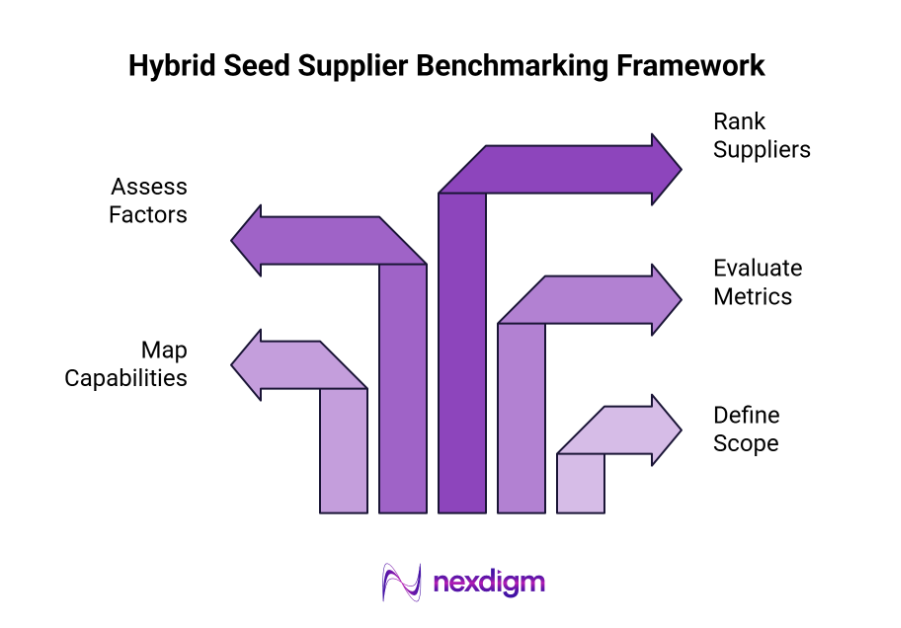
- Define Scope & Requirements: Define the crop segments, target regions, and intended customer requirements.
- Map Supplier Capabilities: Identify suppliers and map their hybrid portfolios, research capabilities, and market presence.
- Evaluate Agronomic & Quality Metrics: Compare field performance, quality indicators, and varietal suitability using consistent evidence.
- Assess Commercial & Support Factors: Benchmark pricing, seasonal availability, distributor economics, and technical support.
- Rank & Shortlist Suppliers: Rank suppliers by crop-specific suitability and commercial competitiveness.
Nexdigm’s Case Study: Benchmarking Hybrid Seed Suppliers
Nexdigm benchmarked 11 hybrid seed suppliers across four crop categories and seven states on 27 agronomic and commercial indicators, giving buyers a vetted shortlist of three priority suppliers to streamline commercial selection.
To take the next step, simply visit our Request a Consultation page and share your requirements with us.
Harsh Mittal
+91-8422857704