

Hyperlocal delivery has built its economics around density. When enough customers live within a small catchment, a dark store can process enough orders to keep riders utilised, spread fixed costs across more transactions and justify a broad local assortment.
India’s quick-commerce network had 5,625 mapped dark stores across 408 cities by July 2026. Yet the top 15 cities accounted for 61% of those stores, showing how strongly infrastructure remains concentrated in large urban markets.
Density Is the Business Model
The economics of rapid delivery depend heavily on the number of orders generated within a limited-service radius. In mature metropolitan markets, dark stores can achieve substantially higher throughput. Industry research in 2025 found mature metro stores handling roughly 2,100–2,600 orders a day, compared with about 1,500–1,700 in Tier 1/2 markets and 1,500–1,550 in Tier 3+ markets.
Lower density affects more than delivery speed. It reduces rider utilisation, limits inventory productivity and increases the cost of maintaining a store for each order served.
Why the Economics Work in the Top Urban Pockets
Large cities provide several advantages simultaneously: dense residential catchments, higher order frequency, larger baskets and established delivery infrastructure.
Metro net average order values were estimated at ₹500–600 in 2025, compared with roughly ₹300–450 in Tier 1/2 cities and ₹250–400 in Tier 3+ markets. The difference matters because a delivery network has relatively fixed costs at the order level. Higher basket values can support better contribution margins without requiring a proportional increase in delivery trips.
The competitive environment is also changing. Flipkart Minutes had expanded to more than 1,000 dark stores across 120–130 cities by September 2026, while established players continue to deepen coverage in major markets.
What Happens When the Catchment Gets Thinner?
Expansion into smaller cities changes the operating equation.
A dark store may require fewer competing facilities and benefit from lower real-estate costs, but it also faces lower order density. The result can be a longer path to store-level profitability.
Recent industry estimates put the operating-profit threshold for a 500 sq. ft. dark store at around 150–200 orders a day, rising to roughly 700 orders for a 2,000 sq. ft. facility.
The relevant market may therefore be large in population terms while remaining unattractive for a dense hyperlocal network.
Basket Size Can Matter More Than Delivery Speed
Lower-density markets need a different economic balance.
A larger basket can improve the economics of each delivery, particularly where order frequency is lower. Product assortment can also shift towards categories with higher margins, stronger purchase intent or less urgency.
The expansion opportunity therefore depends on the relationship between:
- Orders per store
- Average order value
- Delivery radius
- Rider utilisation
- Store operating cost
- Inventory turns
- Local competitive intensity
A market that cannot support high frequency may still support hyperlocal delivery if basket economics and operating costs compensate for lower density.
Beyond Dark Stores
Hyperlocal delivery does not necessarily require replicating the dense metro model everywhere.
Existing retail stores, shared fulfilment facilities, micro-warehouses and larger regional hubs can provide alternative infrastructure. Shared dark-store models are already emerging as a way for specialised quick-commerce businesses to enter markets without bearing the full cost of building their own networks.
This opens a different expansion model: instead of asking whether every city can support a standalone dark-store network, operators can determine which markets require dedicated infrastructure and which can be served through shared or hybrid models.
How Nexdigm Screens Hyperlocal Delivery Opportunities
Nexdigm can assess hyperlocal markets through a five-part commercial viability framework:
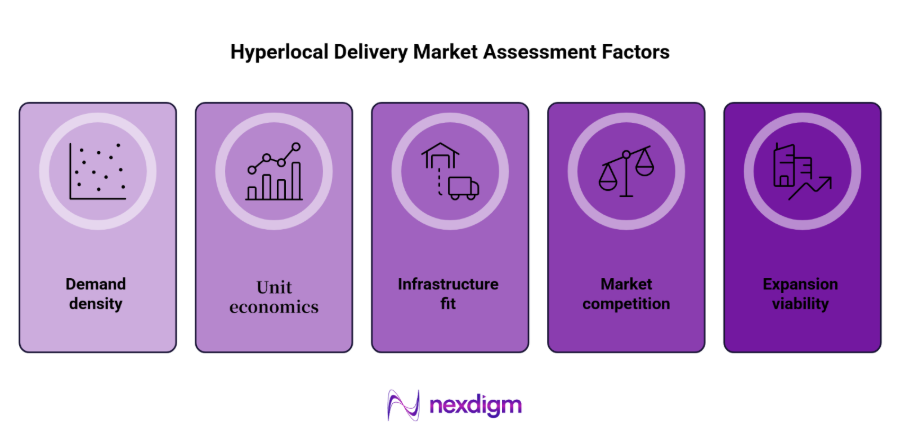
- Demand density: Map households, order potential, catchment size and expected order frequency.
- Unit economics: Model AOV, delivery cost, rider utilisation, store costs and contribution margins.
- Infrastructure fit: Assess dark-store locations, retail assets, fulfilment options and last-mile coverage.
- Market competition: Evaluate incumbent density, assortment, pricing and service levels.
- Expansion viability: Rank cities and catchments by investment requirement, scalability and expected payback.
A hyperlocal delivery market study can therefore distinguish between markets where rapid delivery can scale profitably and those where a different fulfilment model is more appropriate.
How Nexdigm Identified Viable Distribution Expansion
For a diagnostics manufacturer serving 200+ distributors through three DCs, Nexdigm assessed demand patterns, warehouse utilisation and distribution coverage before recommending a fourth facility and relocation of an existing DC. The redesign delivered 16% cost savings, improved service levels by 7% and identified a further 27% supply-chain cost opportunity.
To take the next step, simply visit our Request a Consultation page and share your requirements with us.
Harsh Mittal
+91-8422857704